
Stop Using Fabric Softener! The Real Reason Your HDB Laundry Smells Musty
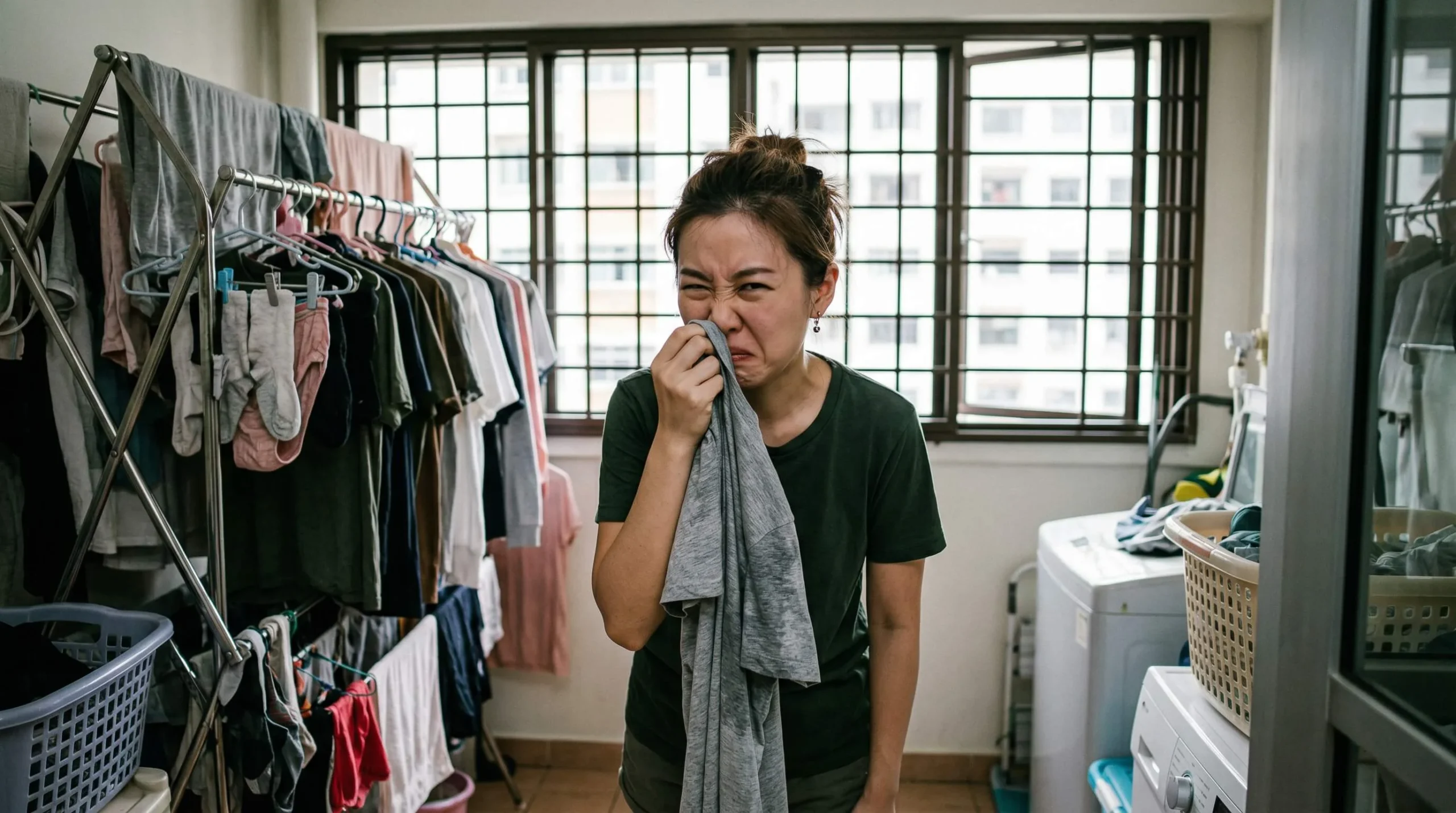

That sour scent on your freshly washed clothes is not a detergent failure. It is bacterial waste. The organism *Moraxella osloensis* thrives in wet fabric. Drying clothes outdoors exposes them to ultraviolet (UV) light and rapid wind evaporation, instantly killing these bacteria. Drying clothes indoors in an 85% humidity environment gives the bacteria hours to feast on trapped sebum and dead skin cells, releasing volatile organic compounds. Beating the stench requires washing machine hygiene, chemical enzyme detergents, and aggressive mechanical dehumidification.
You pull a freshly washed shirt from the indoor drying rack. It looks perfectly clean. You put it on, step out of the flat, and within ten minutes of your morning commute, you notice it. That distinct, sour scent of a wet dog radiating from your own collar. You just washed this garment yesterday, yet it smells like it has been sitting at the bottom of a gym bag for a week.
This is the exact frustration of the musty laundry smell Singapore residents battle during every monsoon season or busy workweek.
We assume that soap and water equal cleanliness. We forget that evaporation is the actual finish line of the laundry process. When you ask why clothes smell fine outside but not inside, you are looking at a brutal intersection of microbiology and atmospheric physics. Out on the bamboo poles or the balcony rack, the sun’s ultraviolet rays act as a relentless, natural sterilizer. The solar radiation annihilates odor causing bacteria on contact, while the open breeze physically strips the water vapor away from the fibers.
Indoors, you strip away the UV light and the wind. You are left with a wet piece of fabric hanging in a stagnant, highly saturated room. You have not created a drying environment. You have built a biological incubator.
The Biology of the Stench
The smell is not just stagnant water. Water itself has no odor. The damp clothes smell humid climate dwellers hate is actually a volatile organic compound.
The primary culprit is a bacterium known as *Moraxella osloensis*. These microscopic organisms naturally exist on our skin and survive the washing machine cycle, especially if you wash with cold water. They do not eat the cotton or the polyester; they feed on the microscopic remnants of human sebum (body oil) and dead skin cells trapped deep within the weave of the fabric.
As these bacteria feast in the wet, dark folds of your hanging clothes, they multiply and excrete waste. That mildew smell laundry gives off is literal bacterial excrement. The longer the garment stays wet, the larger the colony grows. This exponential microscopic reproduction is the exact same mechanism driving why trash smells faster singapore kitchens suffer from. When organic matter meets extreme tropical moisture, things break down rapidly. High humidity drying problems always lead straight back to biology.
The Evaporation Crisis in High-Density Flats
Drying clothes time humid climate residents experience is agonizingly slow because of the concept of relative humidity.
Air acts like a sponge. If the indoor air is already holding 80% to 90% of its maximum water capacity, it cannot easily absorb the moisture evaporating off your wet jeans. The water is effectively trapped inside the textile. Just as you experience sticky skin after shower singapore mornings because the heavy air refuses to let your sweat evaporate, your wet clothes cannot shed their moisture into an already saturated room.
This slow evaporation humidity causes gives the *Moraxella* colonies six to ten hours of perfect breeding conditions. The structural dampness infiltrates everything. It is the same ambient moisture phenomenon that leaves you furious over why bedsheets feel damp singapore nights generate. It even accelerates chemical breakdown on a polymer level, which is how you end up desperately trying to fix sticky plastic singapore humidity ruins on your expensive household electronics.
The environment is aggressively hostile to dry surfaces.
Expert Insight / Material Science Analysis
“The formulation of ‘indoor drying’ detergents specifically addresses the lack of UV sterilization. Standard detergents rely heavily on mechanical agitation and surfactants to lift dirt. Indoor formulations are engineered with high concentrations of enzymes and broad-spectrum antimicrobial agents that actively destroy the lipid walls of Moraxella bacteria during the cold-water wash cycle. However, chemical intervention can only do so much. If the ambient relative humidity in the drying service yard exceeds 75%, capillary condensation within the fabric fibers will outpace evaporation, inevitably leading to microbial repopulation and the subsequent release of malodorous short-chain fatty acids.”
The Machine is the Enemy
Before you blame the weather, you have to inspect the washing machine.
Many people wonder how to stop clothes smelling indoors Singapore style, while ignoring the fact that their washing machine drum is lined with black mold. Front-load washers are notorious for trapping water in the thick rubber gasket around the door. Over months of use, detergent residue, fabric softener, and cold water create a thick, invisible layer of sludge behind the metal drum.
You are essentially washing your clothes in a swamp. The garments come out of the spin cycle already coated in mildew spores. If you hang them outside, the sun burns the spores away. If you hang them inside, the spores immediately begin to bloom. Running a 90-degree Celsius “Tub Clean” cycle with a specialized washing machine descaler once a month is a non-negotiable hygiene practice for tropical living.
Ventilation and The Spacing Error
Poor ventilation Singapore homes suffer from directly sabotages indoor clothes drying.
People cram twenty pieces of wet clothing onto a single folding rack, leaving zero space between the hangers. This creates a dense wall of cold, wet fabric. Airflow cannot penetrate the center of the rack. The shirts in the middle stay wet for twelve hours, guaranteeing a massive bacterial bloom. Proper spacing laundry drying requires at least a hand’s width of empty space between every single garment.
To overcome this, residents point standard standing fans directly at the rack. While moving air is better than stagnant air, a standard fan does not remove water from the room. It just pushes the moisture off the clothes and into the walls. You must open opposite windows to create a cross-breeze, physically pushing the saturated indoor air out of the apartment.
The Financial Toll of Indoor Drying
Fighting the musty laundry smell Singapore environments produce is exhausting and expensive.
When a load of laundry smells foul, the immediate reaction is to wash it again. The sheer physical annoyance of repeating household chores adds significantly to the heavy afternoon fatigue singapore causes for the average urban worker. The constant re-washing destroys fabric fibers, fades colors, and burns through utility bills.
Out of desperation, people start buying heavy-duty compressor dehumidifiers to place under the drying racks, nervously calculating the sp group bill increase singapore aircon cost updates will inevitably bring. You find yourself awake at 1 AM, scrolling through late night shopping singapore apps, reading reviews for Japanese anti-bacterial scent beads and heated drying racks. The cost of managing ambient moisture creeps into every aspect of the monthly budget. It is the exact same underlying environmental tax that dictates why food spoils faster singapore households realize when they throw away a loaf of bread that molded in three days.
Aggressive Odor Eradication Strategies
How to remove musty smell clothes already possess? Stop using fabric softener.
Fabric softener coats the textile fibers in a waxy, lipid layer to make them feel fluffy. This wax is highly water-resistant. It traps existing bacteria and sweat deep inside the weave, making it impossible for the detergent to wash them out. The wax also acts as a limitless food source for the *Moraxella* bacteria.
Swap the chemical softener for half a cup of plain white vinegar in the rinse cycle compartment. Vinegar is a mild acetic acid. It naturally dissolves the waxy buildup, strips away the trapped body oils, and lowers the pH of the fabric to a level where odor causing bacteria cannot survive. Do not worry; the clothes will not smell like a salad dressing once they dry.
If you must dry indoors, the best way to dry laundry in humid climate realities is to combine localized heat with mechanical dehumidification. Place the drying rack in a small bedroom. Close the door and the windows completely. Turn on a compressor dehumidifier directly beneath the clothes. The machine pulls the moisture out of the air and releases slightly warm, bone-dry exhaust air straight up into the hanging garments. This replicates the rapid evaporation of a sunny day without requiring a single ray of sunlight.
✅ Do This
- Switch entirely to detergents explicitly labeled for “Indoor Drying,” which contain specific enzymes that attack bacterial cell walls.
- Leave at least 10 centimeters of empty space between hangers on your indoor rack to allow critical air circulation laundry area needs.
- Use half a cup of distilled white vinegar in the fabric softener dispenser to dissolve trapped body oils and neutralize alkaline odors.
- Leave the washing machine door wide open after every cycle so the internal drum can completely dry out.
- Run a dedicated compressor dehumidifier in a closed room with the wet laundry to physically extract the liters of water suspended in the fabric.
❌ Avoid This
- Do not use commercial fabric softeners if you dry clothes indoors; the waxy residue feeds the odor-causing bacteria.
- Do not fold and store clothes that feel even 1% damp to the touch; the mildew smell will infect your entire wardrobe overnight.
- Do not leave wet, washed clothes sitting inside the washing machine drum for more than twenty minutes after the cycle ends.
- Do not overload the washing machine; crammed clothes cannot agitate properly, leaving microscopic skin cells behind to rot.
To completely eradicate the musty laundry smell Singapore weather traps in your fabric, you have to treat the process like a science experiment. You are fighting an invisible biological enemy. Clean the machine, ditch the waxy softeners, space out the garments, and aggressively control the moisture in the room. You can win the battle against the indoor stench, but you have to attack the bacteria, not just perfume the water.

Ella Dirlasso
Senior Features Writer, SG Vital
Ella specializes in uncovering the science behind Singapore’s unique urban challenges. With years of experience reporting on public health, housing dynamics, and tropical climate adaptations, she grounds everyday frustrations in factual, actionable solutions. Her work aims to bridge the gap between complex microbiology and practical HDB living.
Frequently Asked Questions
Official Context & Environmental Resources
For more official guidelines on managing indoor air quality, appliance energy efficiency, and combating dampness in high-rise living, consult the following local resources: