
18-Degree Trap”: Why Your Aircon is Destroying Your Savings

Setting your thermostat to 18°C doesn’t cool the room faster; it just forces the compressor to run indefinitely and drain power. Concrete walls absorb solar radiation all day and release it at night, forcing your AC to fight the building’s architecture, not just the air. A blocked filter doesn’t just reduce cold air; it suffocates the blower, jacking up energy consumption by up to 15%. Dehumidifying the heavy tropical air takes up a massive chunk of your unit’s energy before the ambient temperature even drops a single degree.
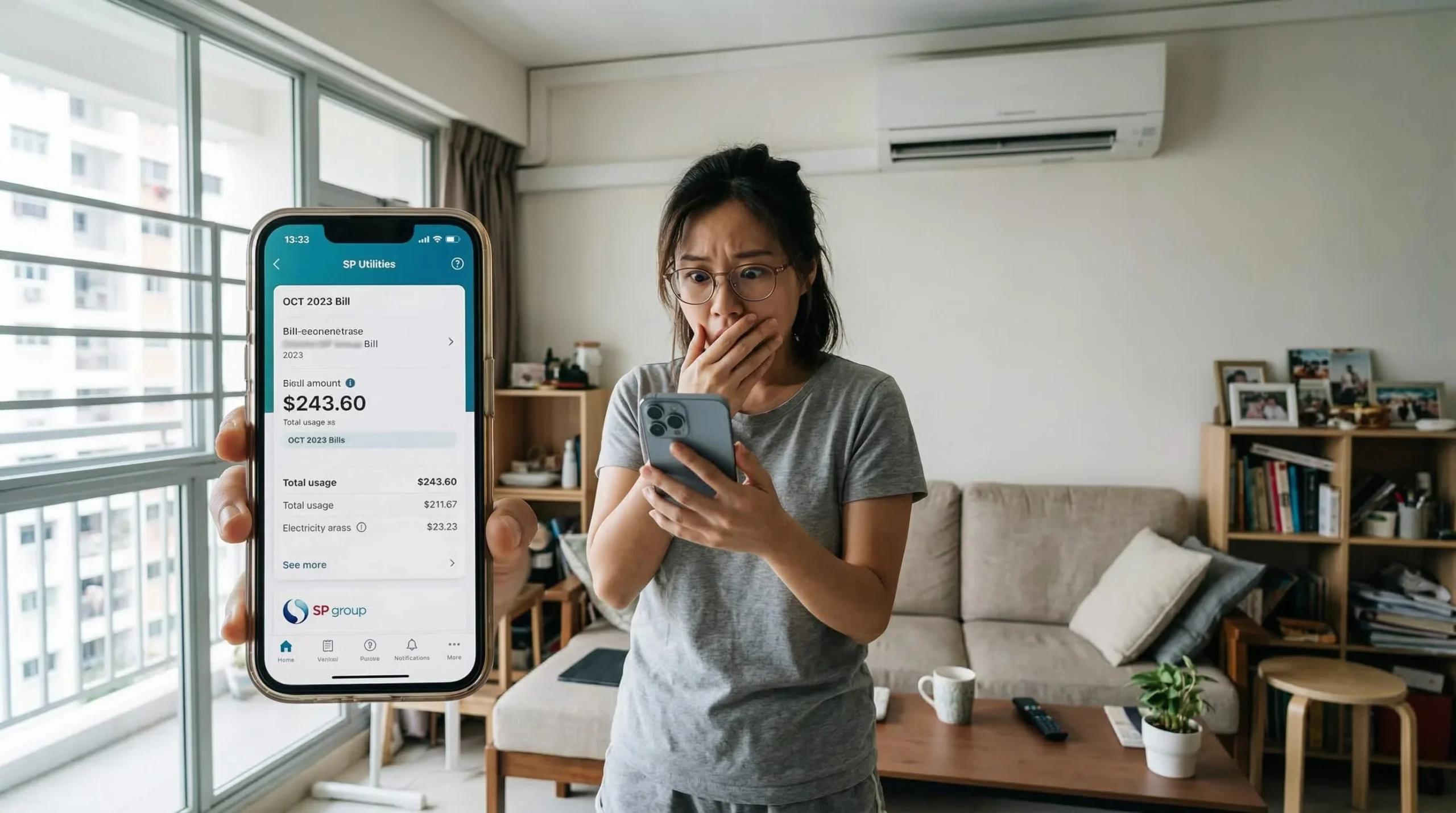
Open the SP app. Stare at the bar chart. Close the app. Wonder if someone tapped into your power grid.
It is a monthly ritual for almost everyone on the island. You haven’t bought any new industrial machinery, your daily routine hasn’t changed, yet the household electricity bills Singapore residents receive seem to creep higher every few months. The immediate reflex is to blame the base tariff rates published in the news. But the tariff only explains a fraction of the financial damage. The real culprit is sitting quietly on your bedroom wall, eating wattage like it’s free.
Let’s talk about the heavy, suffocating moisture we live in. Before your compressor even thinks about dropping the ambient temperature, it has to wring the moisture out of the air. This is the exact same oppressive humidity that explains why food spoils faster singapore style if you leave anything sitting on the kitchen counter for an hour. Fighting water vapor is exhausting for an appliance. You are essentially paying to dry the air first, which is why the baseline aircon electricity cost Singapore households endure feels like a second rent.
You are paying for the water in the air.
The Architecture of Trapped Heat
Think about the building itself. The urban environment is a giant heat sponge. Concrete soaks up solar radiation all day long. If you step out of your flat at 8 PM and find the hdb corridor hotter than outside singapore evenings usually are, your bedroom walls are basically acting as giant radiators. Your unit isn’t just cooling the empty space inside the room; it is actively fighting the thermal mass of the architecture.
During the day, the exterior walls of an HDB block or condo absorb ultraviolet rays. The heat penetrates deep into the masonry. When the sun goes down, that stored thermal energy slowly radiates inward. If you switch on your cooling system at 9 PM, the compressor has to work overtime to neutralize the heat radiating from the walls before it can actually lower the room’s air temperature. This phenomenon drastically inflates your overall air conditioning cost Singapore-wide. The machine is fighting a battle against the building, not the weather.
The 18-Degree Delusion
Then there is the psychological trap of the remote control. People come home sweating, grab the remote, and hammer the down button until the screen says 18°C. They assume this acts like a turbo button.
It doesn’t.
An air conditioner blows air at the exact same speed and temperature regardless of whether you set it to 18°C or 24°C. The temperature setting is just a stopping point. Setting it to 18°C simply tells the compressor to never turn off, because reaching that temperature in a poorly insulated flat is practically impossible in this climate. You wouldn’t buy a week’s worth of imported beef without looking at the price tag, yet ignoring your own air conditioner power consumption is the utility equivalent of ignoring the grocery prices singapore supermarkets quietly hike up during festive seasons. You are burning cash for a temperature you will never reach.
When you ask why electricity bills suddenly increase Singapore residents often point to the hot season, but it is the human reaction to the hot season that causes the spike. The compressor is the most power-hungry component in your home. When it runs continuously because the thermostat is set to an unreachable goal, your electricity usage cost Singapore skyrockets.
Expert Insight / Sector Analysis
“Local consumption data indicates that the ‘thermostat illusion’ is responsible for nearly 40% of excess cooling energy usage Singapore households generate. Compressors draw their peak wattage while attempting to close the gap between ambient temperature and the thermostat setting. In a tropical climate, maintaining 25°C requires a fraction of the kinetic energy compared to a continuous, failing attempt to reach 20°C. Furthermore, delayed maintenance schedules drastically compound this inefficiency, forcing units to draw more current to achieve lower cooling outputs.”
The Late-Night Energy Drain
Look at your nighttime habits. The way we consume electricity shifts drastically after dark.
You stay up scrolling through late night shopping singapore apps, keeping the compressor running on maximum load until 3 AM in the living room. That is why electricity bill increases with aircon usage so aggressively. Your cooling needs tropical cities demand are heavily front-loaded in the first two hours of switching the machine on. Keeping it running at a low temperature all night while you sleep under a thick duvet is a massive waste of resources.
Many modern inverter units are designed to ramp down their power consumption once the target temperature is reached. However, if doors are constantly opened, or if windows are poorly sealed, the cold air escapes. The inverter detects the temperature rise and ramps the compressor back up to maximum power. This constant fluctuating load destroys energy efficiency. Understanding how much electricity aircon uses Singapore relies entirely on recognizing that isolation is just as important as the cooling capacity. If your room isn’t sealed, you are trying to cool the entire neighborhood.
The “Lazy Tax” of Appliance Maintenance
The math is brutal if you let the machine choke. Poor maintenance is a silent killer of household budgets.
If the filter is choked with three months of skin cells and dust, the cold air stays trapped inside the blower. The machine runs longer, drawing maximum amps, but the room stays warm. It is the exact same lack of proper air circulation that makes clothes smell musty drying indoors singapore flats. If air can’t move, the system fails.
A choked evaporator coil restricts the transfer of heat. The refrigerant gas flowing through the copper pipes cannot absorb the heat from your room if it is insulated by a thick layer of grime. When people wonder why aircon costs more to run in Singapore compared to temperate climates, the rapid accumulation of biological matter in the humid environment is a major factor. Jelly-like substances form in the drainage pipes, dust turns into mud on the coils, and the fan motor has to strain against the blockage. This strain translates directly into higher wattage pulled from your electrical panel.
Aging Infrastructure and Hidden Decay
Sometimes, the issue is just old, failing hardware. An aging compressor that is slowly losing its refrigerant gas will sound perfectly fine, but it will draw double the power to achieve half the cooling.
Trying to figure out why your bill is high with an old AC is like trying to figure out why tap water tastes different singapore older estates experience—the unseen infrastructure behind the walls is failing you. Micro-leaks in copper piping cause the freon levels to drop. Without enough freon, the system cannot absorb enough heat. The thermostat registers that the room is still warm, so it commands the compressor to keep running. You end up with a machine that consumes 100% of its rated power but only delivers 40% of its cooling capacity.
This is where the calculation for aircon running cost Singapore becomes critical. It is often cheaper to entirely replace a 10-year-old system with a new 5-tick energy-efficient model than to continue paying the inflated utility bills generated by the dying unit. The National Environment Agency (NEA) rates appliances based on their energy consumption, and the difference between a 2-tick and a 5-tick model can amount to hundreds of dollars in savings annually.
Pragmatic Adjustments for the Urban Resident
Lowering the overall aircon electricity cost for a Singapore apartment doesn’t require suffering in the heat; it just requires a bit of mechanical common sense.
Set the thermostat to 25°C. Turn on a standing fan. The wind chill effect makes 25°C feel exactly like 22°C against your skin because the moving air accelerates the evaporation of sweat from your body. You cut your compressor’s workload in half by letting a 50-watt fan do the heavy lifting instead of a 1500-watt compressor.
Clean the mesh filters in the bathroom sink every two weeks. It takes three minutes. Stop expecting the machine to freeze a concrete box in the middle of the equator and start managing the airflow.
Review your electricity retailer. Since the rollout of the Open Electricity Market (OEM), remaining on the default SP Group regulated tariff might not be the most cost-effective choice for heavy energy users. Fixed-price plans can offer a shield against the quarterly fluctuations of the global energy market, providing a more predictable Singapore electricity bills aircon baseline.
If you want to understand the average electricity bill Singapore aircon usage generates, you have to monitor your daily kilowatt-hour (kWh) consumption through the SP Utilities app. Spikes in consumption usually correlate directly with weekend usage or particularly hot, hazy weeks. Tracking this data allows you to identify exactly which habits are driving the cost.
The machine on your wall is a high-performance heat exchange engine. Treat it with the respect it requires. Give it clean filters, set realistic temperature goals, seal the room properly, and leverage fans to distribute the cold air. The relief from the tropical heat is non-negotiable, but overpaying for it is entirely optional.

Verified Expert & Analyst
Frequently Asked Questions
Official Context & Resources
For more official guidelines on managing your household energy consumption, choosing efficient appliances, and understanding utility tariffs, check the following local resources: