Singapore HDB Neighbour Disputes Guide: Noise, Clutter & Smells


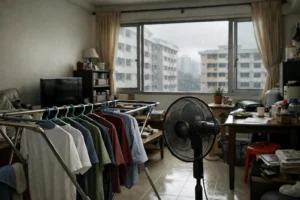
Living in an HDB block means living in 3D. There are people above you, below you, and beside you. Most of the time, the system works. But when the boundaries blur, the frustration is intense. Here is your roadmap to keeping the peace.
The HDB Moment Everyone Dreads
It usually starts with something small. It’s 11:30 PM on a Tuesday. You are trying to sleep. Suddenly, from the unit directly above, you hear the unmistakable sound of a marble dropping on the floor. Tick-tick-tick. Then, the screech of a heavy wooden chair being dragged across tiles.
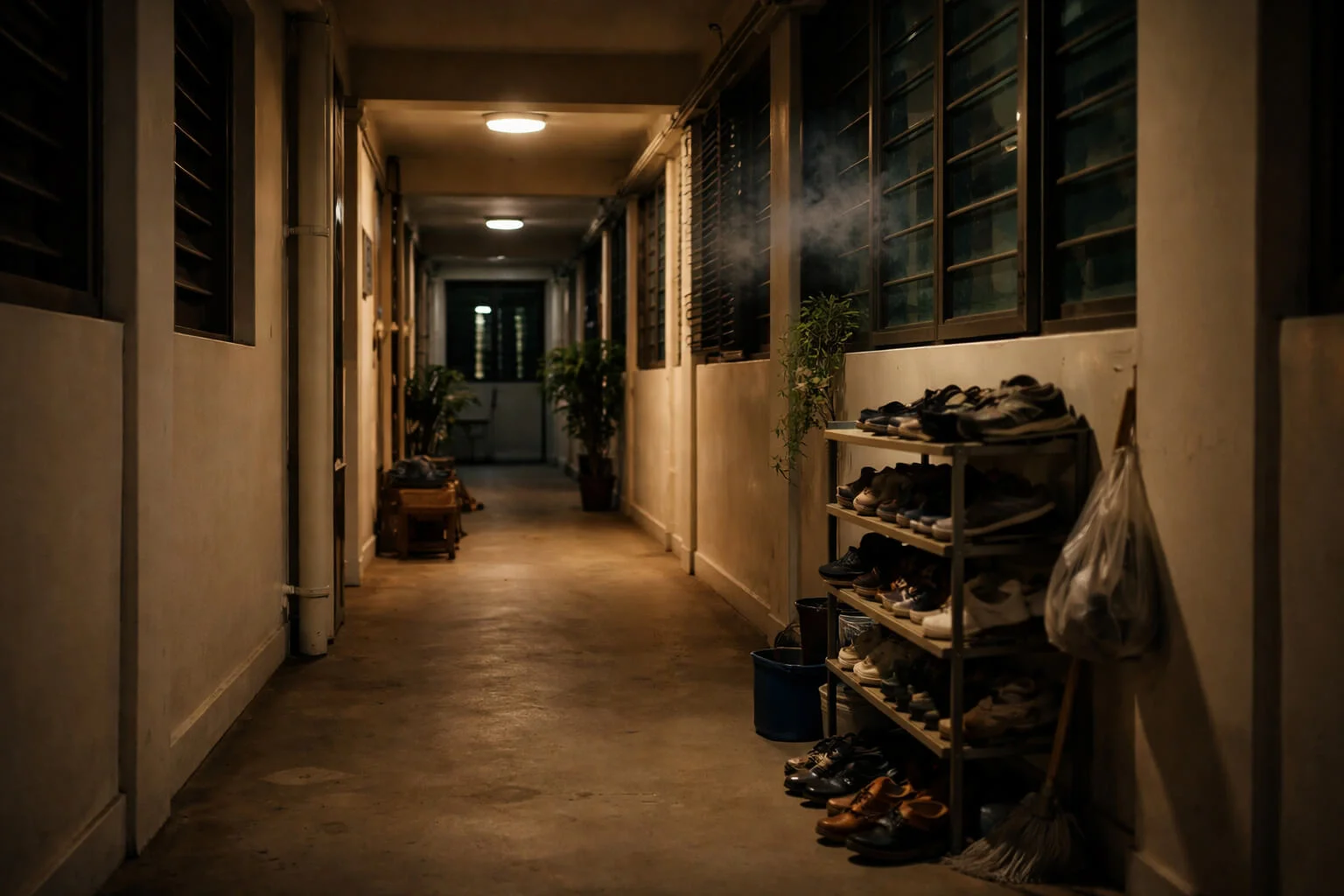
Or maybe you open your front door to go to work, and your neighbour’s new shoe rack has migrated another two inches into your path. Or perhaps the smell of heavy cigarette smoke drifts through your service yard, settling into your freshly washed laundry.
This is the start of the Singapore HDB neighbour dispute guide scenario that everyone dreads. In high-rise living, one person’s lifestyle is another person’s nuisance.
⚡ Quick Survival Guide (30 Seconds)
- Noise? Friendly note first → Log pattern → CMC mediation
- Corridor clutter? Check 1.2m clearance → Talk safety → Town Council
- Smoke/smells? Request window change → No legal ban on cooking
- Remember: Goal = coexistence, not victory (99-year lease!)
- Templates below: Copy-paste ready scripts for all 3 issues
- Never: Bang ceiling, social media shame, or move their items
Why Small Irritations Become Big Wars Fast
In Singapore, our homes are our sanctuaries. When that peace is breached, it feels like an invasion. How to deal with noisy neighbour Singapore questions flood local forums every day, but the solutions are rarely simple. You can’t just move out. You are stuck next to this person for the duration of a 99-year lease. This proximity means that if you handle a dispute wrong today, you create an enemy for tomorrow. The goal isn’t just to stop the noise; the goal is to survive living next to them.
In high-density living, small friction turns personal fast—Singapore runs on unwritten “shared-space” rules, the same ones you see during MRT peak hour commuting.
Before You Do Anything: The 60-Second Calm Check
When the drilling starts at 8 AM on a Sunday, your heart rate spikes. The natural urge is to march upstairs and bang on the door. Do not do this.
That spike of anger is normal—this is exactly how micro-stress builds over time until small issues feel huge.
“Is this a one-off or a pattern?”
Everyone is allowed to have a bad day. Did their baby just start teething? Is that why they are walking heavily at 3 AM? Did they just host a one-off housewarming party? If it’s a single event, the best approach is to let it slide. How to handle neighbour disputes in Singapore without conflict starts with choosing your battles.
Define What You Actually Want
Do you want absolute silence? (Impossible in an HDB). Do you want the corridor completely empty? (Unlikely). Define a realistic goal. You want them to stop dragging chairs after 10 PM. You want a 1.2-metre clear path to the lift. Clarity prevents emotional outbursts.
Problem 1 — Noise (Renovation, Late Nights, Footsteps)
Filing an HDB noise complaint Singapore style is the most common issue in the country. Sound travels through concrete in strange ways.
The Most Common Noise Types in HDB
- Renovation: Drilling and hacking (there are official hours for this, usually strictly 9am-5pm/6pm).
- Living Noise: Heavy footsteps, kids running, dropping items, midnight showers.
- Entertainment: Karaoke, mahjong tiles clacking, dogs barking.
The “First Message” Approach (Non-threatening)
If you don’t know them, don’t start with anger. Knock on the door at a reasonable hour with a smile. Assume they don’t know they are loud. Concrete floors amplify sound downwards; the stomper often has no idea they are stomping.
“Hi neighbour, I live downstairs. Sorry to bother, but the sound of the chair dragging is quite loud in my bedroom. Could you help to add some felt pads to the legs?”
The Simple Log (Without Being Creepy)
If it keeps happening, start a log. “Tuesday, 11:15 PM – Loud bass music.” This isn’t to be petty; it’s because if you ever need to make a formal HDB renovation noise complaint or go to mediation, memory isn’t enough. You need patterns. But don’t record them through the window—that crosses into harassment.
Problem 2 — Corridor Clutter (Shoes, Racks, Bikes, Cabinets)
The common corridor is technically public space, but psychologically, we treat the area right outside our door as ours. Corridor clutter HDB rules Singapore are a massive grey area for many residents.
Why Corridors Trigger Conflict
It’s about safety and dignity. Can neighbours keep items in HDB corridor Singapore? Yes, to a degree. A shoe rack is usually tolerated. A jungle of 45 potted plants, two bicycles, and an ancestral altar blocking the walkway is not.
The Polite Boundary-Setting Script
If you have to squeeze past their bicycle every morning, address the safety aspect, not the aesthetic aspect. “Uncle, your plants are beautiful, but my elderly mum uses a wheelchair and it’s getting a bit tight for her to pass. Can we shift these few pots closer to your wall?”
When It Becomes a Hazard
The general safety rule of thumb (often cited by civil defense standards) is maintaining a clear 1.2-metre walkway. How to report corridor clutter in HDB Singapore becomes necessary when it’s a fire trap. If items block the stairwell or riser doors, that is a legitimate safety risk that Town Councils act on quickly.
Problem 3 — Smells (Cooking, Cigarette Smoke, Trash)
You can wear earplugs for noise. You cannot turn off your nose. This makes a neighbour smell complaint Singapore one of the hardest disputes to resolve.
Smells Are Personal — And That’s the Problem
How to deal with cooking smells from neighbour Singapore? Food is cultural. Complaining about the smell of belachan, curry, or herbal soup can easily be misinterpreted as a cultural attack. Approach with extreme sensitivity.
Cigarette smoke neighbour complaint Singapore issues are equally tense. Smoking inside one’s own flat is legally allowed. If the smoke drifts into your house, you have limited official recourse. What to do if cigarette smoke comes into my flat? You cannot ban them from smoking in their own home, but you can seek a compromise.
Practical Compromises People Actually Accept
Rather than demanding they stop their habit, ask for minor adjustments. “Hi, my wife has asthma and the smoke drifts into our living room at night. Would it be possible to smoke near the kitchen window instead of the main door?” Often, closing your own windows during their routine smoke break is the fastest path to peace.
The Singapore Way: Solve It Without Losing Face
In our culture, “saving face” is critical. If you make your neighbour lose face in public, they will dig in their heels and fight you forever.
The “Soft Start” Conversation
Always talk first. Never start with a written letter. A letter feels permanent and aggressive. A conversation over a box of biscuits feels neighbourly.
In Singapore, “saving face” matters—many conflicts are really about social signals and unwritten etiquette rules, not just the noise itself.
Using a Neutral Third Party
A steps to resolve neighbour dispute Singapore HDB approach often involves grassroots leaders. If you don’t want to confront the neighbour, ask your Resident Committee (RC) member to drop by casually. It frames the issue as an “estate concern” rather than a personal attack.
When to Stop Engaging Directly
If they slam the door in your face, or get aggressive, stop. Do not escalate the shouting. Retreat and use the official channels. Your safety is paramount.
Escalation Ladder (Clear, Non-Drama Steps)
If talking fails, here is the accepted escalation path in Singapore. Note: Calling the police for neighbour noise usually results in them advising you to talk it out or go to mediation, unless a crime is being committed.
Step 1: The Friendly Note / Short Chat
Keep it warm. No accusations. “Just wanted to let you know…”
Step 2: Document the Pattern
Lightweight evidence. Photos of the blocked corridor, or a log of the noise dates. No CCTV cameras pointing into their house.
Step 3: Mediation / Community Channels
The Community Mediation Centre (CMC) is the official channel. It’s cheap, informal, and brings a neutral mediator into the room. Town council complaint neighbour Singapore issues also sit here for common property clutter.
Step 4: The Official Route
The final resort is the Community Disputes Resolution Tribunals (CDRT), which acts like a court. You only go here when everything else has burned to the ground.
What NOT to Do (This Is Where Readers Stay)
We see it on the news all the time. The neighbour dispute that goes viral. Don’t be that guy.
Passive-Aggressive Notes That Backfire
Typing a note in ALL CAPS, taping it to their door, and CC-ing the whole block will not get you silence. It will get you a declared war.
Public Shaming, Recording, WhatsApp Blasting
Do not record your neighbour and post it on TikTok or Stomp. That is the nuclear option. Once you shame them online, there is no going back to “Hi neighbour.”
“Winning” vs “Living Next to Them”
You might “win” the argument and get them to move their shoe rack. But if they hate you, they will find other ways to make your life difficult. The goal is coexistence, not victory.
Quick Templates Readers Can Copy
Use these if you need to slide a note under the door (keep it friendly):
One-liner for noise:
“Hi neighbour at #[Unit]! Hope you’re having a good week. Just a small favour—we’ve been hearing some loud dragging noises late at night. The concrete really carries the sound down here! Would really appreciate it if you could help keep the volume down after 10:30 PM. Thank you so much! – Your neighbour downstairs.”
One-liner for corridor clutter:
“Hi neighbour! Your new plants look great. Just a quick request—my elderly parent uses a walking aid, and it’s a bit tight to get past the pots near the riser. Could we shift them slightly towards your wall? Thanks for understanding!”
One-liner for smells:
“Hi neighbour! Just checking in. Some strong smoke/cooking smells have been drifting into our bedroom recently, and my kid is quite sensitive to it. Could we check if the ventilation fan is on, or maybe close the windows during that time? Really appreciate your help!”
Quick Checklist (Save This)
✅ Do This
- Assume good intentions first (they probably don’t know they are loud).
- Talk face-to-face if you feel safe to do so.
- Use the “sandwich method” (Compliment, Issue, Thank You).
- Focus on safety or health impacts (fire hazard, asthma).
- Offer compromises (e.g., “Can we agree on no drilling during baby’s 2 PM nap?”).
- Involve grassroots leaders if you are shy.
- Keep a written log of recurring issues.
- Check if your own habits contribute to the problem.
- Respect the 1.2m corridor clearance rule.
- Use the Community Mediation Centre for gridlocks.
❌ Avoid This
- Do not bang on the ceiling with a broomstick (it escalates things).
- Do not shout or use profanity.
- Do not touch, move, or throw away their items in the corridor.
- Do not call the police for minor nuisance issues.
- Do not post their face or unit number on social media.
- Do not involve other neighbours in a gossip circle.
- Do not leave passive-aggressive sticky notes.
- Do not install CCTV pointing into their flat.
- Do not criticize their culture, food, or lifestyle.
- Do not expect perfection—it’s high-rise living.
Official Context
Town Councils manage the maintenance of common areas and can enforce regulations regarding corridor obstruction. The Community Mediation Centre (CMC) is a statutory body under the Ministry of Law that provides a confidential platform for neighbours to resolve disputes peacefully with the help of a trained mediator.
Editor’s Note: This guide focuses on de-escalation and everyday nuisance issues in HDB living. If you feel unsafe or there is immediate danger, prioritize personal safety and contact the appropriate emergency services.
“I was furious about my neighbour’s loud music every afternoon. I went over, ready to fight. An elderly uncle answered. He was hard of hearing, listening to old 1970s Chinese radio. He didn’t know it was loud. He smiled, offered me a packet of tea, and turned the volume down. I walked home feeling like a monster for being angry. Sometimes, the ‘nuisance’ is just a lonely old man who forgot the volume was on high. Talk first. Always talk first.”
🏘️ Your Neighbour Dispute Experience?
Have you dealt with a noisy neighbour, corridor clutter, or cooking
smells? What worked (or didn’t work) for you? Share your story in
the comments—your experience could help someone avoid a long feud.
📋 Save & Share This Guide:
- Bookmark: You’ll need these templates eventually!
- Share: Forward to HDB neighbours who might benefit
- Print: Laminate the checklist for quick reference
💡 Pro Tip: The “lonely old man” story? That’s the lesson.
Always assume good intentions first. Most disputes dissolve
with one friendly conversation.