Why You’re Still Sweating in a 23°C Room (The Singapore Aircon Trap)
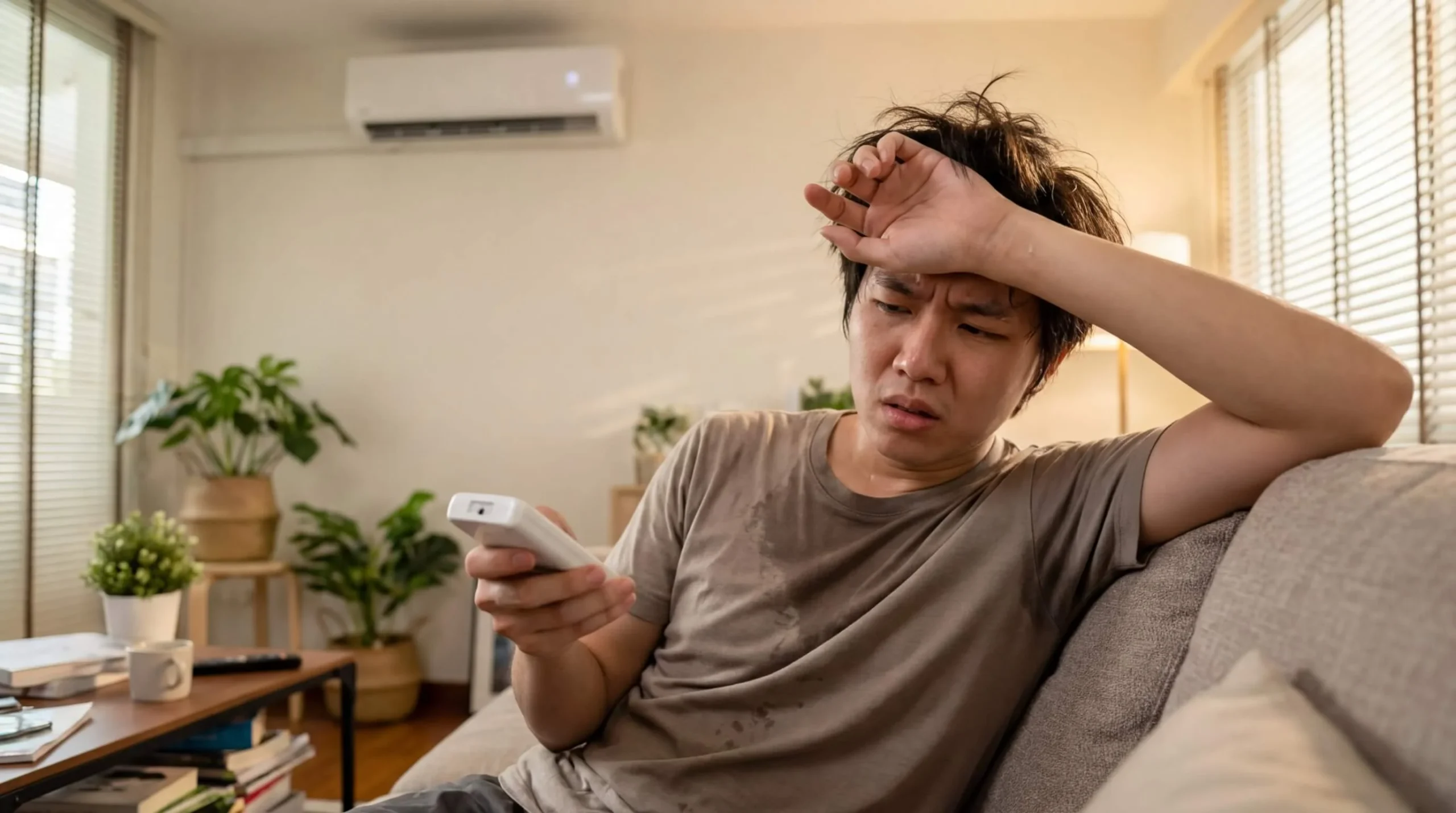

Lowering the temperature in your living room does not automatically stop your body from perspiring. The human cooling mechanism relies entirely on evaporation, not just contact with cold air. If your air-conditioner lowers the temperature but fails to extract the suspended water vapor, the indoor relative humidity spikes. The air becomes too saturated to absorb the moisture off your skin. This results in a cold, clammy environment where your sweat simply pools on your epidermis, tricking your nervous system into a continuous loop of thermal discomfort.
You step into your living room, grab the remote, and blast the split-unit air-conditioner. Within ten minutes, the ambient temperature drops to a crisp 23 degrees. You sit down, expecting immediate relief from the afternoon heat.
But the relief never comes.
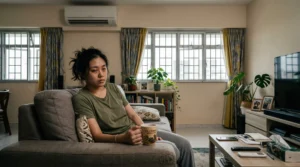
Your arms feel sticky against the armrest. A thin film of moisture beads on your forehead. The air is undeniably cold, yet your body is reacting as if you just finished a brisk walk to the MRT station. You find yourself facing the maddening reality of sweating indoors Singapore residents experience almost daily.
We naturally equate cold air with dry skin. It is a fundamental misunderstanding of human biology and atmospheric thermodynamics. The thermostat on your wall only tells you half the story of your indoor environment. To stop the endless glisten, you have to look past the temperature gauge and confront the sheer volume of water suspended in the air you are breathing.
The Biological Furnace and the Evaporation Engine
Your body is a high-performance heat engine. It operates at an optimal core temperature of around 37 degrees Celsius. When your internal temperature rises, your nervous system commands your eccrine glands to secrete water and salt onto the surface of your skin.
Here is the critical mechanism: the sweat itself does not cool you down.
Cooling only happens when that sweat evaporates. Evaporation is an endothermic reaction. As the liquid water turns into a gas and escapes into the air, it pulls thermal energy away from your skin, lowering your body temperature. This biological design is flawless in a dry desert. In a tropical basin, it is a structural failure.
For sweat to evaporate, the surrounding air must be dry enough to accept the moisture. The tropical humidity Singapore is famous for means the outdoor air is already holding an enormous amount of water. When you step outside and immediately feel oppressed by the heavy atmosphere, noting how the concrete makes the hdb corridor hotter than outside singapore typically feels, it is because the ambient air is utterly saturated. Your sweat has nowhere to go.
The Aircon Illusion: Sensible vs. Latent Cooling
You might assume that closing the windows and turning on the AC solves this. It often makes the physical sensation of dampness worse.
Air-conditioning systems perform two distinct tasks: sensible cooling (dropping the air temperature) and latent cooling (extracting water vapor from the air). Many residential AC units are oversized for the small HDB bedrooms they are installed in. When you turn on an oversized unit, it achieves sensible cooling incredibly fast. The room hits 23 degrees in ten minutes.
Because the target temperature is reached so quickly, the compressor shuts off. However, the fan keeps running. The system never ran long enough to perform the latent cooling required to extract the humidity. You are left sitting in a 23-degree room with 80% relative humidity.
Cold air cannot hold as much moisture as warm air. As the room cools rapidly, the relative humidity percentage actually spikes. The air becomes a dense, cold sponge that is completely full. You are wondering why I still sweat in a cool room Singapore weather dictates, while sitting in an environment that physically prohibits the evaporation of moisture from your skin.
This thermodynamic clash is exactly what causes condensation on appliances. Just look at any fridge sweating singapore guide to see how cold surfaces interact violently with saturated air. Your skin is undergoing a similar, highly uncomfortable reaction.
The Indoor Moisture Trap
The air outside is wet, but we actively manufacture even more moisture inside our homes.
Every time you boil water for noodles, take a hot shower without an exhaust fan, or mop the floor, you are pumping massive amounts of vapor into a sealed box. The moisture has no escape route. If your flat suffers from poor ventilation, this vapor migrates slowly from room to room.
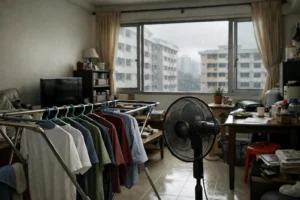
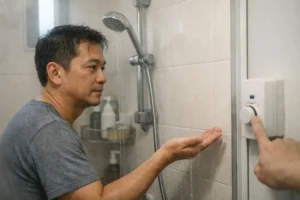
A prime example is the bathroom. If you constantly battle a musty bathroom smell singapore humidity generates, that trapped wetness is slowly creeping into your adjacent living spaces. Laundry is another massive culprit. Trying to dry wet clothes on an indoor rack releases liters of water directly into your ambient air. It is why your clothes smell musty drying indoors singapore style; the air is too full to absorb the water off the fabric, just as it is too full to absorb the sweat off your arms. If you are already fighting a foul musty laundry smell singapore weather forces on you, you are simultaneously destroying your own physical comfort in the living room.
Expert Insight / HVAC Engineering
“The phenomenon of sweating indoors Singapore residents constantly report is fundamentally a failure of the dew point margin. Human comfort is dictated more by the dew point than the absolute temperature. If the indoor dew point remains above 20°C, the skin will feel clammy regardless of whether the aircon is set to 25°C or 18°C. Running an air-conditioner on its lowest fan speed, or utilizing the dedicated ‘Dry Mode’, forces the air to move slowly over the evaporator coils, prioritizing massive water extraction over rapid temperature drops. This expands the vapor pressure deficit, finally allowing human perspiration to evaporate.”
The Exhaustion of a Clammy Environment
Living in a constant state of slight dampness takes a severe physiological toll.
Your nervous system is constantly receiving mixed signals. Your skin feels cold, but your core temperature remains slightly elevated because your primary heat-venting mechanism (evaporation) is blocked. Your heart rate elevates slightly to pump more blood to the surface of your skin in a desperate, failing attempt to shed thermal energy.
This silent cardiovascular strain is exhausting. It is the invisible force behind why tired at home singapore complaints dominate weekend conversations. You sit motionless, yet your body is fighting a quiet war against the atmosphere. When you try to relax on a Sunday and suddenly wonder why you feel tired at home singapore humidity is usually the primary suspect. You are trapped in an environment that demands constant metabolic exertion just to maintain a baseline core temperature.
Hydration and the Sweat Response
Because you are constantly losing moisture through this inefficient, pooling sweat, your hydration needs spike even indoors.
Drinking cold water lowers your core temperature internally, which can temporarily switch off the eccrine glands. The quality and mineral content of the water you consume plays a role in your overall metabolic efficiency. While some residents install expensive filtration systems after wondering why tap water tastes different singapore infrastructure delivers, the crucial factor is simply volume. If you are experiencing severe indoor sweating Singapore weather causes, you must replace the fluids, otherwise, the blood thickens, heart rate increases further, and the lethargy deepens.
The Fan Fallacy
A common reaction to sweating despite aircon Singapore residents have is to turn on a standing fan and point it directly at their face.
This is a tactical error if the room is already saturated. A fan provides zero latent cooling. It does not extract a single drop of water from the air. It merely takes the heavy, 85% humidity air and hurls it at your skin at a higher velocity. If the air is already saturated, it cannot absorb your sweat, no matter how fast it is moving.
Instead of cooling you down, the high-speed air simply pushes the unevaporated sweat around on your skin, mixing it with your natural sebum. This is what creates that highly specific, gross, sticky sensation. You feel cold, wet, and dirty simultaneously.
Targeted Dehumidification Strategies
To stop the sweating, you have to attack the water, not the heat.
The immediate fix is to change the way you use your existing appliances. Stop using the “Cool” mode (the snowflake icon) on your remote. Switch it to “Dry Mode” (the water droplet icon). Dry mode runs the compressor continuously but drops the fan speed to an absolute minimum. This allows the humid air to sit on the freezing evaporator coils much longer, stripping liters of water out of the air and draining it outside, without turning your living room into a refrigerator.
If you refuse to use the air-conditioner due to utility costs, a standalone compressor dehumidifier is the only scientifically valid solution. Placing a dehumidifier in a sealed room and dropping the relative humidity from 80% to 45% changes the physical texture of the air. The room will actually feel slightly warmer on a thermometer because the dehumidifier exhausts minor heat, but your body will feel incredibly cool and dry. The moment the ambient air is dry enough to accept moisture, your sweat will flash-evaporate instantly, taking your body heat with it.
✅ Do This
- Switch your split-unit air-conditioner to ‘Dry Mode’ for the first hour you are home to aggressively strip moisture from the air.
- Use exhaust fans in the kitchen and bathroom for at least 20 minutes after cooking or showering to expel moisture before it migrates.
- Invest in a dedicated compressor dehumidifier for your living room if you prefer not to run the AC during the day.
- Drink ice water to lower your core body temperature from the inside out, shutting off the sweat response neurologically.
❌ Avoid This
- Do not set the AC to 18°C on high fan speed; it shuts the compressor off too quickly and leaves the room cold but soaking wet.
- Do not point a high-speed fan directly at yourself in a highly humid room; it will just smear the unevaporated sweat across your skin.
- Do not dry large loads of laundry inside the living room with the windows closed unless you are actively running a dehumidifier.
- Do not open the windows while the AC is running; you are just inviting the tropical moisture back into the dried space.
The battle against a clammy home is entirely winnable once you respect the physics of the tropics. Your body is doing exactly what it is designed to do: pump out water to shed heat. It is up to you to engineer the indoor environment so that water can actually evaporate. Turn off the temperature obsession, focus on the humidity, and you will finally feel dry.

Ella Dirlasso
Senior Editor, Daily Life & HDB Living
Ella is an independent journalist based in Singapore, specializing in the intersection of tropical climate, society, and everyday HDB living. To ensure scientific accuracy for this piece, she collaborated closely with certified local HVAC engineers, translating complex atmospheric thermodynamics into practical solutions. Her mission is to provide evidence-based, on-the-ground strategies to improve the quality of daily life in Singapore.
Frequently Asked Questions
Official Context & Environmental Resources
To understand the official data regarding local humidity patterns, energy-efficient cooling methods, and managing indoor health, consult the following authorities: