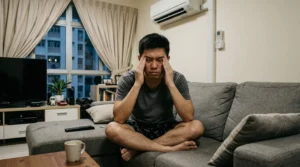
Stop Opening Your Bedroom Window: The Real Reason Your HDB Feels Suffocating
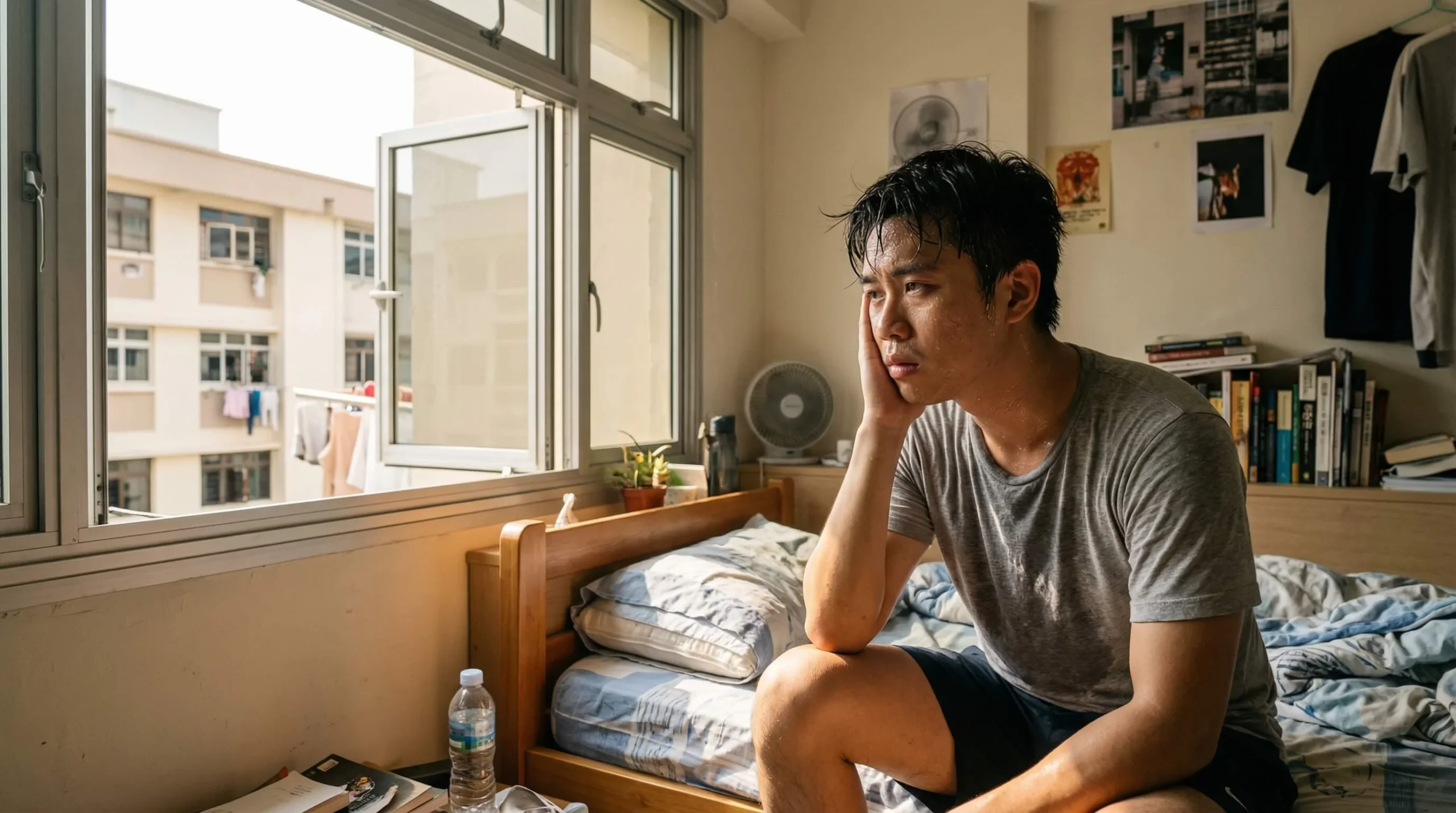

Opening a single window does not create ventilation; it merely pressurizes the room. Air is a fluid that requires both an entrance and a clear exit to flow. The extreme tropical humidity makes the indoor air physically heavy and difficult to move. When urban structures block natural wind corridors, the stagnant, moisture-heavy air traps carbon dioxide, cooking odors, and ambient heat inside your flat. Breaking this invisible barrier requires forced mechanical exhaust, strict cross-ventilation geometry, and aggressive dehumidification.
You slide the glass pane open. You push the blinds aside. You stand there, waiting for the relief of a cool breeze to sweep through the bedroom and rescue you from the afternoon heat.
Nothing happens.
The curtains do not flutter. The air simply sits there, heavy and utterly motionless. You stare out at the street, wondering why the wind actively refuses to enter your home. The reality of a stuffy room Singapore residents deal with daily is not an illusion or a stroke of bad luck with the weather. It is a highly specific clash between fluid dynamics, architectural geometry, and the crushing weight of the equator’s atmosphere.
We instinctually believe that an open window equals fresh air. But air does not magically teleport. It has to be pushed or pulled. Understanding why room feels suffocating despite open windows requires dismantling everything you thought you knew about how your apartment actually breathes.
The Physics of Heavy Air
Let us talk about the sheer physical density of the atmosphere you are sitting in.
The tropical humidity Singapore generates is not just a measurement on a weather app. It is a physical burden. When the relative humidity outside is 85%, the air is packed with suspended water vapor. Water vapor is dense. It changes the thermal conductivity of the air around you. This is why indoor air feels heavy Singapore style; you are literally moving through a gaseous soup.
When you open your window, you are inviting this massive wall of moisture inside. If the air inside your room is slightly cooler or drier than the air outside, the heavy outdoor air hits the threshold of your window and simply stops. It acts like an invisible barrier. The sheer density of the humid air indoors Singapore weather forces upon us makes the atmosphere incredibly stubborn. It takes a significant amount of kinetic energy—a strong, sustained wind—to push that heavy mass around.
The exact same atmospheric saturation that ruins your morning by causing sticky skin after shower singapore bathrooms produce is the reason the air in your bedroom feels unbreathable. The moisture traps ambient heat and refuses to let it dissipate.
The Cross-Ventilation Myth
People ask why fresh air doesn’t enter room Singapore apartments all the time. The answer is usually hiding in the hallway.
Air behaves exactly like water in a pipe. If you turn on a hose but keep the nozzle completely blocked, the water goes nowhere. It just pressurizes the hose. The exact same principle applies to your bedroom. If you open your bedroom window, but keep your bedroom door closed, the air cannot enter. You have created a pressurized box. The outdoor wind pushes against the window opening, hits the wall of trapped air inside, and deflects away.
This is the failure of natural ventilation issues in modern living. To get air to move, you absolutely must have a low-pressure exit point. This is the fundamental requirement of cross ventilation Singapore architects try to design into housing blocks. You need an intake window and an exhaust window on the opposite side of the flat.
Even then, the HDB layout airflow design can be sabotaged by your own interior decorating. Large wardrobes blocking the direct path between the living room and the kitchen service yard will instantly kill the breeze. Air prefers the path of least resistance. If it has to navigate around a massive L-shaped sofa and a floor-to-ceiling bookshelf, it simply stops moving. The room turns into a stagnant pocket.
Expert Insight / Urban Fluid Dynamics
“High-rise airflow issues are deeply exacerbated by the Urban Heat Island (UHI) effect. Concrete facades absorb massive amounts of solar radiation throughout the day. By late afternoon, the building exterior is significantly hotter than the ambient air. As this heat radiates off the walls, it creates thermal updrafts—air moving vertically up the side of the building. This vertical air current acts as a shear layer, effectively blocking horizontal breezes from entering the actual windows. The wind is simply skimming past the facade, leaving the interior residential spaces completely isolated and stagnant.”
The Stale Air Cocktail
When air stops moving, it begins to degrade.
A stuffy room Singapore style is not just hot. It is chemically altered. Every breath you take depletes oxygen and adds carbon dioxide to the enclosed space. The off-gassing from your synthetic carpets, the volatile organic compounds from your mattress foam, and the lingering particulate matter from cooking all become trapped in this stagnant pocket.
This toxic accumulation explains why room feels suffocating Singapore residents often complain. The oxygen levels slowly drop. The CO2 buildup indoors directly impacts your cognitive function. Your brain senses the lack of fresh oxygen and signals your body to slow down, conserving energy.
This is a massive, highly misunderstood reason why tired at home singapore weekends are so prevalent. You are sitting in a room that is quietly poisoning you with your own exhaled breath. When you wake up from a nap feeling worse than when you lay down, trying to figure out why you feel tired at home singapore weather creates, the answer is almost always a lack of air circulation home environments desperately need.
Adding Insult to Injury: Indoor Laundry
Now, take that stagnant, heavy, unmoving air and add a drying rack full of wet clothes.
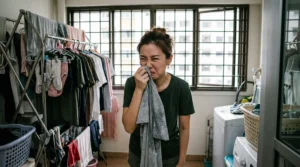
The situation goes from uncomfortable to unbearable. Drying clothes without sunlight in an enclosed room releases liters of water vapor directly into the already saturated air. The moisture has absolutely nowhere to go. It settles into the paint on the walls, seeps into the mattress, and clings to the curtains.
Not only does this drastically increase the humid climate ventilation problems, but it also creates the perfect biological incubator. The trapped moisture guarantees you will be dealing with a musty laundry smell singapore indoor drying racks are notorious for. The airborne bacteria thrive in this dense, unmoving soup. You are breathing in a heavy mixture of evaporating detergent, bacterial waste, and stale carbon dioxide.
The Fan Delusion
The immediate reaction to a stuffy room is to point a high-speed standing fan directly at your face.
While the mechanical wind chill feels nice on your skin, it does nothing to solve the underlying problem. A fan does not create fresh air. It does not introduce oxygen. It simply takes the dense, stale, CO2-heavy air and spins it around the room in a chaotic circle.
If the room feels heavy because of the moisture, a fan is essentially useless. This is a common trap when trying to figure out how to stop sweating indoors aircon singapore guides mention. Moving wet air across wet skin does not facilitate evaporation. It just pushes the moisture around. If you want to know how to fix stuffy room in humid climate conditions, you have to stop recirculating the bad air and start physically extracting it.
Forcing the Atmosphere
You have to take control of the atmospheric pressure.
If the wind refuses to enter naturally, you must force it. Position a box fan or a high-velocity circulator fan exactly in the window frame, facing entirely outward. Turn it on high.
This seems counter-intuitive. You want air in, so why blow air out? It is called creating negative pressure. By forcefully exhausting the stagnant indoor air out of the window, you create a vacuum inside the room. Physics dictates that this vacuum must be filled. The room will violently pull fresh, cooler air from the hallway, under the door gaps, or from a window on the opposite side of the house. You are mechanically forcing cross-ventilation.
This single trick is the best way to ventilate room Singapore environments demand when the outdoor wind is dead.
Next, attack the moisture. The dense air feeling is structural. If you drop the relative humidity from 85% down to 50%, the air physically changes texture. It becomes light. It becomes crisp. Running a dedicated compressor dehumidifier in a sealed room strips the heavy water vapor out of the environment.
This changes everything. It prevents the rapid material degradation that forces you to constantly try to fix sticky plastic singapore electronics suffer from. It allows your sweat to actually evaporate, bringing your core temperature down. It makes the room breathable again.
✅ Do This
- Open windows on opposite ends of the apartment and ensure all interior doors between them are wide open to create a clear wind tunnel.
- Place a high-velocity fan facing outward in one window to act as an exhaust, forcing stagnant air out and pulling fresh air in from elsewhere.
- Run a dedicated compressor dehumidifier to pull the physical weight of the moisture out of the air, making it feel significantly lighter and cooler.
- Wipe down your window screens monthly; a thick layer of trapped urban dust completely destroys the permeability of the mesh, blocking subtle breezes.
❌ Avoid This
- Do not open a single bedroom window while keeping the bedroom door closed; it pressurizes the room and creates a dead-air pocket.
- Do not place large, bulky furniture directly in the path between your main windows and the hallway doors.
- Do not dry large loads of wet laundry inside a closed bedroom; the massive influx of water vapor makes the air unbearably heavy and suffocating.
- Do not assume a ceiling fan is providing ventilation; it merely recirculates the exact same oxygen-depleted air without introducing anything fresh.
The frustration of an unmoving room is a structural failure of fluid dynamics. You cannot just open a gap in the glass and hope the atmosphere does the work for you. By understanding how to manipulate air pressure, create clear intake and exhaust pathways, and aggressively strip out the humidity, you can finally force your apartment to breathe.

Daily Life & Urban Environment Editor
Kun is a Singapore-based urban living specialist with a deep understanding of HDB architecture and tropical climate dynamics. Drawing from years of on-the-ground observation, he translates complex structural physics—like urban fluid dynamics and humidity control—into practical, everyday solutions for Singaporeans.
Frequently Asked Questions
Official Context & Architectural Resources
For more official guidelines on maximizing natural ventilation, understanding urban heat islands, and maintaining healthy indoor air quality, refer to these local authorities: