The Unwritten Hawker Centre Rules Singaporeans Follow


It is a ballet performed in flip-flops. It is a negotiation conducted without words. To the uninitiated, the hawker centre at peak hour looks like anarchy. To the regular, it is a system of beautiful, ruthless efficiency.
The Hawker Centre Scene Everyone Recognises
It is 12:30 PM. The sun is vertical, beating down on the zinc roof of a sprawling food centre—perhaps Maxwell, perhaps Old Airport Road, or perhaps the one just downstairs from your office. The heat is a physical weight, mixing with the thick, savory steam rising from a hundred woks.
The soundscape is overwhelming: the metallic clang-clang-clang of spatulas hitting woks, the roar of high-pressure gas burners, the whir of industrial ceiling fans cutting through the humidity, and the piercing shout of an auntie calling out order numbers in Mandarin, then English, then Hokkien.
But the real action isn’t in the kitchen. It is in the aisles.
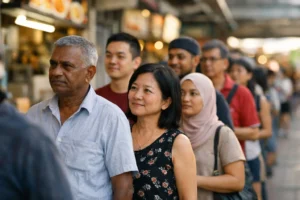
Observe the floor. It is a sea of office workers, retirees, and students, all moving with a singular purpose. They are scanning. Their eyes dart from table to table, looking for the Holy Grail of the lunch hour: an empty seat. A woman in a tailored skirt spots a circular table near the center. It’s empty. She takes a sharp step toward it, her body language shifting from search to acquisition. But then she stops. She deflates slightly. She turns away.
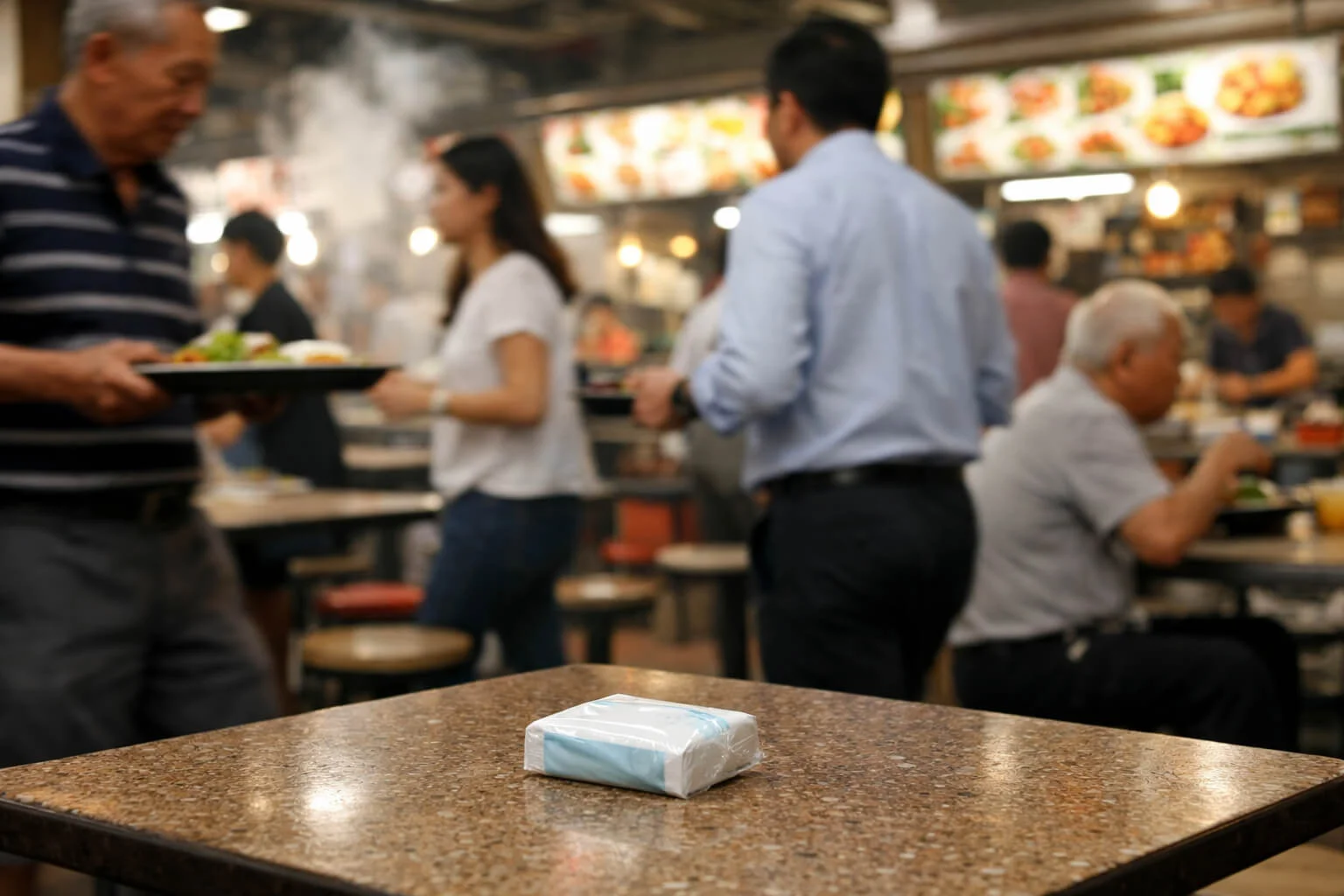
On the center of the table, sitting innocuously on the faded laminate, is a packet of tissue paper. It costs maybe ten cents. It weighs nothing. But in this environment, it has the legal weight of a property deed. The table is taken. The system is working.
Hawker centre etiquette Singapore is not a set of laws written by the government. It is a living, breathing social code. It is a collective agreement by millions of people to make a chaotic situation livable. To navigate it requires observation, timing, and a healthy respect for the unspoken rules of the community.
The Art of the “Chope”
If there is one concept that defines Singapore hawker centre rules, it is “choping.” Derived from the Hokkien word for “stamp” or “seal,” it is the practice of reserving a seat before you get your food.
In other countries, you might buy your food first, then wander around looking for a place to sit, tray in hand. In Singapore, that is considered a rookie mistake. Here, you secure the territory first. Then, and only then, do you hunt for sustenance.
The Hierarchy of Markers
How to chope seats in Singapore depends on what you have in your pockets. Not all markers are created equal, but they all serve the same function.
The Tissue Packet: This is the undisputed king. It is disposable, low-value, and universally recognized. “I saw a tourist try to pick up a tissue packet once, thinking someone lost it,” says an office worker in Shenton Way. “Three people at the next table shouted ‘Hey!’ at the same time. The tourist dropped it like it was hot coal.”
The Umbrella: The sturdy alternative. Used mostly on rainy days or for outdoor seats where the wind might blow a tissue away. It signals a stronger claim, a physical occupation of the space.
The Name Card / Lanyard: This is the “CBD Flex.” You will see this in places like Amoy Street Food Centre. Office workers leave their corporate passes or name cards on the table. It is a subtle signal of trust in Singapore’s safety—nobody steals the identity; they just respect the seat.
The Water Bottle: A functional marker, often used by those who don’t carry tissues. It’s effective because it looks like someone is mid-meal and just stepped away.
The “Chope” Backfire (A Scenario)
However, the system is not without its glitches. Consider this awkward moment, observed last Tuesday at a busy centre in Bedok:
A man places a lightweight tissue packet on a table near the edge of the hawker centre. He walks away to queue for char kway teow. A sudden gust of wind—common before a storm—sweeps through. The tissue flutters off the table and lands under a nearby chair.
Two minutes later, a couple arrives. They see an empty table. No tissue. No umbrella. They sit down. They chope seats Singapore style with their own heavy umbrellas.
Ten minutes later, the first man returns with a steaming plate of noodles. He stops. He stares at the table. He looks at the couple. He looks at the floor and spots his rogue tissue. The couple looks up, confused. There is no shouting. There is no fight. The man simply sighs—a deep, resonant exhale of defeat—picks up his tissue from the floor, and wanders off to find a new spot, his noodles slowly cooling. The wind is the only force that can override the chope.
The Queue: A Silent Social Contract
Once the seat is secured, the next phase begins: the queue. Hawker centre queue etiquette is perhaps the most rigid part of the experience. The line is sacred.
The “Invisible” Queue
At popular stalls, the queue is obvious. It snakes around corners, carefully avoiding blocking other stalls. But at smaller stalls, the queue can look amorphous. It might be a cluster of people standing near the counter.
Do not be fooled. It is still a queue. The uncle frying the carrot cake knows exactly who arrived when. He has a mental ledger.
This tense, silent pressure is part of Singapore’s everyday “micro-stress” texture — the kind you feel in queues, escalators, and small friction points. If you’ve noticed the mood shifting lately, read this: Singapore’s micro-stress mood explained.
Awkward Moment #1: The Accidental Cutter
A young man walks up to a drink stall. There are three people standing loosely around the front. He assumes they are waiting for orders, so he steps up to the counter and says, “Uncle, Kopi O.”
The uncle doesn’t look up. He continues stirring a pot. The three people behind the man do not speak, but the temperature in the air drops. Finally, the uncle points his spoon at the lady standing two meters back. “She come first,” he says flatly. The young man shrinks, muttering an apology, and moves to the back of the phantom line. He has broken the rhythm, and everyone felt it.
The Indecisive Orderer
The second greatest sin is indecision. When you reach the front of the line, you are expected to execute your order with military precision.
“I stand behind people who get to the front and then start calling their wife to ask what she wants,” says a regular patron at Tiong Bahru Market. “I just look at the ceiling. The hawker looks at the ceiling. We are all praying for patience.”
Ordering at hawker centre Singapore requires preparation. You should know what you want before the hawker looks at you. The interaction is rapid-fire:
“Makan?” (Eat here?)
“Makan.”
“Chili?”
“More.”
“Four dollar.”
It is a transaction stripped of all fat. It is efficient because it has to be.
Table Sharing: The Intimacy of Strangers
With food on the tray, you return to your choped seat. But often, during the peak hours, you cannot hold a whole table. This brings us to table sharing Singapore hawker centre style.
Sharing a table is standard practice. If there is a four-person table and only two people are sitting there, the other two seats are fair game. However, there is a protocol to joining.
You approach. You make eye contact with the current occupants. You gesture to the empty chair and ask, “Can share?” or simply “Anyone sitting?”
The response is almost always a nod or a mumbled “Can.”
The Silence of the Shared Meal
Once seated, a strange phenomenon occurs. You are sitting elbow-to-elbow with a stranger. You are watching them eat. You can smell their food. But you exist in parallel universes.
Locals do not make small talk at shared tables. There is no “Nice weather” or “The food looks good.” You eat in your bubble. You look at your phone. You look at your food. You look anywhere but at the person chewing just thirty centimeters away from you.
Generational Difference #1:
The older generation—the uncles and aunties in their 60s and 70s—might break this rule. They might ask, “The char siew today okay?” or comment on the crowd. It is a remnant of a more communal past. The younger crowd, however, will put on noise-canceling headphones the moment they sit down, sealing themselves into a private audio capsule amidst the public noise.
Awkward Moment #2: The Bag Spreader
Conflict arises when someone refuses to acknowledge the density of the crowd. We have all seen the “Bag Spreader.” This is the person who sits at a four-top table alone and places their backpack on one chair, their laptop bag on another, and their umbrella on the third.
During peak hour, this is an act of aggression. People walking by with heavy trays will stare. They will hover. Eventually, a brave soul will approach. “Excuse me, can I sit?”
The Spreader will usually sigh, dramatically consolidating their belongings into a pile on their lap, radiating irritation. They are technically sharing, but they are making sure you know it is an inconvenience.
The Aftermath: Tray Return and Leaving
The meal is done. The last sip of Kopi is gone. Now comes the final act: the exit.
The Shift in Culture
For decades, the norm was to leave your plates on the table. An army of elderly cleaners would swoop in to clear it. But in recent years, this has changed. The National Environment Agency (NEA) has pushed hard for a self-return culture.
Do you have to return trays at hawker centres in Singapore? Yes. It is now the expected norm. You stand up, take your tray, and walk it to the massive, colorful racks labeled “Halal” and “Non-Halal.”
Generational Difference #2
You will still see a divide here. Younger diners do this automatically; it is muscle memory. Older diners, who spent fifty years being served, sometimes struggle with the habit. You might see an uncle leave his cup behind, not out of malice, but out of decades of routine.
Awkward Moment #3: The Cleaner Standoff
Sometimes, you stand up to take your tray, and a cleaner reaches for it at the same time. You freeze. They freeze. You are trying to be a good citizen; they are trying to do their job. Usually, the cleaner will wave you off, taking the tray with a smile. It is a moment of confused courtesy.
The Evening Rhythm
As the clock ticks past 1:30 PM, the frenetic energy dissipates. The office workers rush back to their air-conditioned towers. The tables clear. The aunties at the drink stalls sit down and fan themselves.
But come 7:30 PM, the cycle restarts, though the beat is slower.
The evening crowd is different. It is families in flip-flops. It is couples sharing a satay. The “chope” is less aggressive. The queues are more patient. The beer bottles appear on the tables.
At a table in the corner, a family finishes their meal. The father stands up, gathers the bowls onto the tray, and walks to the return station. A young couple standing nearby watches him. As soon as he steps away, the woman walks over. She doesn’t sit immediately. She pulls a packet of tissue from her bag and places it gently in the center of the table.
The cycle is complete. The table is claimed.
The Hawker Centre Checklist
✅ Do This
- ✔ Chope with cheap items: Use tissues or an old umbrella, never your phone or wallet.
- ✔ Check for markers: Look for tissues on seats before you get excited about an empty table.
- ✔ Ask “Can share?”: A polite nod to existing diners goes a long way.
- ✔ Know your order: Decide what you want while waiting in the queue, not at the counter.
- ✔ Clarify “Makan” or “Dabao”: Tell the hawker immediately if you are eating there or taking away.
- ✔ Bring cash: Many older stalls still prefer cash over digital payments.
- ✔ Return your tray: Clear the table for the next person; it’s the law and the culture.
- ✔ Eat and go: During peak hours, treat the table as a utility, not a lounge.
❌ Avoid This
- ✘ Don’t “Ghost Chope”: Do not reserve a table 30 minutes before you actually arrive.
- ✘ Don’t cut the queue: Even if your friend is at the front, joining them is considered rude.
- ✘ Don’t hoard seats: Two people taking a six-person table is a major faux pas.
- ✘ Don’t leave mess: Bones, used tissues, and spills should be cleaned up.
- ✘ Don’t customize excessively: Hawkers are cooking for volume; respect the standard menu.
- ✘ Don’t hover too close: Standing right behind someone eating to pressure them to leave is aggressive.
- ✘ Don’t engage in long calls: Sharing a table means keeping your noise level down.
- ✘ Don’t assume credit cards work: You will likely be disappointed.