
Singapore’s Micro-Stress Mood: Why Daily Life Feels Tense

The trains are running. The malls are open. The economy is stable. Yet, a wire-taut tension has settled over the island. We explore the ‘micro-stress’ epidemic that everyone feels but no one talks about.
A Small Moment That Says Everything
The doors opened at Bishan MRT on a Tuesday morning at 8:15 AM. Nobody shoved. Nobody shouted. The crowd flowed out with practiced efficiency.
But the energy was different.
A woman hesitated for a fraction of a second, her bag catching on the door frame. The man behind her didn’t offer help. He didn’t even say “Excuse me.” He just let out a sharp, audible exhale—a sigh loaded with disproportionate frustration. He swerved around her, his shoulder rigid, eyes locked forward.
Nobody shouted. Nobody shoved. But the air between people felt tighter, like everyone was holding their breath just a little longer.
This isn’t an isolated incident. If you pay attention, you see it everywhere. In the kopitiam queue in Tampines. At the traffic light in Orchard. In the void deck in Yishun.
Singapore didn’t suddenly become unsafe or chaotic. It just started to feel… heavier. Daily life in Singapore lately has acquired a new texture—a brittle, glassy tension that threatens to crack at the slightest friction. Singapore mood changing isn’t about a single event; it’s about a million micro-moments of exhaustion.
Peak-hour hawker centres run on unspoken rules — learn them here: Hawker centre etiquette (chope, queues, tray return).
It’s Not Panic. It’s Something Quieter.
We aren’t seeing riots. We are seeing withdrawal.
The Shorter Patience Test
Five years ago, we had a buffer. If the auntie took too long to count her coins, we waited. We smiled. Today, that buffer is gone.
The tolerance window has shrunk from five minutes to thirty seconds. If the MRT gantry takes an extra second to read a card, you hear a “tsk.” If the drink stall uncle gets the order wrong, the reaction isn’t “never mind,” it’s a sharp “aiyah” that sounds like an accusation.
I watched a scene at a FairPrice Finest. A man was trying to use a discount coupon at the counter. It wasn’t working. The man behind him didn’t say anything. He just stared at the back of the first man’s head with such intense, silent fury that you could feel the temperature drop.
It’s not anger. It’s something quieter. Like everyone’s internal timer got set 30 seconds shorter, and everyone is perpetually late for a meeting that doesn’t exist.
The Disappearing Small Talk
The everyday stress Singapore residents carry has killed the casual chat.
In my block, the lift ride used to be a social event. “Morning.” “Going work ah?” “Have you eaten?” Today, the silence feels more deliberate. Not rude—just faster. Like everyone is conserving energy.
“Used to be, uncle at the coffee shop will ask ‘How’s work?'” says a regular at a Bedok kopitiam. “Now he just hand me my kopi. Not rude. Just… faster. Like everyone saving energy.”
Even in the void decks, the evening gatherings are shorter. The uncles gather at 8 PM, but by 8:45 PM, they are dispersing. The stamina for socializing has evaporated.
Where You Feel It Most
The tension isn’t evenly distributed. It congregates in the transition zones.
MRT Rides and Escalators
The MRT commuters Singapore sees every day are the barometer of the nation’s stress. The escalator etiquette—stand left, walk right—has become a militarized zone. If you stand on the right for a second too long, the glare you receive is withering.
Inside the train, the “space negotiation” has ended. People sit down and immediately expand. They do not shrink to accommodate a neighbor. They claim their square footage and defend it with elbows and bags.
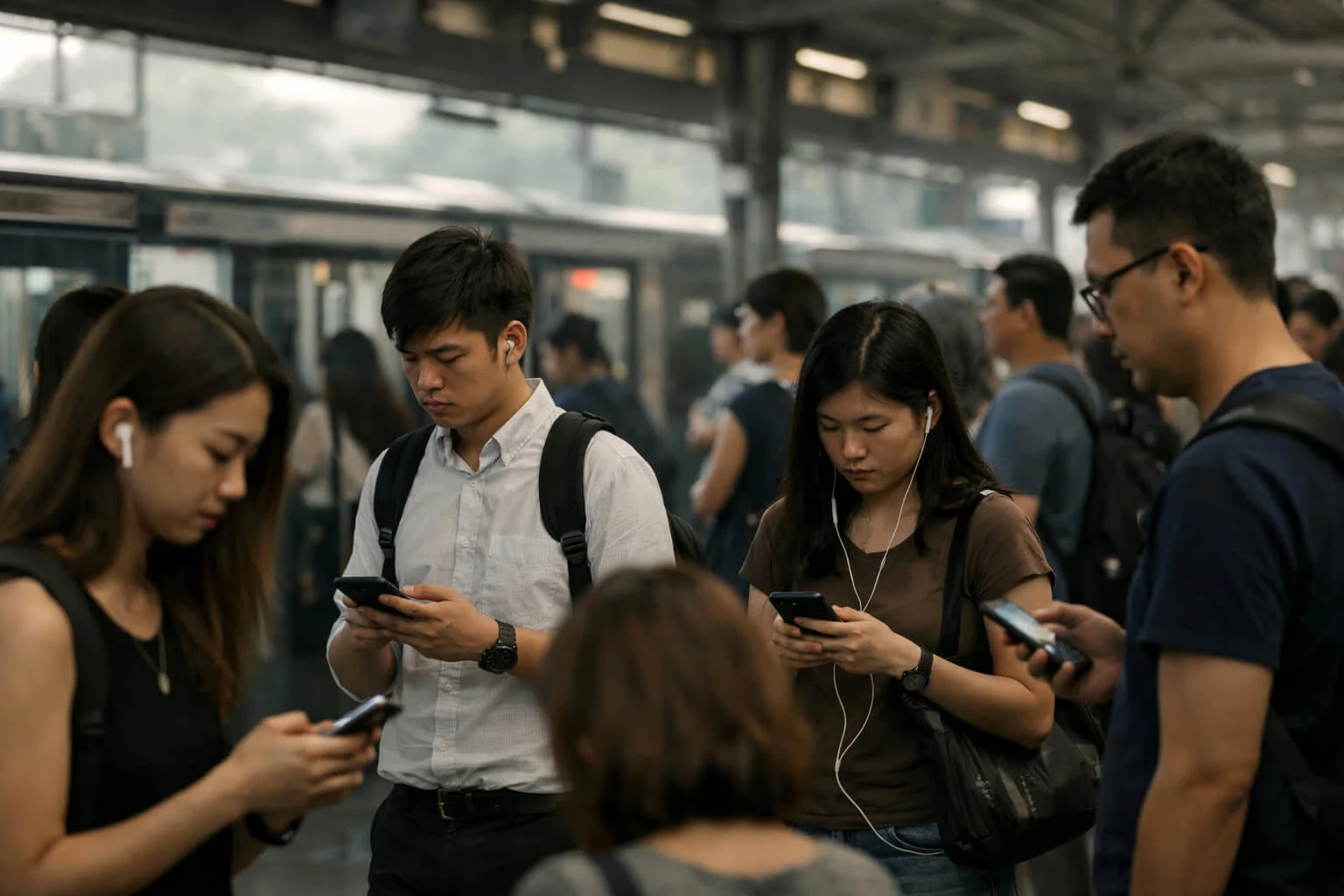
The train carriage used to have this low hum of whispers. Now it’s just AirPods, silent scrolling, and the occasional sigh of someone missing their connection.
Kopitiams and Hawker Centres
The kopitiam atmosphere has cooled. The “Kampung Spirit” is struggling against the “Efficiency Spirit.”
I watched a man at a Toa Payoh kopitiam eat his wonton mee. He finished it in eight minutes flat. He didn’t check his phone. He didn’t look around. He just ate, stood up, and left. The uncle at the next table noticed. “Everyone rushing nowadays,” he muttered to no one.
The shared tables—once a place for accidental conversation—are now silent zones. People ask “Can I sit?” with a gesture, receive a nod, and then proceed to ignore each other completely.
Supermarkets and Queue Culture
The self-checkout counter is a stress test. “Unexpected item in the bagging area.” That robotic voice triggers a physical flinch in shoppers. You see their shoulders hunch. You hear the heavy breathing.
At an NTUC in Clementi, a woman accidentally brushed someone’s trolley. She said “sorry” twice. The other person didn’t respond—just moved the trolley silently. No eye contact. The apology hung in the air, unaccepted and unacknowledged.
We have become a city of ghosts bumping into each other, too tired to even say “excuse me.”
| The Situation | The Old Reaction (2018) | The New Reaction (2026) |
|---|---|---|
| Lift Door | Hold for neighbour. | Press “Close” immediately. |
| Wrong Order | “Never mind.” | “Aiyah.” (Sharp tone) |
| Queue Jumper | “Queue behind please.” | Silent, intense glaring. |
| Apology | “It’s okay.” | Silence / Ignore. |
The Quiet Causes People Hint At (Without Big Claims)
Why does Singapore feels different now? Nobody points to one big thing. They point to a thousand small things.
Time Pressure Everywhere
“Everything now need to book slot,” says a mother in Punggol. “Clinic, bank, even cut hair also must appointment. Last time can walk in. Now if no slot, cannot.”
This kills spontaneity. It creates a background anxiety: Am I late? Did I book? We are living our lives in 15-minute blocks, and the transitions between them are fraught with the fear of missing out.
Digital Friction
The patience running thin Singapore experiences is often digital. It’s the QR code that won’t scan. It’s the app that crashes. It’s the OTP that arrives ten seconds too late.
“Uncle at CC trying to scan SafeEntry. Phone say ‘invalid QR.’ He try three times. Then he just walk in. Security guard call him back. He just tired lah.”
It’s not one big problem. It’s twenty small ones, every day, adding up to a mountain of frustration.
Cost Sensitivity in Small Choices
Living in Singapore 2026 stress is financial, but subtle. It’s the pause before ordering a drink.
At the hawker centre, a man ordered char kway teow. When told it’s $5, he paused. Just one second. Then nodded. That pause used to not exist. It is the sound of mental math happening in real-time. It is the sound of “Is it worth it?”
Who Notices First
The sensitivity to this tension varies by generation.
Seniors in the Heartlands
“Last time everything slower. Now everyone in a hurry,” says Mdm Tan, 74. “Young people don’t talk anymore. Even the market auntie no smile.” In some mature estates, the slower rhythm is structural too — here’s why daily life feels slower in older HDB neighbourhoods.
Their rhythm has been disrupted. The slow morning chat has been replaced by the fast transaction. They feel the loss of connection most acutely.
Working Adults
For the workforce, the feeling is flatness. “Everyday same thing. Wake up tired, go work tired, come home tired,” says a Grab driver. “Even weekend also don’t feel like break.”
On the MRT at 7 PM on Friday, nobody looked excited. Just… flat. The “TGIF” energy has been replaced by a “Thank God It’s Over” exhaustion.
Young Parents
For them, life is a logistics operation. “One thing delay, everything collapse,” says a father of two. There is no buffer. If the bus is late, the childcare pickup is late, the dinner is late, the bedtime is late.
A mother at Bishan Junction carrying two school bags, one stroller, one coffee. She dropped the coffee. Didn’t cry. Just stood there for three seconds. Then picked up the cup and kept walking. It was a masterclass in suppressed despair.
What People Do Instead of Complaining
Interestingly, daily life in Singapore lately isn’t filled with complaints. It is filled with adaptation.
People aren’t fighting the system. They’re just… shrinking around it. Eating faster. Talking less. Moving quicker. Making themselves smaller so the day fits.
They change their routes to avoid crowds. They order food delivery to avoid queues. They wear noise-canceling headphones to avoid conversation. It is a retreat into the self.
A Day Ends the Same Way — But Feels Different
Go to Toa Payoh Lorong 8 at 9:00 PM. Look at the void deck.
There are three aunties and one uncle sitting on plastic chairs. Five years ago, you would have heard laughter. You would have heard gossip about the drama on Channel 8.
Today, they sit. They talk. But the energy is different. The sentences are shorter. The silences are longer. After twenty minutes, they stand up, nod, and head to the lifts.
The lights are the same. The chairs are the same. The people are the same. But something shifted. And everyone feels it, even if no one says it out loud.
This article reflects observed behavioural shifts in everyday Singapore life and does not refer to a single policy change or crisis event.
Official Context
If you or someone you know is struggling with mental well-being, help is available. The Institute of Mental Health (IMH) operates a 24-hour helpline. Additionally, mindline.sg provides self-care resources and connects residents to community support services.
🕰️ One Small Moment
“I was on the bus when it started pouring rain. A young student realized she had left her umbrella. She looked panicked. The man next to her, who had been aggressively typing on his phone the whole ride, saw her face. He stopped typing. He reached into his bag, pulled out a spare umbrella, and handed it to her. ‘Take,’ he said. ‘I got extra.’ He went back to typing before she could say thank you. The tension is there, yes. But so is the kindness, buried deep under the rush.”