Singapore MRT Peak Hour Guide: Where to Stand, Queue, and Move Smart


It’s a synchronized dance of 3 million people. It looks chaotic, but it runs on a strict, invisible code. If you break the code, you don’t get fined—you just get the collective “tsk” of the entire carriage.
The 8:30 AM Jurong East Shuffle
If you want to understand the soul of Singapore, stand on the platform at Jurong East Interchange at 8:30 AM. It is a sea of heads. The air-conditioning is fighting a losing battle against the body heat of thousands.
The train pulls in. The announcement chimes: “Doors opening.”
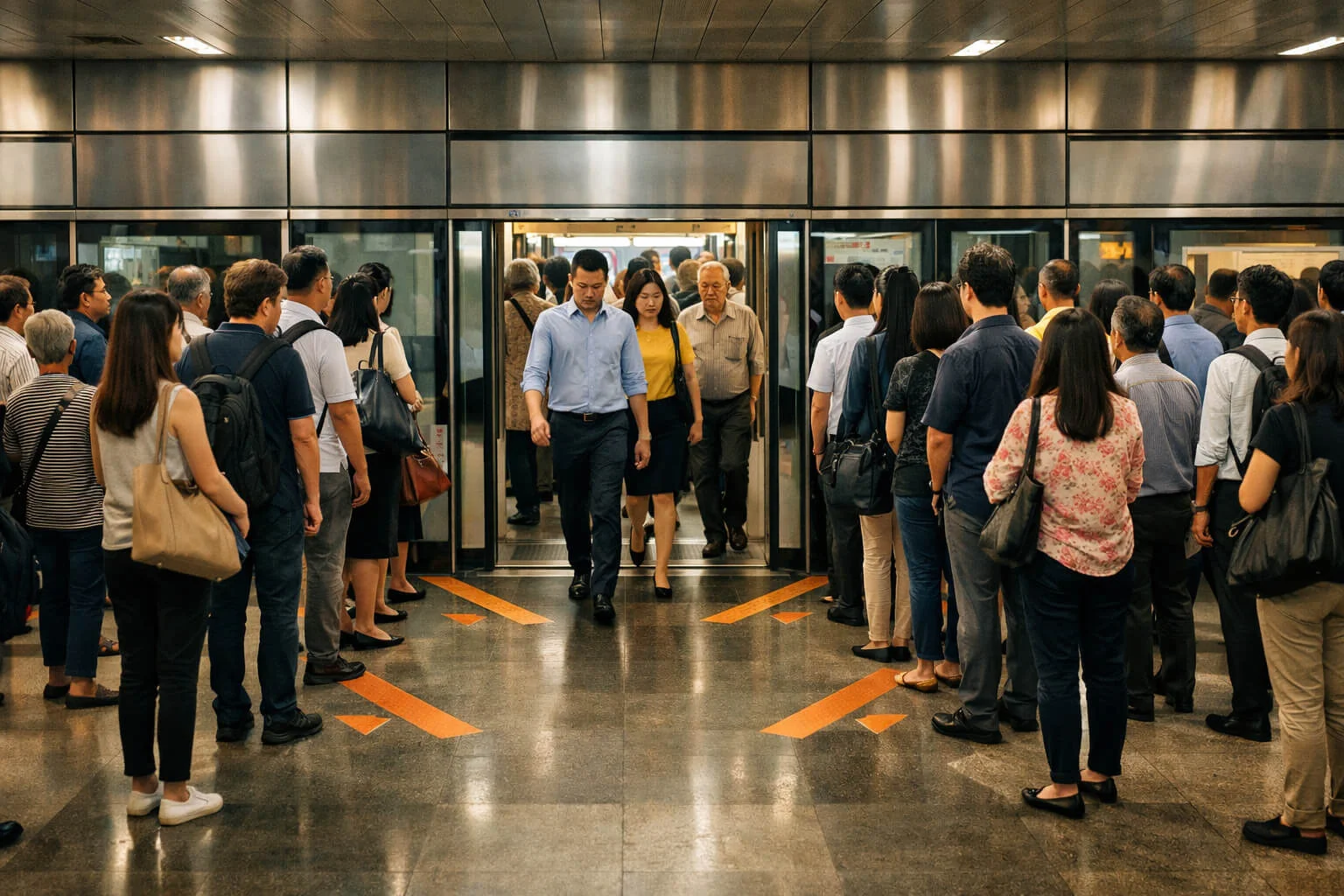
For a split second, there is a standoff. The people inside want to get out. The people outside want to get in. In a perfect world, the Red Sea parts. In reality, it’s often a friction-heavy shuffle where shoulders collide and patience wears thin.
Surviving the Singapore MRT peak hour guide isn’t just about knowing which line to take. It’s about knowing how to move. It’s about the geometry of the crowd. Whether you are a local trying to optimize your commute or a newcomer terrified of the crush, knowing where to stand MRT platform Singapore style is the first line of defense against madness.
If you like Singapore’s “invisible rules” culture, you’ll also enjoy our guide to hawker centre etiquette (chope seats, queueing, and unspoken norms).
The Platform Strategy: The Arrows Are Not Suggestions
Look at the floor. Those colored arrows? They are the law.
The “V” Formation
The most critical rule of how to queue for MRT Singapore lies in the markings.
* Red/Green Arrows (Center): This is the “Alighting Channel.” It must remain clear.
* Side Arrows: This is where you queue.
[Image of Singapore MRT platform floor markings showing queue arrows]
The biggest mistake people make is forming a “wall” in front of the doors. When the doors open, the passengers exiting have nowhere to go. This creates a bottleneck. If you stand to the side, the flow is faster, and you actually get on the train sooner.
The “End of Platform” Hack
Human beings herd. We tend to cluster near the escalators. If you walk just twenty meters to the far ends of the platform (the first or last carriage), the crowd density often drops by 30%. It’s the difference between being crushed against a glass panel and having space to check your phone.
The same social code shows up in food centres too — here’s the evergreen version:Hawker Centre Etiquette in Singapore.
The Boarding Etiquette: The War on Backpacks
Once you are inside, the rules change. The space is finite. The tension is high.
The Backpack Problem
If there is one thing that makes MRT etiquette Singapore discussions heat up, it’s the backpack. When you wear a bulky bag on your back in a packed train, you are effectively taking up the space of two people. You are also hitting the person behind you every time you turn around.
The Fix: Put it on the floor. Or wear it on your front (the “kangaroo” method). It looks silly, but it saves space and keeps your belongings safe.
The “Center of the Carriage” Myth
We see it every day. The door area is a mosh pit. People are nose-to-nose. But look at the middle of the carriage. There is space. Actual, breathable space.
Why don’t people move there? Fear. The fear that they won’t be able to get out at their stop. But letting passengers alight first and moving deep into the car helps everyone. Trust that people will make way for you when you need to exit.
The “Pole Leaner”
The vertical pole is for holding, not for spinal support. When you lean your entire body weight against the pole, you deny three other people a handhold. In a jerky train, that’s a safety hazard. Hold the pole with your hand, not your back.
Escalator Etiquette: The Sacred Left Lane
This is arguably the most enforced social rule in the country.
Stand Left, Walk Right.
If you stand on the right side of the escalator during rush hour, you will feel the burning gaze of a hundred angry commuters behind you. The right lane is the fast lane. It is for the people who are late for meetings. The left lane is for the chillers, the scrollers, and the tired.
Common Mistake: The “Landing Pad” Blocker
You reach the top of the escalator. You step off. And then… you stop to check which way to go. DO NOT DO THIS. There is a conveyor belt of humans behind you. If you stop, they pile up. Keep walking for at least five meters before you orient yourself.
It sounds stressful, but it’s actually cooperative. We are all trying to get home.
| Scenario | The “Rookie” Move | The “Pro” Move |
|---|---|---|
| Platform Queue | Blocking the center of the doors. | Queueing at the sides, leaving a gap. |
| Boarding | Rushing in before people exit. | Waiting for the last person to step off. |
| Inside Train | Wearing backpack, blocking door. | Bag on floor, moving to center aisle. |
| Escalator | Standing on the right side. | Standing left, walking right. |
The Habits That Make Crowds Worse
Sometimes, the congestion isn’t caused by the number of people, but by behavior.
Peak-hour friction isn’t only physical — it builds up mentally too. If you’ve felt this,read how Singapore’s micro-stress affects mood and daily decisions.
1. The “Phone Zombie” Shuffle
Walking slowly while watching a Korean drama. During peak hour, speed matters. If you need to watch, stand to the side. Don’t block the flow of the interchange tunnel.
2. The Door Hog
Refusing to step out onto the platform to let others alight because “I will lose my spot.” If you are blocking the door, step out, stand to the side, and step back in. It’s the polite thing to do.
3. The Seat Sprinter
The person who spots an empty Priority Seat and sprints for it, elbowing an elderly auntie. Just don’t. The karma isn’t worth it.
Official Context
The Land Transport Authority (LTA) actively promotes gracious commuting through campaigns like “Stand-Up Stacey” and “Bag-Down Benny.” You can also download the MyTransport.SG app for real-time crowd levels at stations.
🕰️ One Small Moment
“The train was packed. Suffocatingly so. A young man was sitting in the priority seat, eyes closed, headphones on. An elderly lady with a walking stick shuffled in. Before anyone could say a word, a secondary school boy standing nearby tapped the sleeping man on the shoulder. He didn’t shout. He just pointed. The man opened his eyes, saw the lady, and immediately stood up. The boy didn’t take the seat; he let the lady sit. No words spoken. Just a nod. System restored.”
Editor’s Note (Internal)
- Fines & rules: Any stated figures (e.g., “up to $500”) should be verified against the latest LTA/SMRT/authority pages before publishing, as amounts and enforcement details can change.
- Foldable bikes: Size limits and peak-hour restrictions vary by policy updates. Keep phrasing as “allowed when folded and within size limits” and avoid absolute claims unless double-checked.
- Peak hour timing: Use “typically” / “generally” (not absolute). Crowding differs by line, interchange, and school holidays.
- Image safety: Avoid logos, ad panels, or clearly readable brand signage in feature images; use generic platform markings/crowd visuals for Discover compatibility.
- Practical framing: Ensure at least one “Quick Summary” line near the top so the piece reads as a guide, not only narrative.