Singapore Cost of Living 2026: Monthly Budget for Singles, Couples & Families

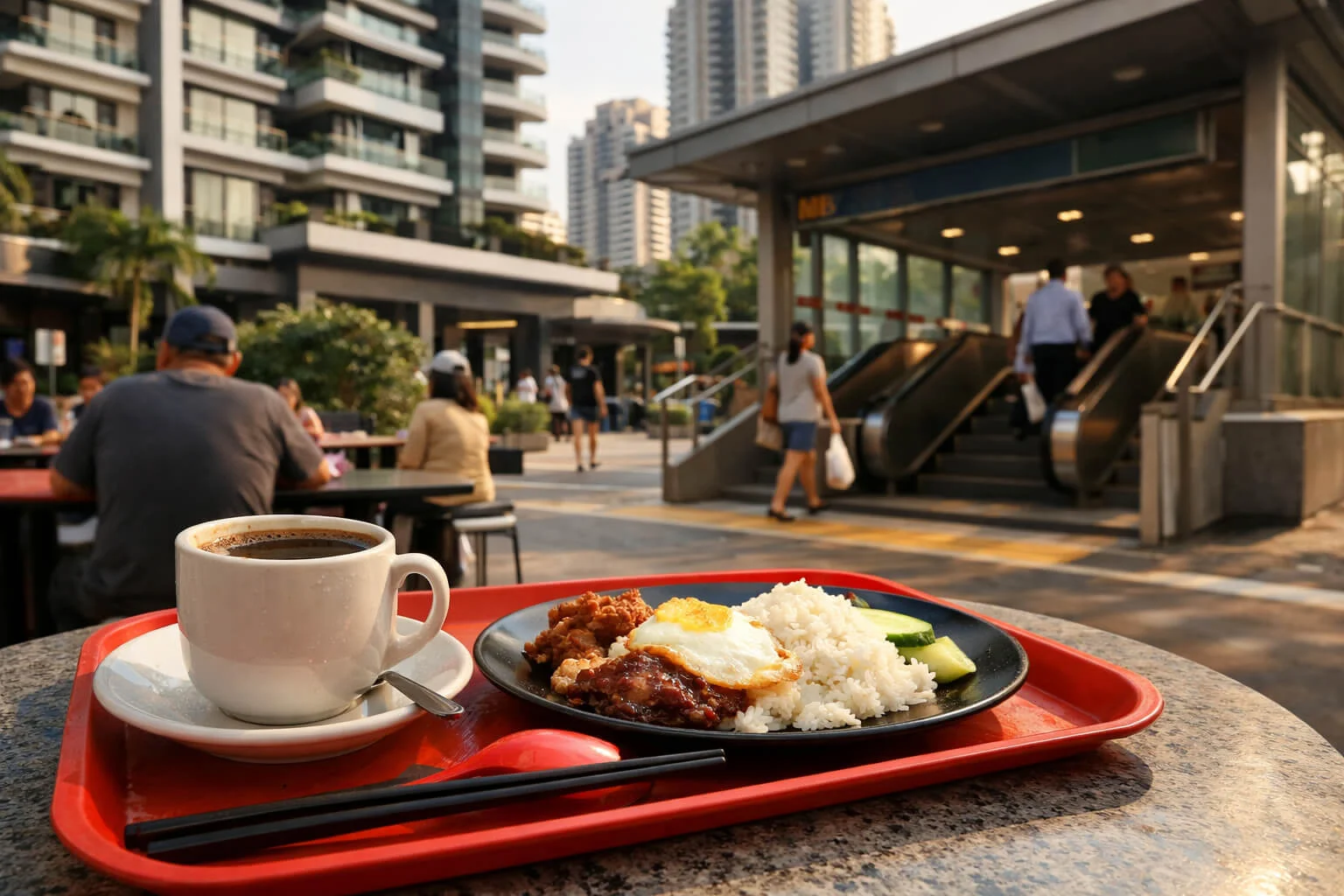

The charts say Singapore is the most expensive city in the world. But ask the uncle drinking a $1.40 Kopi O, and he’ll tell you a different story. The truth lies somewhere between the Michelin star and the hawker stall.
The Quick Reality Check (Why This Guide Exists)
All figures are in SGD. If you Google how much to live in Singapore, you will get terrifying numbers. You will read about $5,000 rents and $20 cocktails. And yes, that Singapore exists.
But there is another Singapore. It is the Singapore of the $4 chicken rice, the $0.90 bus ride, and the free library air-conditioning. Understanding the Singapore cost of living 2026 isn’t about memorizing a single number; it’s about understanding the “Lifestyle Lever.”
Why Costs Feel Different Depending on Lifestyle
You can spend $30 on lunch at a cafe in Telok Ayer, or you can spend $5 at the Amoy Street Food Centre next door. Both fill your stomach. One empties your wallet.
The biggest mistake newcomers (and even locals) make is mixing these lifestyles. They rent like a local but eat like a tourist. Or they eat like a local but commute via Grab like a CEO. Your monthly burn rate is determined entirely by how many “convenience taxes” you are willing to pay.
The “Same Salary, Different Life” Problem
I know two graphic designers. Both earn roughly $4,500. One saves $1,000 a month. The other borrows money by the 25th. The difference? One rents a room in Yishun and cooks dinner. The other rents a studio in Tiong Bahru and orders delivery. In Singapore, geography is financial destiny.
A Simple Monthly Budget Framework (Singapore Version)
Forget complex spreadsheets. In Singapore, your money goes into five main buckets.
The 5 Buckets Most People Spend On
- Housing (30%-50%): The unavoidable giant.
- Food (20%): The most flexible variable.
- Transport (5%-10%): Cheap if public, expensive if private.
- Bills & Tax (5%): Utilities, phone, internet.
- Fun & “Saver” (Remaining): What keeps you sane.
Housing — The Biggest Lever
This is where the battle is won or lost.
What Changes the Budget Most
Rent in Singapore has stabilized somewhat in 2026, but it remains high. A condo in the Core Central Region (Orchard/River Valley) behaves like a different currency compared to an HDB in the Outside Central Region (Woodlands/Punggol).
- HDB Room Rental: $800 – $1,200 (Common Room)
- Condo Room Rental: $1,500 – $2,500
- Whole HDB Unit (3-Room): $2,800 – $3,500
- Whole Condo Unit (2-Bed): $4,000 – $6,000+
Official data from HDB can give you the median rents by town, which is a crucial negotiation tool. Never pay the asking price without checking the median first.
Rent vs Commute Trade-Off
Is it worth saving $500 on rent to live in Tuas if you work in Changi? Probably not. The time cost and the MRT fare (capped, but still real) add up. Most savvy residents aim for the “Circle Line Sweet Spot”—locations like Paya Lebar or Bishan that offer connectivity without the Marina Bay price tag.
Food — Hawker vs Cooking vs Convenience
The common wisdom is “Cooking is cheaper.” In Singapore, that is not always true.
See also: this budget shift is part of a bigger pattern — Singapore shoppers aren’t spending less, they’re spending differently in 2026:
Singapore shoppers spending differently in 2026.
Hawker Staples vs “Food Court” Reality
If you eat at a neighbourhood hawker centre, a meal is $4.50 to $6.00. That’s roughly $450 a month for lunch and dinner. If you cook, and you buy local produce (wet market veggies, frozen meat), you might spend $350.
The saving is marginal unless you are cooking for a family. For singles, the hawker food vs cooking at home debate often ends in a draw once you factor in gas, water, and time.
The Convenience Trap
The real killer is the “GrabFood Tax.” A $6 meal becomes $18 after delivery fees and small order charges. Do this three times a week, and you blow a $150 hole in your monthly budget Singapore plan.
Transport — The Daily Budget You Feel
Singapore has one of the best public transport systems in the world. It also has the most expensive cars.
MRT/Bus Routine vs Grab Habit
Transport costs Singapore for public commuters are capped. Even if you travel cross-island daily, you will struggle to spend more than $130 a month on MRT/Bus fares. The Land Transport Authority (LTA) regularly reviews fares, but they remain affordable globally.
However, one Grab ride during peak hour is $25-$35. That is equivalent to one week of MRT rides. The math is brutal. If you are on a budget, delete the app.
Utilities & Bills — Quiet but Constant
Utilities bills Singapore residents pay fluctuate with the price of gas and water conservation taxes.
- Electricity/Water (2-Room HDB): ~$80 – $120
- Electricity/Water (4-Room/Condo): ~$150 – $250
- Mobile (SIM Only): $10 – $20 (Data is cheap here!)
- Home Fibre Broadband: $30 – $45
Families: Childcare and School-Related Spending
If you are a family, the game changes. Childcare costs Singapore can rival rent.
What Changes When Kids Enter the Picture
For citizens, subsidies are generous. But for PRs and foreigners, international school fees range from $2,000 to $4,000+ per month. Even local preschools for non-citizens can hit $1,500.
Then there is the “Enrichment Industrial Complex.” Piano lessons, Math tuition, Swimming. Budget at least $300-$500 per child for weekend activities if you want to keep up with the local norm.
Sample Budgets (Ranges)
Note: These are estimates for a “comfortable” moderate lifestyle, not bare survival or luxury.
Single (Renting a Room)
- Rent: $1,000 – $1,500
- Food: $500 – $700
- Transport: $100 – $150
- Bills/Mobile: $50 – $80
- Fun/Misc: $400 – $600
- TOTAL: $2,050 – $3,030
Couple (Renting a 3-Room HDB / 1-Bed Condo)
- Rent: $2,800 – $3,800
- Food: $1,000 – $1,500
- Transport: $200 – $300
- Bills/Mobile: $150 – $200
- Fun/Misc: $800 – $1,200
- TOTAL: $4,950 – $7,000
Family of 4 (Expat/PR profile with School Fees)
- Rent: $4,000 – $6,000
- School/Childcare: $2,000 – $6,000 (Highly variable)
- Food: $1,500 – $2,200
- Transport: $300 – $500
- Helper (optional): $800 – $1,000
- TOTAL: $8,600 – $15,700+
How People Cut Costs Without Feeling Miserable
You don’t have to eat bread crusts. The secret to how to save money in Singapore everyday is blending in.
Related: If you feel your daily choices have become more calculated lately, here’s why everyday spending feels more careful in Singapore:
Why everyday spending feels more careful in Singapore.
The 80/20 Moves:
– Drink Kopi ($1.40) instead of Latte ($7).
– Shop at Valu$ or wet markets for produce, not Cold Storage.
– Use the library instead of buying books.
– Weekends at East Coast Park (Free) instead of the cinema ($15/ticket).
Official Context
For official data on household expenditure, refer to the Department of Statistics Singapore. For rental market trends, the URA publishes quarterly data on private residential property rentals.
🕰️ One Small Moment
“I was at the checkout counter at NTUC. The lady in front of me had a basket full of groceries. The total came to $85. She tapped her phone, realized she forgot to scan her member card for points, and actually asked the cashier to void the transaction and start over. It took three minutes. Nobody behind her complained. We all waited. In Singapore, saving that $2.50 isn’t being cheap; it’s a respected sport.”
Costs vary most by rent location and convenience spending (delivery + ride-hailing).