Why Everyday Spending in Singapore Suddenly Feels So Careful


The queues for luxury bags are gone. The queues for $1 sushi are getting longer. The mood has shifted from “You Only Live Once” to “How Long Can This Last?”
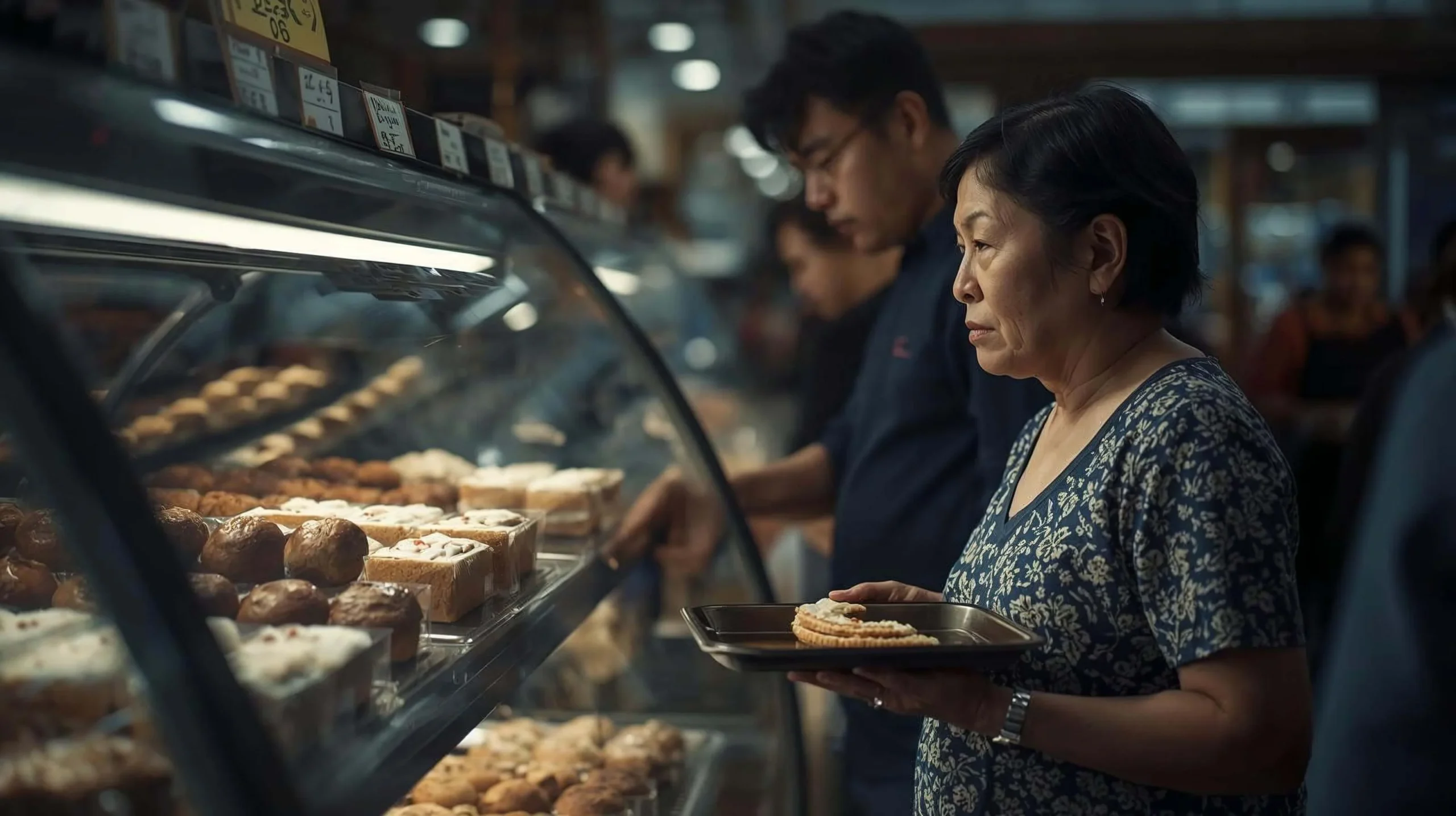
Watch the lady in the bread shop at Bedok Mall.
She is holding a tray. She picks up a sausage bun ($2.20). She looks at a cheese tart ($3.50). She hovers. Two years ago, right after the borders opened, she would have taken both. She would have treated herself. “Revenge spending,” we called it.
Today? She puts the tart back. She walks to the counter with just the bun.
It’s a micro-moment. It happens in less than a second. But if you stand there for ten minutes, you see it happen again and again. The hesitation. The mental math. The quiet decision that “I don’t really need this.”
Singapore hasn’t stopped spending. The malls are still full. But the *texture* of the spending has changed. It feels heavy. It feels careful. The era of “buy first, think later” has evaporated, replaced by a ruthless, defensive pragmatism.
The “Cai Fan” Economic Indicator
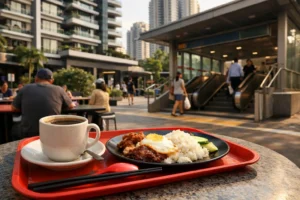
Forget the Consumer Price Index. If you want to know how Singapore feels, look at the economy rice (Cai Fan) queue.
I stood in line at a coffee shop in Toa Payoh. The behavior is different now. People are watching the server’s scoop like a hawk. They are asking prices before pointing. “Fish how much? $4? Okay, give me egg instead.”
The Monetary Authority of Singapore (MAS) releases reports about “core inflation easing.” They use charts with nice curves.
But the uncle in the queue doesn’t live in a chart. He lives in a world where adding a piece of otah feels like a financial risk. He isn’t reading the MAS report; he is reading the mood of the hawker auntie to see if she is going to give him a big scoop or a small scoop.
“Eat simple can already,” he mutters to his friend. “Save money for rainy day. Don’t know when the rain coming, but sky look dark.”
The End of the “Upgrade” Mentality
For a decade, the Singaporean dream was defined by the upgrade. Upgrade the phone. Upgrade the car. Upgrade the flat.
That momentum has stalled.
Talk to a Grab driver. They used to talk about changing cars. Now? They talk about extending the COE. Talk to a homeowner. They aren’t looking at condos; they are looking at renovation loans to just fix what they have.
We have entered the era of “Maintenance Mode.” We aren’t trying to climb the ladder right now; we are just trying not to fall off.
It feels like the whole country collectively decided to switch to “Low Power Mode” on their iPhone at the same time.
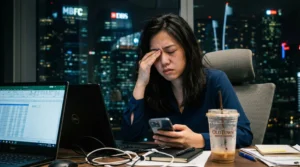
We are not just spending more carefully — we are also working more quietly, with fewer illusions about passion, performance, and upward mobility.
This same emotional shift is showing up at work, where many Singaporeans are quietly stepping away from performative hustle and the old
“wayang” version of office life
.
The “Loud Budgeting” Trend
The weirdest part? We are proud of it.
Being cheap used to be shameful (“sia suay”). Now, it’s a flex. It’s called “Loud Budgeting.”
I sat with a group of young executives at lunch. They weren’t comparing watches. They were comparing who got the cheapest deal on toilet paper. One guy bragged about bringing a packed lunch. “Save $8 a day, bro. That’s $40 a week.”
His colleagues didn’t laugh. They nodded with respect. In a high-cost environment, financial discipline is the new status symbol. The guy blowing money at the bar isn’t the cool one anymore; he’s the reckless one.
What This Means for Residents
This shift isn’t a recession. It’s a correction.
We are realizing that the post-pandemic party couldn’t last forever. The GST hike to 9% was the sobering bucket of cold water. It forced us to look at the receipt and ask: Is it worth it?
The Resilience of the Heartland:
The winners are the neighborhood shops. The $10 barber. The traditional bakery. The businesses that offer value without the “experience tax.” We are trading down, but we are trading closer to home.
Official Context
The government recognizes this cost-of-living pressure. The Assurance Package and regular GST Vouchers are designed to cushion the impact, but officials have also signaled that “prudence” is the new keyword for the fiscal year ahead.
A Small Scene That Says Everything
“I saw a young couple at IKEA yesterday. They were looking at a sofa. They sat on it. They loved it. Then the husband pulled out his phone, checked his banking app, and shook his head. They stood up and walked away. No argument. No drama. Just a silent agreement that ‘not yet.’ It was a small moment, but it showed more discipline than any finance minister could ever preach.”