
Why Singapore Shops Feel Busy — But Cash Drawers Feel Lighter

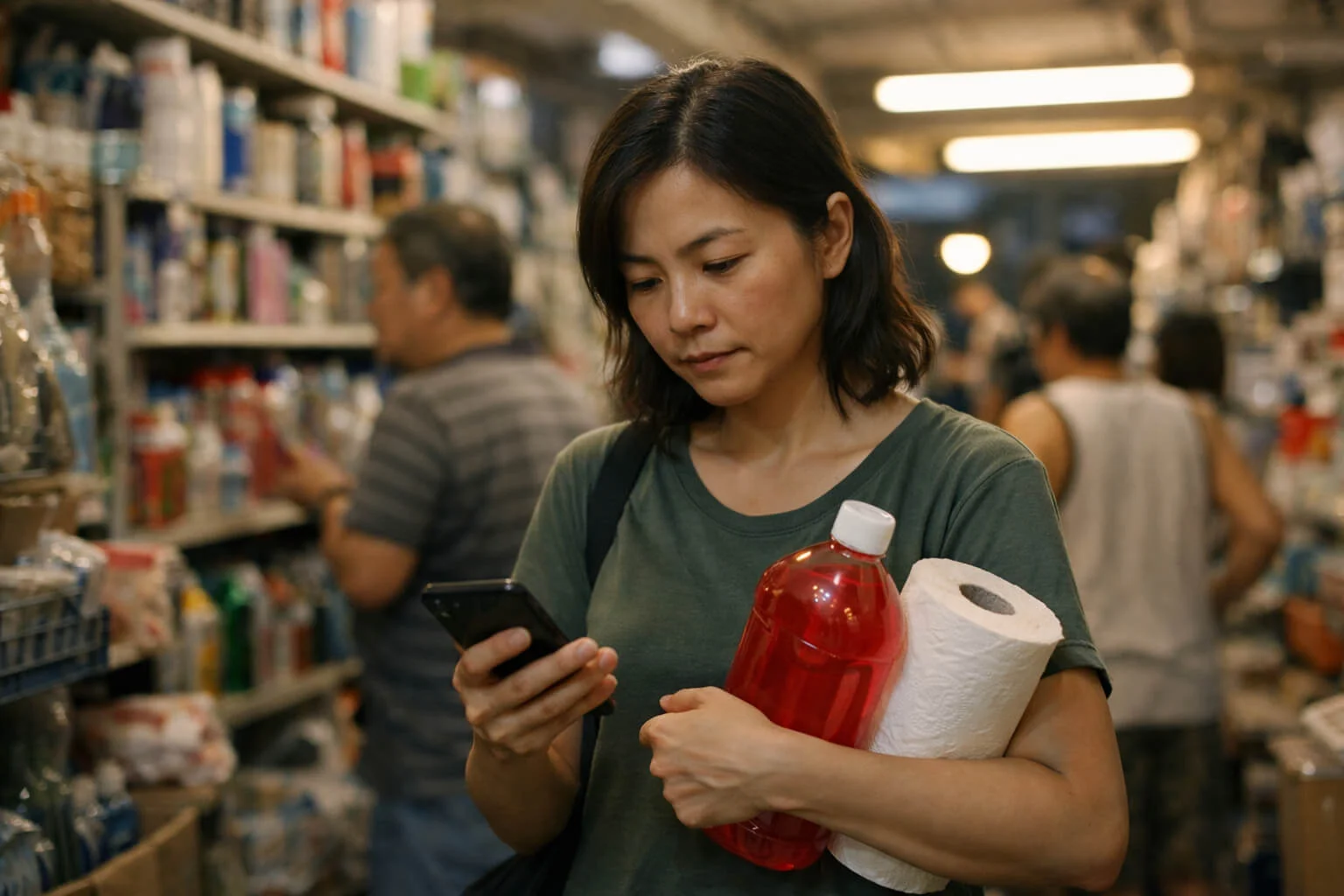

The footfall count says everything is fine. The cash register says something else. Inside the “tactical austerity” of the Singaporean consumer.
A Scene at the Counter That Shop Owners Recognise
Mr. Low manages a household goods shop in Toa Payoh Central. It is a Friday evening, and the shop is humming. There are couples looking at storage boxes, aunties squeezing sponges, and students looking at stationery.
But watch the counter.
A young couple approaches. They are holding a $35 frying pan and a set of $12 kitchen towels. They reach the cashier. The man pulls out his phone, taps a few times—checking a price on Shopee, perhaps—and whispers to the woman. She nods. They hand the towels to Mr. Low but gently push the frying pan aside.
“This one next time first,” the man says.
Mr. Low smiles and scans the towels. He knows “next time” means “never.” He knows they will buy it online later, or decide they don’t need it at all.
This is the defining scene of Singapore spending habits changing in 2026. It is not an emptiness; it is a hesitation. The crowds are still there. The desire to buy is still there. But the trigger finger has frozen. Small businesses Singapore heartlands host are the front line of this psychological shift, witnessing a consumer who is engaged, present, but incredibly guarded.
Related: If you’ve noticed the same “busy but earning less” paradox, here’s why it’s happening across the heartlands:why Singapore heartland shops earn less.
The “Same Crowd, Different Basket” Effect
If you look at the raw data of visitors, the economy looks robust. But if you look at the basket size shrinking Singapore retailers are reporting, the story changes.
Fewer Impulse Buys
Five years ago, the area around the cash register was a gold mine. Chocolate bars, batteries, wet wipes, chewing gum. You threw them in without thinking. It was the “might as well” tax.
Today, that zone is a dead zone.
We have become disciplined. We enter the shop with a mission: Buy the detergent. We execute the mission. We exit. The impulse buying Singapore relied on for margin has evaporated. We have trained ourselves to look straight ahead, blinders on, ignoring the little luxuries that used to make shopping fun.
More Comparing, More Pausing
Every purchase now comes with a pause. You see it in the supermarket aisles. A shopper picks up a bottle of shampoo. She doesn’t just put it in the basket. She weighs it. She reads the volume (ml). She checks the “Unit Price.” She puts it back and picks up the House Brand.
This isn’t poverty; it’s optimization. The Singapore cost of living daily impact has turned every grandmother and teenager into a forensic accountant. We aren’t spending less total money—our bills are high—but we are demanding maximum efficiency from every dollar that leaves our pocket.
For the bigger picture behind this “optimization,” see:why the cost of living feels higher in Singapore in 2026.
Where the Shift Shows Up First
The tremor is felt strongest in the places we visit every day.
Kopitiams and Hawker Centres
The “Set Meal” is under attack. In the past, you ordered the Toast Set: Eggs, Toast, Coffee. Cost: $4.50. Today, you see more people ordering “Toast only” ($1.80) or “Eggs only.”
And the drinks? As we’ve noted before, the rise of the personal water bottle is killing the profit margins of hawker and kopitiam prices. The uncle brewing the coffee is busy, but he is selling fewer cups per hour than he did when everyone bought a drink as a default social habit.
Neighbourhood Shops and Minimarts
The provision shop downstairs used to be the primary pantry. Now, it is the Emergency Room. We only go there when we run out of something urgently at 10 PM. The bulk buying happens on RedMart or during the FairPrice weekend specials. The neighbourhood shop gets the scraps—the single onion, the one packet of salt.
Online vs Offline Choices
We are treating physical shops as showrooms. We touch the fabric at the boutique in the mall. We check the size. Then we go home and order it from a platform that offers a $5 voucher. The physical shop bears the cost of the air-con and the staff; the digital platform reaps the sale.
Agencies like Enterprise Singapore are actively helping retailers digitize to capture this omnichannel spend, but for the traditional uncle-run shop, the gap is hard to bridge.
Why It’s Happening (Without Turning Into a Lecture)
Why are Singapore consumer behaviour patterns shifting so drastically?
Price Sensitivity in Small Decisions
It’s the “Cai Fan Math.” When the price of fish goes up by 50 cents, we don’t stop eating. We just switch to egg. We are hyper-sensitive to small price changes because those are the only ones we can control. We can’t control the rent or the COE, but we can control whether we add an egg.
Time Pressure and Convenience Spending
Conversely, we will spend money to save time. This is the contradiction. We scrimp on the shampoo, but we pay for the Grab if we are late. We skip the drink, but we pay for food delivery fees. Our spending has polarized: extreme thrift on goods, extreme willingness to pay for convenience.
The Quiet Psychology of ‘Not Today’
There is a mood of procrastination. “I’ll buy it when the 11.11 sale comes.” “I’ll buy it when I get my bonus.” “I’ll buy it when the CDC vouchers drop.” We are constantly deferring gratification, waiting for a better deal that may or may not exist.
Who Feels It Most
Small Business Owners
The neighbourhood businesses Singapore relies on are squeezed. They have to pay the supplier cash upfront, but the customers are holding back. “My stock doesn’t move,” says a hardware store owner. “Last time, one box of batteries gone in one week. Now, three weeks still there.”
Regular Customers
The customers feel it too. They miss the joy of carefree spending. There is a low-level fatigue that comes from constantly calculating. It is exhausting to always be “smart” with money.
Families and Caregivers
For families, the “pester power” of children is being managed. “No” is heard more often in the toy aisle. Parents are steering their kids away from the premium displays, sticking strictly to the list.
How Businesses Are Adjusting Quietly
The shops are fighting back, but quietly.
- Shrinkflation: The curry puff is slightly smaller. The Kopi cup has more ice.
- The “Value” Bundle: 3 for $5. Trying to force the basket size back up.
- Inventory Trimming: They stop stocking the slow-moving, expensive items. The shelf variety decreases. The shop becomes more utilitarian.
The Department of Statistics (DOS) reports show resilience in retail numbers, but the mix is undeniably changing towards essentials and food, leaving discretionary goods fighting for scraps.
What This Says About Singapore Right Now
This shift isn’t about being broke. Singapore is still wealthy. It’s about being *careful*.
We have moved from an era of “Expansion” spending—buying things to show we made it—to an era of “Maintenance” spending—buying things to keep us going. What heartland retailers are noticing lately is a population that is hunkering down, protecting its core, and waiting for the skies to clear.
Closing Scene:
Mr. Low turns off the sign at 9:30 PM. He counts the cash register. It’s not empty. It’s decent. But as he looks at the shelves of unsold frying pans, he sighs. “Tomorrow,” he says to himself. “Maybe tomorrow they will buy.”
This article reflects observed everyday spending behaviour in Singapore and is not based on a single retail report or one-off event.
Official Context
The government provides regular cost-of-living support through the CDC Vouchers Scheme and U-Save rebates. These inject liquidity into the heartland economy, often causing temporary spikes in spending during payout months.
🕰️ One Small Moment
“I stood behind a man at the bakery. He had a tray with a sausage bun and a cheese tart. He stood there for a full ten seconds, staring at the tart ($2.80). Then, he slowly picked up the tongs, put the tart back on the shelf, and walked to the counter with just the bun. He didn’t look broke. He looked disciplined. That gesture—the ‘put back’—is the most common physical movement in Singapore right now.”