Why the Same Shops in Singapore Keep Changing Owners


You walk past the same row of shops in your neighbourhood mall and notice something familiar: the sign has changed again. A new name, new paint, new products — the same unit that was a bubble tea shop last year is now a phone repair kiosk. Small shop ownership change Singapore is so common that many residents barely notice it anymore. Yet behind every quick handover is a story of high costs, tough competition and owners deciding it’s time to move on. This guide explains why ownership changes happen so often in Singapore’s retail scene and what it really means for both business owners and customers in 2026.
TL;DR – Why Ownership Changes So Often
- High fixed costs (rent, manpower, utilities) make it hard to stay profitable long-term.
- Many first-time owners underestimate the daily grind and sell within 2–3 years.
- Lease transfers and business takeovers are relatively easy and common in Singapore.
- Some owners treat the shop as a short-term investment rather than a lifelong business.
- Survival rate improves dramatically when owners have strong cash flow discipline.
If you live in Singapore, you’ve probably seen the same shop unit change names again and again. One year it’s a bubble tea stall, the next it becomes a phone repair shop or snack kiosk. This constant turnover isn’t random — it reveals how challenging the small retail business environment really is in Singapore.
The Real Reasons Ownership Changes Happen So Often
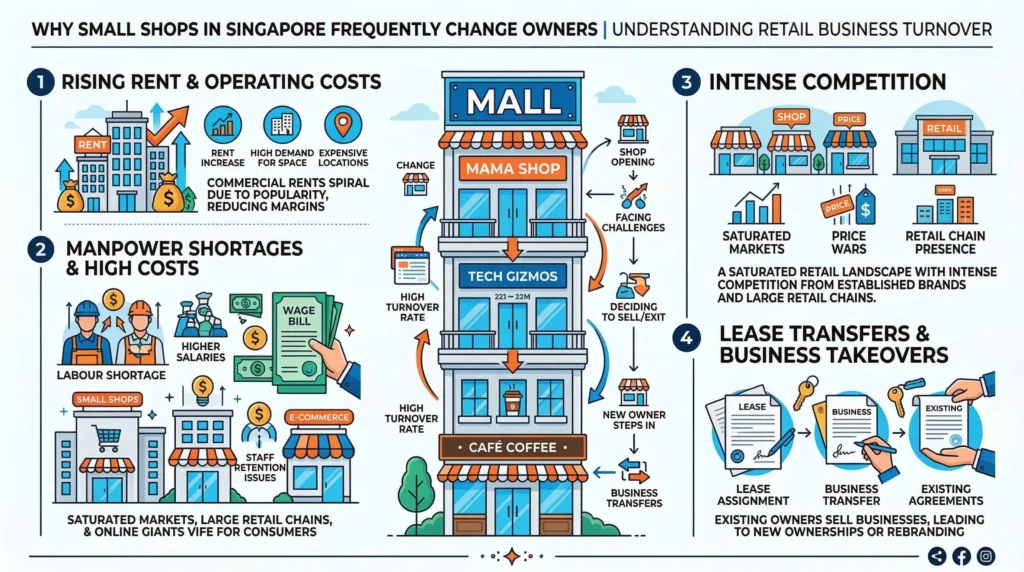
Running a small shop in Singapore is tough. Rent and manpower costs keep rising every year while customer spending habits shift quickly. Many first-time owners enter with high hopes but discover the daily reality of slim margins and constant pressure. After 2–3 years, they decide to sell the business rather than keep fighting.
If you’re feeling the same financial pressure in your own household while watching these shops change hands, our middle class financially stuck guide explains how the same cost increases affect both individuals and small businesses.
High Rent and Fixed Costs – The Biggest Driver
Commercial rents in malls and heartland shops can take 25–40% of revenue. When sales are inconsistent, the rent still has to be paid on the first of every month. Many owners reach a point where they calculate that selling the lease and goodwill is better than continuing to lose money month after month.
💡 Did You Know?
In Singapore, the average small retail business changes hands or closes within 3–5 years. Many owners sell while the business is still operating because transferring the lease and goodwill is easier and faster than shutting down completely.
Why shops change owners frequently Singapore?
Because fixed costs like rent and salaries rise faster than revenue for many small retail businesses, forcing owners to exit before losses become too big.
The Emotional and Practical Toll on Owners
Running a small shop is not just a business — it’s often a lifestyle. Long hours, weekend work, and constant worry about cash flow burn out many owners. Some sell because they want a more stable job or simply need a break. Others move on because a better opportunity appears elsewhere.
If you’re considering starting or buying a small business, our why SMEs fail Singapore guide shows the common pitfalls that lead to frequent ownership changes.
The Easy Transfer Process Makes It Common
Singapore makes it relatively straightforward to sell or take over a small shop. ACRA handles the company transfer, and landlords often allow lease assignment with some paperwork. This low-friction process means owners can exit quickly when things get tough, and new buyers can step in without starting from zero.
Mini Quiz: Why Does That Shop Keep Changing Owners? (Tap to reveal)
- The shop has had 3 different owners in 4 years:
Click for answer
Typical high-rent, low-margin retail cycle in Singapore.
- New owner every 18 months but the business model stays the same:
Click for answer
Owners are treating it as a short-term investment, not a long-term business.
- Shop looks the same but name and products change often:
Click for answer
Frequent takeovers — previous owners sell the lease and goodwill to the next person.
How shop ownership transfer works Singapore?
It usually involves selling the company shares or assets and assigning the lease. Many deals happen privately through agents or word-of-mouth within a few weeks.
The Role of Mall and Landlord Strategy
Malls prefer steady occupancy over long vacancies. Some landlords quietly encourage takeovers because a new owner often means fresh renovation and renewed energy in the space. This keeps the mall looking active even when individual shops change hands frequently.
If rising costs are also affecting your personal savings rate, our emergency savings guide and how much to retire in Singapore guide show how to build buffers while navigating these economic realities.
When Frequent Ownership Changes Signal a Deeper Problem
Sometimes the constant turnover points to a bad location, unrealistic rent or changing consumer habits in the area. Shops that change hands too often can create a negative perception for customers, making it harder for the next owner to succeed.
✅ What Smart Buyers Check Before Taking Over
- Review the last 12–24 months of actual revenue and expenses
- Ask about lease terms and renewal options
- Check the condition of equipment and renovation costs
- Talk to neighbouring shops about foot traffic trends
❌ Common Mistakes New Owners Make
- Buying based only on the location without checking numbers
- Taking over without negotiating better lease terms
- Assuming the previous owner’s customer base will stay
Real Stories from Singapore Shop Owners
“I bought a small gift shop that had changed owners three times in five years. After fixing the pricing and adding online sales, we finally stabilised in year two.” – Mei Ling, current owner
“I sold my café after 28 months because rent kept rising and customers weren’t coming back after COVID. The next owner lasted only 14 months.” – Raj, former F&B owner
Expert Insight – Business Broker (specialising in retail takeovers for 14 years)
“Frequent ownership changes are normal in Singapore retail. The market is competitive and costs are high. The owners who succeed long-term are the ones who treat the business like a marathon, not a sprint, and keep adapting.”
A Personal Note
I’ve watched the same row of shops change owners multiple times over the years. Some owners left richer, some left exhausted. The pattern is clear: the ones who treat ownership change as a strategic exit rather than a failure usually come out ahead. Singapore’s small business scene is tough, but it also rewards those who know when to hold on and when to let go.
Official Resources & Further Reading
- Enterprise Singapore – SME Support and Transition Resources
- ACRA – Business Transfer and Strike-Off Guidelines
Seen a shop change owners recently?
Tell us in the comments — what do you think was the real reason behind the change? Have you ever bought or sold a small shop? Your story helps other readers understand the reality behind the frequent handovers.
Small shop ownership change Singapore is a normal part of our retail ecosystem. High costs and intense competition mean many owners eventually decide to sell or move on. The businesses that last longer are the ones that adapt quickly, manage cash tightly and treat ownership as a journey rather than a lifetime commitment. If you’re thinking of buying or selling, do your homework — the numbers and lease terms matter more than the location alone.

Written by Kun Kerssa
Business & Economy Observer, SGVital
Kun has spent years analyzing Singapore’s SME landscape and retail trends. With on-the-ground experience walking the heartland malls from Jurong to Tampines, he breaks down complex economic shifts into stories that matter to everyday Singaporeans.