Why Your Usual Singapore Lunch Costs More Now


You order your usual Cai Fan or Kopi-O, and the total is higher than it was six months ago. It is easy to blame greed, but behind the counter, a complex survival game is being played. Here is why the “cheap lunch” is becoming a memory.
🇸🇬 Quick Summary: Why your $5 meal is now $6.50?
- Import Costs: 90% of our food is imported; global supply chain disruptions hit us first.
- The 2026 Reality: Continued adjustments in GST and carbon taxes impacting logistics.
- Manpower Crunch: Progressive Wage Model (PWM) means better pay for cleaners/servers, which is factored into prices.
The Lunch Shock: Same Order, Different Total
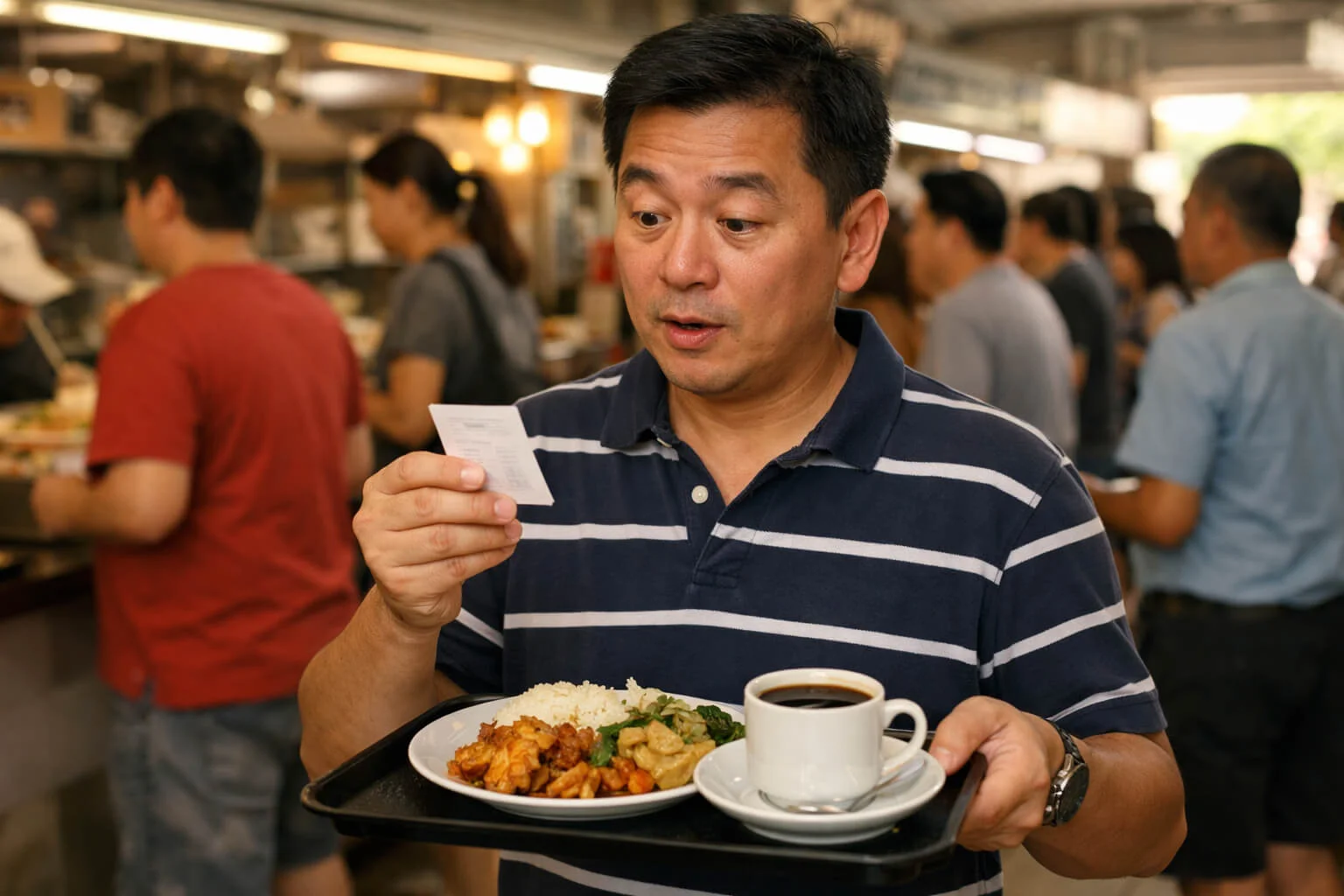
It is a typical Tuesday in a Jurong or Toa Payoh coffee shop. You stand in the familiar queue for your favorite minced meat noodles. You’ve been ordering the same “dry, no chili” bowl for years. You pull out your phone to PayNow, and you stop. The price has ticked up again.
This is the Singapore lunch prices explained moment happening across the island. Whether it is a heartland Kopitiam or a shiny CBD food court, that extra 50 cents or a dollar feels personal. Is it just “greed”? Or is there a deeper reason why food in Singapore is getting more expensive? To understand the receipt, we have to look at the three invisible monsters sitting at the table with you: Rent, Manpower, and Ingredients.
Stop Asking “Why So Expensive?” Ask “What Changed Behind the Counter?”
For an F&B owner in Singapore, price isn’t just a number they pick; it is a survival calculation. Most small hawker stalls operate on thin margins. When you pay $6 for a meal, that money is immediately split between the landlord, the supplier, the staff, the utilities, and finally, the owner’s take-home pay. When one of those slices grows, the total price must rise, or the stall closes. It is a fragile math of Singapore F&B costs rent manpower ingredients.
Rent: The Invisible Ingredient in Every Plate
Rent is the silent killer of the “affordable meal.” How rent affects hawker and coffeeshop prices is simple: location equals cost. A stall near an MRT station or in a high-traffic renovation project pays a premium for “foot traffic.”
In many modern food courts, the rental model isn’t just a flat monthly fee; it can involve a percentage of sales. When a stall owner faces a rent hike, they have three choices: raise prices, reduce portions (shrinkflation), or try to “upsell” you into a set meal with a drink and a side. This is why you see more “Value Sets”—it is an attempt to cover the rent by increasing the total bill per customer.
Manpower: The Queue vs Payroll Trade-Off
Have you noticed more QR codes and self-order kiosks lately? This isn’t just about “being tech-savvy.” It is a reaction to the manpower shortage F&B Singapore is grappling with.
Finding staff to work in a hot, 12-hour-shift environment is harder and more expensive than ever. Higher levies and the push for better wages mean the payroll is a massive overhead. If a stall can’t find staff, they simplify the menu to something a smaller team can handle, or they invest in automation. Ultimately, the cost of that labor is baked into your $1.80 Kopi.
If you want to understand the wage pressure behind these price moves, see our Singapore Salary Guide 2026 for what pay expectations look like across roles and sectors.
Ingredients: Small Changes You Taste but Can’t Name
Why cai fan is more expensive lately Singapore residents often ask? Look at the supply chain. Most of our food is imported. Fluctuations in global oil prices, climate change affecting crop yields in neighboring countries, and logistics costs all trickle down to the hawker’s procurement list.
Typical Cai Fan Price Hike (Estimated Breakdown)
| Item | 2024 Price | 2026 Price (Current) |
|---|---|---|
| 1 Meat + 2 Veg (Heartlands) | $3.80 – $4.50 | $4.80 – $5.50 |
| 1 Meat + 2 Veg (CBD Area) | $5.50 – $7.00 | $7.50 – $9.00 |
| Premium Fish Add-on | +$2.50 | +$3.50 – $5.00 |
🧐 Are you a “Smart Eater” or just “Rich”?
Quick Check: Do you know how much a Cai Fan price should increase if you add fish?
Option A: It should be a flat $2.00 extra.
❌ Wrong! Fish is seasonal and depends on the grade (Batang vs. Pomfret). Flat pricing is rare now.
Option B: It depends on the stall’s rent and daily market price.
✅ Correct! Most stalls in 2026 use a “Market Price” logic for premium proteins to stay afloat.
(Click the options above to see the answer!)
*Prices vary by stall location and specific ingredient choices.
Sometimes, to keep the price stable, a stall might change the “grade” of the oil or the type of protein used. You might notice the “same dish” tastes slightly different—this is often a quiet adjustment to survive a spike in ingredient costs Singapore stall owners face.
Platforms: Why Delivery Feels Like a Different Universe
Why food delivery prices are higher than in-store? It is the delivery platform commission Singapore factor. Platforms can take up to 30% or more from the merchant. To protect their margins, most shops raise their “app prices” to cover the commission. When you add the delivery fee and the “small order fee,” you are often paying 50% more for the same chicken rice. This is why “Self Pick-up” and “Dine-in” are making a massive comeback for the budget-conscious.
Shrinkflation & Menu Psychology (The Quiet Tricks)
Why portions feel smaller but price is higher? This is “Shrinkflation.” Instead of raising the price to $7 (which scares customers away), an owner might keep it at $6 but reduce the protein portion by 15%.
Another trick is the “Add-on” culture. The base bowl looks cheap, but once you add an egg, a slice of cheese, or upgrade to a larger size, the price balloons. It is a way to make the menu look “affordable” at first glance while actually pushing the average spend higher.
SGVital Insider Lobang: How to find $3.50 meals?
Did you know? Under the BudgetMealGoWhere initiative, many HDB coffee shop stalls are required to provide at least one budget meal option (usually priced between $3.00 to $3.50).
How to Spend Smarter Without Becoming Miserable
You don’t have to stop eating out. You just need a selection logic:
* **The “Kopi” Factor:** Drinking water or bringing your own bottle can save you $40–$60 a month.
* **The Timing:** Some places offer “off-peak” discounts.
* **The Set vs. Ala Carte:** Calculate if the “Value Set” actually has value. If you don’t want the drink, you are overpaying for the food.
If your budget still feels tight even after smarter choices, many Singaporeans try to bridge the gap with extra income. Here’s a practical, legal breakdown in our Singapore Side Hustle Guide (Legal & Practical).
A personal note: I remember my favorite Kopitiam uncle in Toa Payoh telling me, “Boy, if I don’t increase 20 cents, I cannot pay the auntie who clears the plates.” It changed how I saw that price hike. It wasn’t about him getting rich; it was about the whole ecosystem staying alive. Sometimes, that extra 50 cents is the price we pay for having a vibrant hawker culture tomorrow.
Quick Checklist (Save This)
✅ Do This
- Opt for “Dine-in” or “Self-collection” to avoid high app markups.
- Check if the “Set Meal” actually saves you money compared to ala carte.
- Look for “Budget Meal” signs in HDB coffee shops (government initiatives).
- Bring your own water bottle to save on high drink prices.
- Support hawkers who are transparent about their pricing.
- Use CDC Vouchers for heartland meals to offset costs.
- Try “off-peak” dining if the stall offers lower prices then.
- Use cashback cards or apps like ShopBack/Trust for F&B rewards.
- Order “less rice/noodles” if you know the portion is too big (reduce waste).
- Understand that GST impact food prices Singapore affects the whole chain.
❌ Avoid This
- Do not blame the stall owner personally for general inflation.
- Do not order delivery for single, small items (the fees are highest there).
- Do not ignore the “Unit Price” when buying sides in a Cai Fan stall.
- Do not assume all air-conditioned food courts have the same price as HDB stalls.
- Do not get tricked by “Limited Time” upsells you didn’t actually want.
- Do not forget to check for digital payment discounts (PayLah/GrabPay promos).
- Do not leave food waste—it’s a hidden cost for everyone.
- Do not assume “Expensive” always means “Better Quality.”
- Do not disregard “House Brand” drinks if available.
- Do not get discouraged; smart choices can still keep lunch under $6.
The Bottom Line
Lunch in Singapore isn’t getting pricier because of a single factor. It’s a layered cost increase involving global supply chains, higher local wages (PWM), and rental structures. While we can’t change the prices, we can change our habits—opting for HDB coffee shops over mall food courts and using digital apps to track discounts can save a typical office worker over $100 a month.
Official Context & Resources
For more information on the Singapore F&B landscape and cost of living initiatives, refer to the Ministry of Trade and Industry (MTI) or the National Environment Agency (NEA) regarding hawker center management. You can also check for cost-saving vouchers and schemes on the CDC Vouchers portal.
Editorial Note
This piece explains everyday price increases in plain language, focusing on the real cost stack behind a “simple lunch” in Singapore—rent, manpower, and ingredients. It’s not a defense of bad value, but a clearer way to read what’s changed behind the counter so you can make smarter choices without resentment.
Don’t let your wallet “Leaking”! 💸
Where is the cheapest $4.00 Chicken Rice left in Singapore? Is it still in your neighborhood?
Help your fellow Singaporeans:
Found this helpful? Share this with your office group chat so they don’t overpay for lunch tomorrow!