How to Chope Seats in Singapore (Hawker Etiquette Guide)


It looks chaotic. It sounds chaotic. But beneath the clatter of plates and the shouting of order numbers, there is a strict, invisible system running the show. If you don’t know it, you will feel it.
The Hawker Centre Scene Everyone Recognises
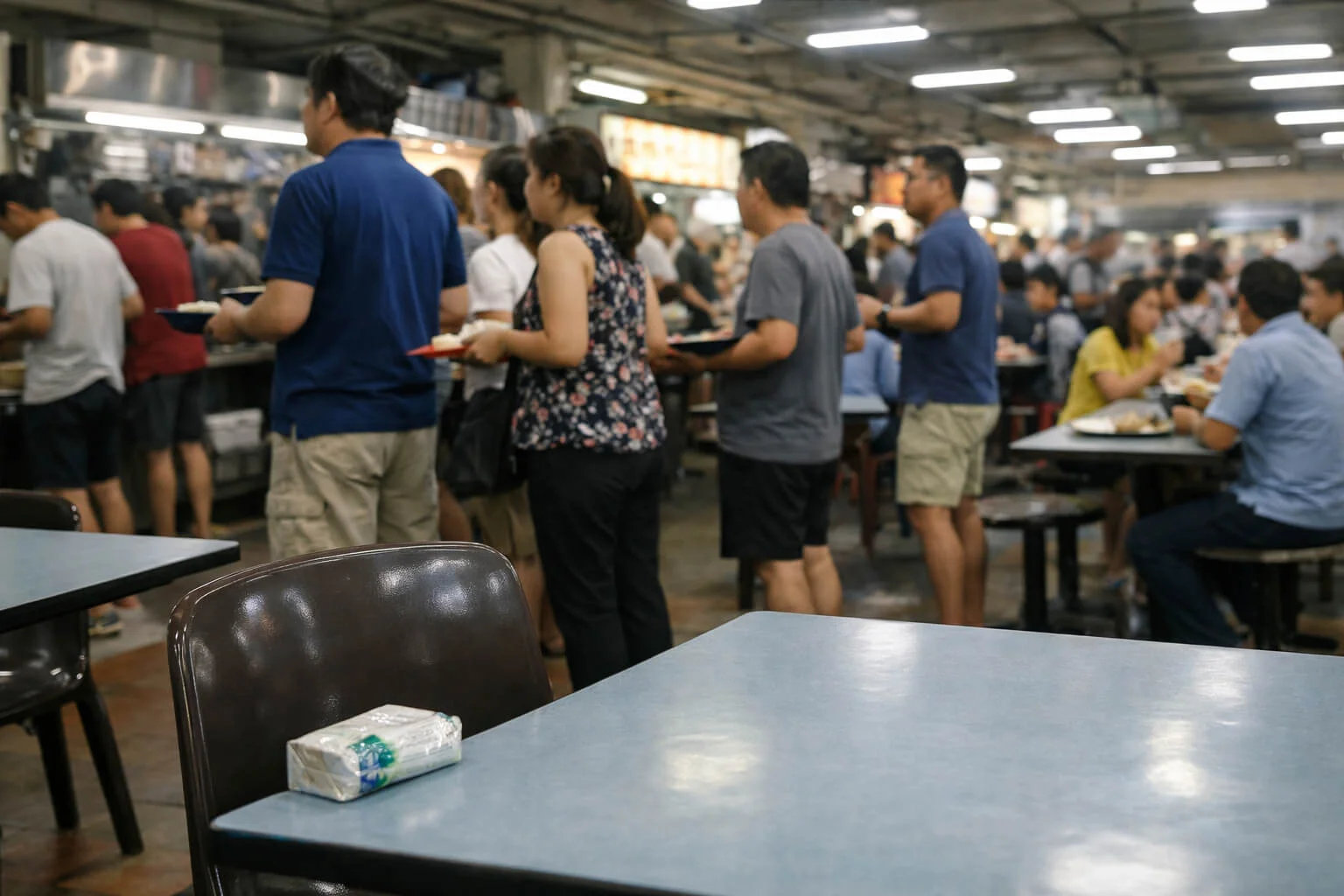
Walk into a place like Maxwell Food Centre at 12:30 PM. The air is thick with the smell of wok hei, chicken rice, and boiling laksa broth. The sound is a wall of noise: spatulas hitting metal woks, aunties shouting order numbers, and plastic plates slapping onto laminate tables.
But stop and look at the crowd.
Three people are standing near the entrance, scanning. They aren’t looking at the food stalls. They are looking at the tables. A woman spots an empty chair. She takes a step towards it, then stops. On the seat of the chair lies a small packet of tissue paper. She hesitates. She looks around. She moves on. The tissue has claimed that seat. She knows the rules.
Peak-hour hawker centres run on unspoken rules — learn them here: Hawker centre etiquette (chope, queues, tray return).
(This is part of a wider “micro-stress” pattern Singaporeans are feeling in daily routines — read the full breakdown here.)
Hawker centre etiquette Singapore isn’t written on a sign at the entrance. It is a social contract forged over decades of crowded lunches. It operates on a rhythm that everyone follows, and if you break that rhythm, the reaction isn’t usually a shout—it’s a pointed stare or an awkward silence.
Hawker centres aren’t chaotic. They just operate on a system that nobody wrote down. And if you don’t know the system, you’ll be the one standing with a tray of hot soup, spinning in circles, wondering why nobody is moving.
Lunch Rush, Empty Seats, Full Tables
Timing is everything. Between 12:00 PM and 12:15 PM, the mood is relatively relaxed. You can find a table. You can browse.
But from 12:30 PM to 1:00 PM, it is a battlefield. Every square inch of seating is contested property.
At 12:35 PM, a man finishes his chicken rice in eight minutes flat. He doesn’t linger. He wipes his mouth, stands up, picks up his tray, and heads to the return station. Behind him, two office workers are already hovering. The moment his tray lifts off the table, they sit. No words exchanged. Just perfect timing.
This is the game. Everyone is watching everyone else’s plate, calculating how many bites are left.
If the stares feel sharper lately, it’s not just in hawker centres — here’s why daily life feels more tense in Singapore.
Why Etiquette Matters More Than “Rules”
Why does hawker centre queue etiquette matter? Because the hawker centre is a high-speed ecosystem. Everyone is hungry. Everyone has limited time. If you move slowly, or block the flow, or leave a dirty table, you jam the gears of the machine.
It’s not just about being polite. It’s about being in sync. If one person slows down, everyone feels it.
What “Chope” Really Means (And How Locals Do It)
If you are new to Singapore, the word “Chope” is essential vocabulary. Derived from Hokkien slang meaning to stamp or seal, in the hawker context, it means to reserve a seat.
Tissue Packets, Umbrellas, Name Cards — The Unspoken System
How to chope seats in Singapore is an art form. The tools of the trade vary:
- Tissue Packet: The gold standard. Cheap, disposable, universally recognized. 90% of choping is done this way.
- Umbrella: Common on rainy days or for outdoor seats.
- Name Card / Lanyard: The risky “CBD flex.” Office workers use these, signaling trust in the safety of Singapore.
- Water Bottle: Effective, hard to miss.
The Protocol:
Find an empty table. Place the item clearly in the center of the seat or table (not the edge). If you are a group of four, you need four markers. Once the marker is down, the seat is yours. You can now join the queue for food without anxiety.
When is Choping Rude?
– Too Early: Putting a tissue down at 11:30 AM for a 12:30 PM lunch is frowned upon.
– Too Much Space: Two people choping a six-person table during peak hour is selfish.
– The “Ghost Chope”: Leaving a tissue and disappearing for 45 minutes.
“Uncle put tissue on table at 11:45. Went to order. Came back 12:10. By that time, lunch crowd angry already. Someone moved his tissue to the side and sat. Uncle complain small small, but didn’t fight. He know he chope too early.”
When Chope Backfires
Occasionally, systems clash. You might place a tissue just as someone else places an umbrella from the other side. Who wins?
Usually, the person who physically arrived first claims it. The other person apologizes and moves on. It rarely escalates. The social pressure to be reasonable keeps the peace.
Queueing — The Real Social Contract
The One Thing That Annoys Everyone
There is one cardinal sin in Singapore hawker centre rules: cutting the queue.
It happens subtly. Someone tries to slide in from the side, pretending to look at the menu. Or they join a friend who is already at the front (“Eh, help me order one more”).
The reaction is swift. “Eh, got queue leh,” someone will say. It’s a polite phrase, but the tone is sharp. Or, you get the silent treatment: ten pairs of eyes burning into the back of your head until you retreat.
At a popular chicken rice stall, the queue was six people deep. A man walked up from the side, trying to squeeze in. The auntie at the front turned. She didn’t say anything. Just looked. The man stopped. “Oh sorry,” he muttered, and walked to the back. The queue restored itself.
Stalls That Look Like Chaos (But Aren’t)
Sometimes, there is no visible line. A crowd just hovers around the stall front. This is common at drink stalls or smaller dessert places.
Don’t panic. The hawker knows who came first. They have a mental list. When the hawker looks at you and nods, that’s your turn. Don’t shout your order before that nod.
“The queue isn’t always a line. Sometimes it’s a cloud of people. But the hawker knows the order. Trust the system.”
Ordering Like a Local (Without Pretending)
The Fast Order Pattern
Hawkers are busy. They appreciate brevity. The typical interaction lasts 15 seconds.
Hawker: “Yes?”
You: “One chicken rice.”
Hawker: “Makan here or dabao?” (Eat here or takeaway?)
You: “Makan here.”
Hawker: “Drink?”
You: “Teh-O.”
Hawker: “Four dollar fifty.”
Why so fast? Because ten people are behind you. If you hem and haw (“Um, what do you recommend?”), you break the flow.
Common Ordering Mistakes
1. Wrong Queue: At economic rice stalls, you order the food first, move down the line, and pay at the end. Don’t try to pay the person scooping the rice.
2. Cash Fumble: Don’t wait until the total is announced to start digging for your wallet. Have cash or your payment app ready.
3. Customization Overload: “Can make less oily? No MSG? More sauce but not too salty?” Some hawkers accommodate; many will just say “Cannot, standard only.” Respect the “Standard.”
Paying, Returning Trays, and the Post-Meal Routine
Cash vs Cashless — What Actually Happens
While most modern centres accept SGQR (PayNow/GrabPay), cash is still king at older stalls. Always carry at least $20 in small notes.
“Tourist try to pay with Amex. Hawker shake head. ‘Cash only.’ Tourist blur. Queue behind getting restless. Someone behind offer to pay first, tourist pay back later. That’s the vibe.”
Tray Return Etiquette Without Making It a Lecture
Do you have to return trays at hawker centres in Singapore? Yes. It is technically mandatory now, enforced by the National Environment Agency (NEA).
But beyond the law, it’s about consideration. Leaving dirty plates means the next person can’t sit. Or birds might swoop in. The “Tray Return Station” is usually highly visible (green or blue racks). Stack your plates, separate the halal/non-halal if indicated, and bin your trash.
Returning your tray isn’t just following the law. It’s signaling that you are part of the community.
Table Sharing and Seat Politics
When It’s Normal to Share a Table
Table sharing Singapore hawker centre culture is unique. During peak hours, holding a 4-person table for yourself is seen as selfish.
If you see two empty seats at an occupied table, approach and ask: “Can share?” Most locals will nod, shift their bags, and make space. It’s a silent agreement: We share the space, but we ignore each other while eating.
When Sharing Becomes Uncomfortable
The “Bag Spreader”: Someone putting their bag on one chair, jacket on another, phone on a third. Don’t be this person.
The “Camper”: Sitting for 45 minutes after finishing food, watching Netflix while others hover for a seat. The rule is: Eat and go. This isn’t Starbucks.
Peak Hour Survival Guide
The 3 Timing Windows That Feel Different
- Morning (7am-9am): Relaxed. Uncles reading papers. Easy to find seats.
- Lunch (12pm-1:30pm): High intensity. War zone for seats. Eat fast.
- Evening (6pm-8pm): Social. Families. More noise, but less rush than lunch.
How People “Hack” the Crowd (Quietly)
Smart diners split up. One chops the table; the other queues for food. Or they go for the “second best” stall—the one with a queue of 3 people instead of 20, knowing the food is 90% as good but the wait is 90% shorter.
A Simple Checklist Before You Go
✅ Do This
- Chope with tissue: Use cheap items, not valuables.
- Check before sitting: Look for tissue/umbrella markers.
- Order fast: Know what you want before reaching the front.
- Return tray: Clear your table for the next person.
- Ask to share: “Can share?” is the magic phrase.
- Bring cash: Cash is still the fastest way to pay.
❌ Avoid This
- Ghost Chope: Don’t reserve 30 mins early.
- Cut Queue: Never join from the side.
- Hog Table: Don’t sit for 1 hour after eating during peak time.
- Leave Mess: Don’t leave bones/tissues on the table.
Editorial note: This article describes commonly observed hawker-centre norms and etiquette in Singapore. Practices can vary slightly by venue, crowd level, and time of day.
Closing Scene:
The hawker centre hums on. People arrive. People leave. Tissue packets mark territories. Queues form and dissolve. And somewhere in the middle of it all, everyone knows their part. Not because someone taught them. Just because they’ve been here before.