
Always Sneezing in Singapore? Aircon, Dust, Haze Fixes

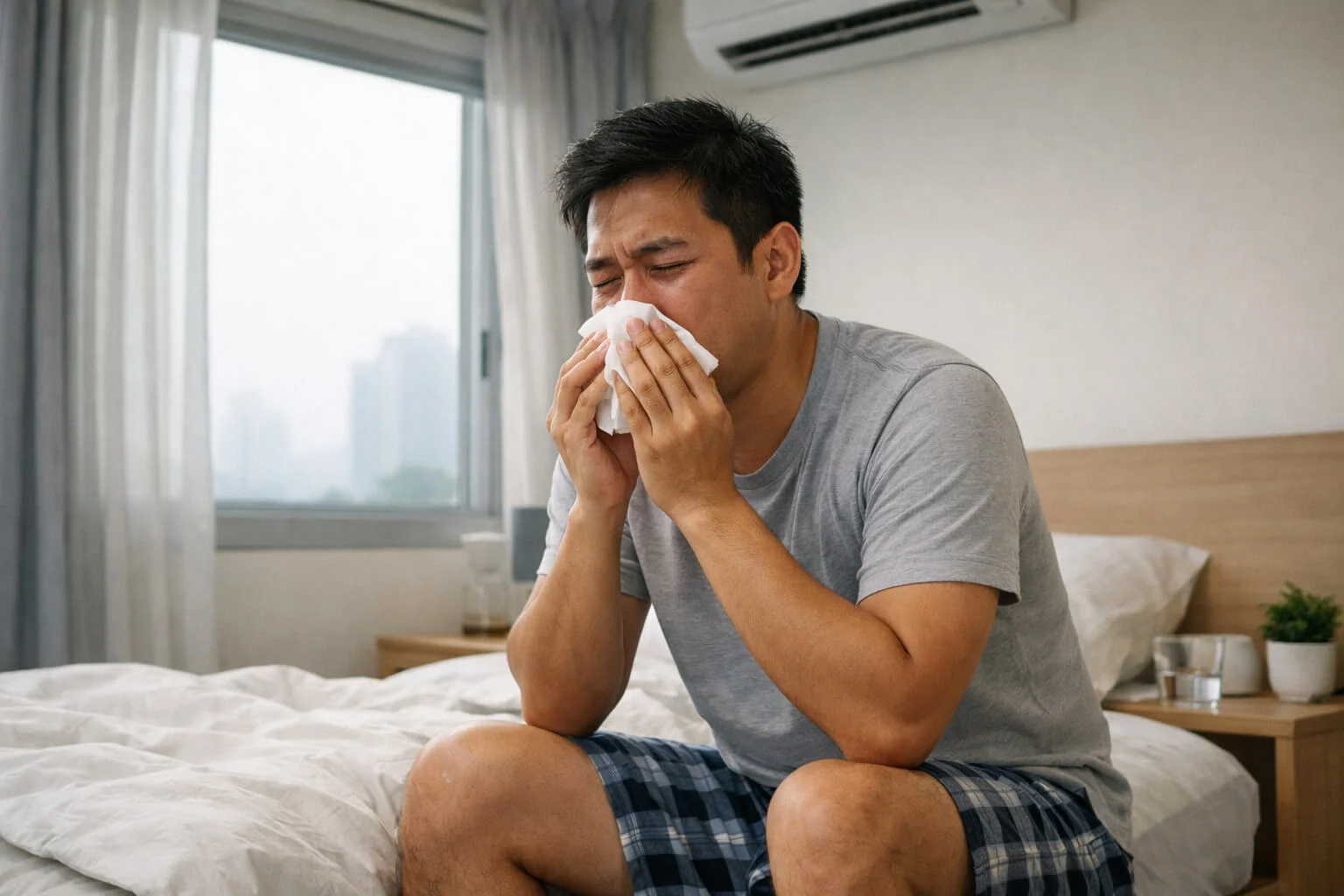

It’s a national sound: the morning sneeze. For many of us, the day doesn’t start with a coffee; it starts with a five-minute battle with a tissue box. If you feel like your nose is a permanent weather station, here is why Singapore triggers your sinuses—and how to fix your environment.
TL;DR: Sneeze-Free in 30 Seconds
- The Culprit: High humidity (dust mites) + Dry Aircon (irritation) + PM2.5 haze.
- Top Fix: Wash bedsheets at 60°C (cold water won’t kill mites).
- Aircon Hack: Set to 25°C + Fan. Avoid direct airflow to the face.
- Must-Have: A saline nasal spray and a HEPA air purifier.
The Singapore Morning: You Wake Up Fine… Then the Sneezing Starts
It’s 7:15 AM. You open your eyes. You feel great for exactly ten seconds. Then you sit up, swing your legs off the bed, and your nose starts to itch. One sneeze. Then three. Then five. By the time you reach the bathroom, you’re already half-way through a packet of tissues.
This is the sneezing every morning Singapore ritual.
We often joke that we are “allergic to Singapore,” but the reality is more specific. We live in a world of extreme contrasts. We move from 32°C humidity into 20°C dry aircon offices. We sleep on mattresses that absorb humidity like sponges. This constant oscillation makes sinus congestion Singapore residents face a daily struggle rather than a seasonal one.
Allergy, Cold, or “Aircon Nose”? (No Diagnosis, Just Clues)
You’re at your desk, sniffing every thirty seconds. Your colleague asks, “Are you sick?” You honestly don’t know.
Allergy vs cold how to tell? While only a doctor can diagnose you, there are patterns. A cold usually comes with a sore throat, a thick yellow/green discharge, and maybe a low-grade fever. An allergy? It’s almost always a clear, watery runny nose, itchy eyes, and no fever. If you’ve been “sick” for three weeks but feel fine otherwise, it’s probably not a virus. It’s your environment.
Then there is “Vasomotor Rhinitis”—or what we call aircon allergy Singapore. This isn’t necessarily an allergy to dust; it’s your nose overreacting to the sudden drop in temperature and humidity when you enter the office. Your nose tries to protect itself by swelling up and producing mucus. Result? A blocked nose aircon office nightmare.
Uniquely Singaporean Sinus Triggers
Sometimes it’s not the air; it’s the lifestyle. Here are three things we do in SG that might be making your sneezing worse:
1. The “Cold Water” Bath
Many of us love a cold shower to beat the heat. However, a sudden temperature shock can trigger Vasomotor Rhinitis. Try lukewarm water if you’re already feeling “sniffly.”
2. Indoor Drying
HDB flats are compact. Drying laundry in the living room spikes humidity levels to 85%, creating a paradise for dust mites. Use a dehumidifier if you must dry indoors.
3. Late Night Supper
Spicy Laksa or hot soup before bed? The steam clears you up temporarily, but the spicy “rebound” can cause a blocked nose while you sleep.
The Big Triggers in Singapore Life
1. Aircon Offices: The air is dry, the filters are often overdue for a wash, and the air is just recirculated. This is why I keep sneezing in aircon office Singapore buildings.
2. Bedroom Dust: Our humidity makes dust “heavy” and sticky. Dust allergy bedroom Singapore issues are common because dust mites love the 80% humidity inside our pillows and mattresses.
3. The Haze: When it hits, the PM2.5 particles are small enough to enter your bloodstream, but they stop in your sinuses first, causing haze symptoms sneezing and heavy congestion.
🇸🇬 The “HDB Corridor” Factor
Living near the common corridor or a busy road? In Singapore, our windows are often kept open for ventilation, but this invites construction dust and exhaust soot. If your window mesh looks black, that’s exactly what your nose is fighting every morning.
Chemical Wash or Just Filter Clean?
Many of us wait until the aircon is leaking before calling the technician. But for sinus sufferers, mould buildup inside the fancoil is a hidden trigger.
In our 90% humidity, a dirty aircon isn’t just “not cold”—it’s a spore distributor. A 3-month regular service is the “gold standard” for most SG households to keep the sneezing at bay.
The “Steamboat” Effect & Your Nose
Notice your nose starts running at a hot hawker centre or while having Haidilao? This is Gustatory Rhinitis. The contrast between the spicy/hot steam and the cold mall aircon “confuses” your nerves.
Quick Fix: Carry a small bottle of menthol-free saline spray. It calms the nasal lining without the “rebound effect” of medicated sprays you find at Watsons or Guardian.
The “Kiasu” Cleaner’s Guide to a Sneeze-Free Room
If you want to be extra sure (very Singaporean, we know), follow these 3 steps:
- Vacuum with HEPA: Standard vacuums without HEPA filters just blow the fine dust back out the exhaust.
- No more ‘Damp’ Laundry: Drying clothes inside a closed HDB room increases humidity to 90%, which is a party for dust mites. Use a dryer or a well-ventilated balcony.
- The 25°C Rule: Try setting your aircon to 25°C with a fan. It’s less drying for your nasal membranes than a 21°C blast.
Bedroom Fixes That Actually Help (Small Steps)
If you want to know how to reduce morning sneezing in Singapore home environments, start where you spend 8 hours of your life: your bed.
Laundry and Linen Routine
Wash your bedsheets once a week in hot water (at least 60°C). Cold water doesn’t kill dust mites; it just gives them a bath.
Pillow and Mattress Habits
If your pillow is three years old, it’s basically a colony. Use anti-dust mite covers. These have a weave so tight that mites can’t get through. It’s one of the few simple habits to reduce sinus congestion day to day that actually shows results within a week.
The “MRT Escape” Strategy
Ever notice how you’re fine on the platform, but the moment you step into the North-South Line, your nose goes into overdrive?
The thermal shock (moving from 32°C to 22°C in seconds) is a major trigger for non-allergic rhinitis in Singapore.
- The Scarf Hack: Keep a light “office scarf” in your bag. Covering your neck and chest during your commute can stop the cold air from triggering your sneeze reflex.
- Breathe through your mouth? Try not to. Use a mask on the bus to warm the air before it hits your lungs.
The “Sinus Survival” Shopping List
Heading to Watsons, Guardian, or Unity? Look for these specific items that help SG residents manage daily congestion:
| Category | What to Look For |
|---|---|
| Nasal Wash | Sterimar or Flo. Great for washing out haze particles after a day out. |
| Dehumidifiers | The classic Thirsty Hippo for your wardrobe to prevent mould on clothes. |
| Dust Mite Spray | Look for eucalyptus-based sprays for your sofa and curtains. |
The Fabric Traps
Curtains, rugs, and soft toys. If you can, swap fabric curtains for blinds that can be wiped. If you have a collection of plushies on your bed, you are sleeping in a dust farm. Move them to a glass cabinet.
Office & Commute Habits (Realistic, Not Perfect)
You can’t control the central aircon, but you can control your space.
Seat Positioning: If the vent is blowing directly on your face, you will get a sinus headache causes Singapore type of pain. Use a deflector or move your desk.
Hydration: Dry aircon air dries out your nasal membranes, making them crack and get irritated. Sip water constantly.
Masking Up: During haze weeks, a standard surgical mask helps with big dust, but only an N95 stops the fine particles.
Is it the Haze or the Humidity?
In Singapore, our symptoms change depending on the season. Here is how to differentiate:
| Symptom | Humidity (Dust Mites) | Haze (PM2.5) |
|---|---|---|
| Peak Time | Worse in the morning (in bed). | Worse when outdoors or windows open. |
| Eye Feeling | Itchy and watery. | Gritty and stinging (“sand” feeling). |
| Throat | Post-nasal drip (itchy). | Dry, scratchy, and painful. |
The “1-Week Reset” Routine
Try this for 7 days to see if your symptoms drop:
* Day 1-2: Sun your pillows and wash all bedding in hot water.
* Day 3-4: Vacuum the corners of your wardrobe. Use a damp cloth so you don’t just kick the dust into the air.
* Day 5-7: Track your triggers. Do you sneeze more after lunch? It might be the sudden temperature change from the hawker centre back to the office.
The solution often depends on whether your problem is the air’s *purity* or its *dryness*.
| Device Type | What It Does | Best For |
|---|---|---|
| Air Purifier | Filters out dust, dander, and haze. | Dust allergies and haze seasons. |
| Dehumidifier | Sucks moisture out of the air. | Stopping mold and dust mite growth. |
| Nasal Spray (Saline) | Flushes out allergens and hydrates. | Aircon nose and post-nasal drip. |
When It Might Be More Than “Just Allergy” (Red Flags)
If your sinus congestion Singapore experience includes severe facial pain, yellow/green discharge for more than 10 days, or a high fever, it might be a bacterial sinus infection. When to see a doctor for sinus problems Singapore? If you have trouble breathing, facial swelling, or if the “allergy” is affecting your sleep and work performance, get a professional opinion from a GP or an ENT specialist.
Quick Checklist (Save This)
✅ Do This
- Wash bedsheets in 60°C water weekly.
- Use anti-dust mite covers for pillows and mattresses.
- Use a saline nasal spray/rinse to clear out allergens after a day out.
- Keep a jacket or scarf in the office to stay warm and reduce “aircon nose.”
- Wipe down surfaces with a damp cloth instead of dry dusting.
- Open your bedroom windows for 15 mins daily to cycle the air.
- Check aircon filters monthly and wash them if they look grey.
- Sip warm water to soothe post nasal drip Singapore throat irritation.
- Shower before bed to avoid bringing outdoor dust onto your pillow.
- Use an air purifier during the haze season.
❌ Avoid This
- Do not ignore mold spots on the ceiling (major allergy trigger).
- Do not keep plush toys or heavy rugs in the bedroom.
- Do not sit directly under the aircon vent at work.
- Do not use strong scented candles or diffusers if you are congested.
- Do not sleep with the aircon set below 23°C (too dry for the nose).
- Do not rub your eyes when they itch (spreads allergens).
- Do not dry laundry in a closed room without ventilation.
- Do not assume it’s “just a cold” if it lasts for months.
- Do not over-use decongestant nasal sprays (ask a pharmacist first).
- Do not skip your morning water—hydration starts inside.
Official Context & Safety Disclaimer
This guide is for general informational purposes and everyday environmental management. It is not medical advice. For persistent or severe respiratory issues, consult a medical professional via the HealthHub directory. For haze updates, refer to the NEA Haze microsite. General health resources are available at the Ministry of Health (MOH) website.
🕰️ One Small Moment
“I lived with a blocked nose for three years. I thought it was just the Singapore air. Then I moved houses and realized my old bedroom had a thick fabric headboard that I’d never cleaned. I switched to a simple wooden bed frame and started using an air purifier. Two days later, I woke up and I could… breathe. Through my nose. It wasn’t a miracle; I just stopped sleeping in a dust trap.”
Editorial Note
In Singapore, “always sneezing” is often not a cold — it’s the environment: cold dry aircon, humidity-driven dust mites in bedding, and haze particles during bad weeks. This guide focuses on practical home and office fixes that reduce triggers day to day. If symptoms persist, worsen, or affect sleep and breathing, see a GP/ENT for proper assessment.