
Always Tired in Singapore? Heat, Work, Sleep Debt Fixes


It’s a national epidemic hidden behind cups of Kopi-O. We are highly productive, incredibly busy, and perpetually exhausted. Here is the breakdown of why you feel drained—and the micro-habits that actually help you recharge.
TL;DR: Why You’re Tired & The Quick Fix
- The ‘Singapore Tax’: 80% humidity forces your body to work 20% harder just to stay cool.
- Fake Energy: Your 3 PM Kopi-C is masking adenosine, leading to a massive 7 PM crash.
- Sleep Debt Math: Missing 1 hour of sleep nightly equals a 5-hour debt by Friday. You can’t fix this with Sunday lie-ins.
- Quickest Fix: Drink 500ml of water *before* your morning caffeine to fight AC dehydration.
The Singapore Feeling: You Slept, But You’re Still Drained
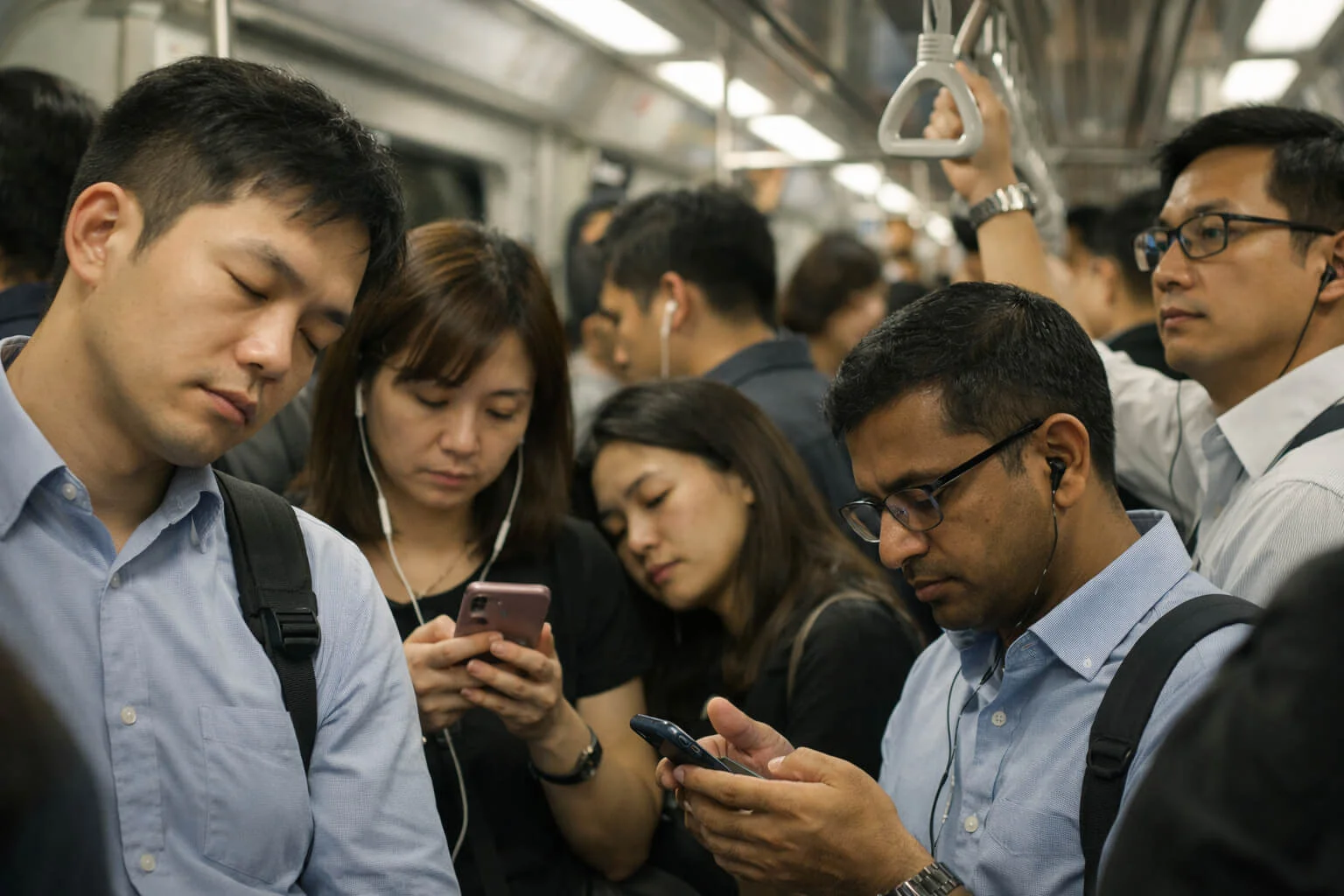
It’s 8:15 AM on the East-West Line. Look around the MRT cabin. Half the passengers are staring blankly into their phones. The other half have their eyes closed, heads nodding with the motion of the train. You had seven hours of sleep last night, but your eyes are burning. You feel like you just ran a marathon.
This is the baseline state for many of us. When asked how we are doing, the default Singaporean response is, “I’m fine, just a bit tired.” But it’s not just “a bit.” We drag ourselves through the morning, crash into the 3 PM wall, and stumble home at 7 PM with just enough energy to shower and scroll TikTok.
Searching why am I always tired Singapore yields millions of results. It is a shared cultural experience. But why? The answer lies at the intersection of our climate, our hustle culture, and a concept called “sleep debt.”
The Big Three: Work, Heat, Sleep Debt
Work: Mental load that doesn’t “clock out”
Physical exhaustion is easy to understand. Mental exhaustion is deceptive. In a knowledge-based economy, office burnout Singapore residents face isn’t from lifting heavy boxes; it’s from decision fatigue. The brain consumes about 20% of your body’s energy. When you are toggling between Zoom calls, urgent Slack messages, and spreadsheet deadlines for nine hours, your brain is running a marathon. Even when you log off, the mental load doesn’t switch off immediately.
If you’ve noticed more people casually saying “I’m exhausted” or “burnt out” at work lately, you’re not imagining it.Here’s how clinic conversations and health language are shifting in Singapore:how Singaporeans are talking about health at clinics.
Heat + humidity: Energy tax you don’t notice
Never underestimate heat fatigue Singapore puts on the body. We live in a perpetual 31°C climate with 80% humidity. When you step out for lunch in the CBD, your body goes into overdrive. Blood flows to the skin, heart rate increases, and you sweat. This is an invisible energy tax. How heat and humidity affect energy levels is biological: your body is literally working overtime just to maintain its core temperature.
Sleep debt: The hidden borrowing problem
Sleep debt Singapore workers carry is immense. Sleep debt is the difference between the amount of sleep you *need* (usually 7-8 hours) and the amount you *actually get*. If you lose 1 hour a night from Monday to Friday, you have a 5-hour debt by the weekend. Your body doesn’t forgive this debt easily. It compounds, leading to that “heavy eye” feeling that no amount of coffee can fix.
Are You Actually Resting? (Not Just Sleeping)
We often confuse “time in bed” with actual restorative rest.
The Sleep Science
“In tropical climates like Singapore, maintaining a bedroom temperature of 22°C to 24°C is optimal. Lowering it to 18°C forces the body to burn energy to stay warm, leading to morning fatigue and muscle stiffness.”
Sleep quantity vs sleep quality
You can be in bed for eight hours and still wake up exhausted. Poor sleep habits Singapore lifestyle encourages—like sleeping with the aircon blasting at 18°C, or ambient light from street lamps in your HDB estate—disrupt your “Deep Sleep” and “REM” cycles. Deep sleep is when the body repairs itself. If your quality is low, quantity doesn’t matter.
The “weekend catch-up” trap
The classic local habit: sleep 5 hours on weekdays, sleep 10 hours on Sunday. This actually makes you more tired. It induces “social jetlag,” shifting your circadian rhythm so violently that Monday morning feels like you just flew back from London.
Why late nights feel okay… until they don’t
You stay up till 2 AM. You feel fine the next day. This is adrenaline and cortisol (the stress hormone) keeping you afloat. But eventually, the biological bill comes due, and the crash is spectacular.
The Everyday Habits That Quietly Drain Energy
Fatigue daily habits Singapore residents adopt are often coping mechanisms that backfire.
Phone scrolling in bed
We call it “Revenge Bedtime Procrastination.” You have no free time during the day, so you steal time from your sleep to scroll Instagram. The blue light suppresses melatonin (the sleep hormone), keeping your brain wired long after you put the phone down.
Caffeine timing (The crash pattern)
A Kopi-O at 8 AM is fine. A caffeine crash Singapore workers experience happens because of the 4 PM bubble tea or coffee. Caffeine has a half-life of 5 hours. Drink coffee at 4 PM, and half of it is still in your bloodstream at 9 PM. Why caffeine makes me more tired later is simple: it blocks sleep pressure (adenosine) temporarily. When it wears off, the fatigue hits you all at once like an MRT breakdown.
Sugary drinks & “fake energy”
That Teh Peng with extra condensed milk gives you a sugar high. But the inevitable insulin spike and subsequent drop leaves you shivering at your desk an hour later, craving a nap.
Skipping water in aircon life
Hydration fatigue Singapore office workers suffer is subtle. Air-conditioning dehydrates the air, which dehydrates you. A mere 2% drop in hydration levels can trigger brain fog, headaches, and lethargy. If you only drink coffee and no water, you are running on empty.
Heavy late meals
Eating a heavy char kway teow at 9 PM means your body spends the whole night digesting instead of resting. It drastically hits your sleep quality.
The Afternoon Slump — Why 3pm Feels Like a Wall
Why I’m sleepy in the afternoon at work is a mix of biology and lunch choices.
Lunch patterns (hawker vs desk lunch)
A heavy, carb-loaded hawker lunch (chicken rice, mee pok) triggers a massive release of serotonin and melatonin. It is the infamous “food coma.”
Sitting + low movement
If you sit completely still for 4 hours, your heart rate drops, and oxygen flow to the brain slows down. Your body thinks it is time to hibernate.
Screen fatigue and micro-breaks
Staring at a monitor strains your eyes. Eye strain triggers facial muscle tension, which translates to a headache and general fatigue. The 20-20-20 rule helps: Every 20 minutes, look at something 20 feet away for 20 seconds.
Commute & City Living Fatigue
Standing, crowds, noise — “quiet stress”
Even if your job is easy, just existing in a crowded city is tiring. The sensory overload of the MRT—announcements, crowding, navigating escalators—drains your battery before you even reach the office. It is “quiet stress.”
Why “small stress” adds up
Worrying about catching the bus. Navigating a crowded hawker centre to find a seat. These micro-stressors accumulate, releasing small bursts of cortisol that leave you tired after work Singapore.
Simple commute moves that reduce drain
Use noise-cancelling headphones. Not to listen to loud music, but to create a bubble of silence. Wear comfortable shoes for the commute and change at the office.
A Practical “Energy Reset” Routine (No Miracle Claims)
How to stop waking up tired every day? You don’t need a life overhaul. Just tweak the edges.
Morning: 3 small moves
- Drink a full glass of water before your coffee.
- Get 5 minutes of direct sunlight (tells your brain the day has started).
- Take a colder shower to shock the system awake.
Midday: 3 small moves
- Walk outside for 10 minutes (even in the heat, movement beats the desk slump).
- Swap the 3 PM sugary drink for green tea.
- Take 5 deep breaths away from the screen.
Evening: 3 small moves
- Dim the lights in your house after 8 PM.
- Put the phone across the room 30 minutes before bed.
- Keep the bedroom temperature cool (around 23°C – 24°C).
A 7-Day “Less Tired” Plan
Don’t try to fix everything today. What is sleep debt and how to reduce it? Slowly.
Day 1–2: Fix the easiest leak
Focus purely on hydration. Drink two litres of water a day. You will feel 10% better just from this.
Day 3–5: Sleep debt reduction
Go to bed 15 minutes earlier than usual. Just 15 minutes. It adds up over the week without feeling like a drastic lifestyle change.
Day 6–7: Keep it realistic
Audit your weekend. Instead of staying up until 3 AM on Saturday, aim for 1 AM. Protect your Sunday night so Monday doesn’t hurt as much.
Sometimes, we just need to identify if we are actually tired, or just mentally done with the day.
Quick Self-Check (Non-medical)
Are you tired, sleepy, or burnt out?
- Sleepy: You could fall asleep right now if you lay down. (Fix: Sleep).
- Fatigued/Tired: Your body is heavy, you lack energy, but you can’t sleep. (Fix: Rest, nutrition, hydration).
- Burnt Out: You have slept 8 hours, but you have zero motivation to face the day. (Fix: Mental break, boundaries).
Signs it’s time to get professional advice
If you have tried improving your sleep, reduced caffeine, and fixed your diet, but the always tired Singapore feeling persists for months—especially accompanied by muscle aches, dizziness, or snoring (sleep apnea)—it is time to see a GP.Not sure where to start? Use this quick guide:Polyclinic vs GP in Singapore (cost, waiting time, booking).
Quick Checklist (Save This)
✅ Do This
- Pay down sleep debt in 15-minute increments.
- Hydrate heavily, especially when sitting in cold offices.
- Take micro-breaks to rest your eyes from screens.
- Eat lighter lunches to avoid the 3 PM food coma.
- Use noise-cancelling tech on public transport.
- Wind down with dim lighting an hour before bed.
- Keep bedroom temperatures conducive for deep sleep.
- Use the weekends to rest, not just to binge-socialize.
- Move your body slightly in the afternoon (stretching works).
- Accept that high humidity drains energy; pace yourself.
❌ Avoid This
- Do not drink caffeine after 2 PM if you are sensitive to it.
- Do not doom-scroll in bed (the blue light destroys sleep quality).
- Do not try to “catch up” by sleeping 12 hours on Sunday.
- Do not eat heavy, spicy meals right before bedtime.
- Do not ignore constant snoring (get checked for sleep apnea).
- Do not rely on sugar for energy (the crash is worse).
- Do not set 5 different snooze alarms (it ruins sleep continuity).
- Do not work from your bed (keep sleep spaces sacred).
- Do not assume being tired is just “normal” forever.
- Do not self-diagnose severe fatigue without a doctor’s input.
🇸🇬 The Singaporean Energy Drain Checklist
How many of these are you guilty of this week?
If you checked more than two, it’s time to start the 7-Day Reset Plan below.
Official Context & Disclaimer
This guide is for general informational purposes and everyday lifestyle habits. Prolonged or severe fatigue can be a symptom of underlying health conditions (e.g., thyroid issues, anemia, sleep apnea). If your exhaustion persists despite lifestyle changes, please consult a medical professional at a Polyclinic or GP. More resources on mental well-being can be found at MindSG by the Health Promotion Board.
🕰️ One Small Moment
“A colleague of mine was always exhausted. Always the first one to say ‘So tired lah.’ One week, she stopped bringing her phone into the bedroom. She bought an old-school alarm clock. Within days, the dark circles faded. She had more energy. She didn’t buy expensive supplements or quit her job. She just stopped fighting her biology at 11 PM. Sometimes, the solution is just subtraction.”
This guide focuses on everyday Singapore fatigue (work stress, heat/humidity, sleep debt) and practical habits that may help.
It is not medical advice and does not replace a consultation with a doctor.
If tiredness persists for 6+ weeks or comes with red flags (chest pain, dizziness/fainting, shortness of breath, unexplained weight change,
heavy snoring/possible sleep apnea, or low mood), consider speaking to a GP or visiting a Polyclinic for a proper assessment.