Zero Physical Labor, 100% Exhausted: The Brutal Reality of Singapore Office Work
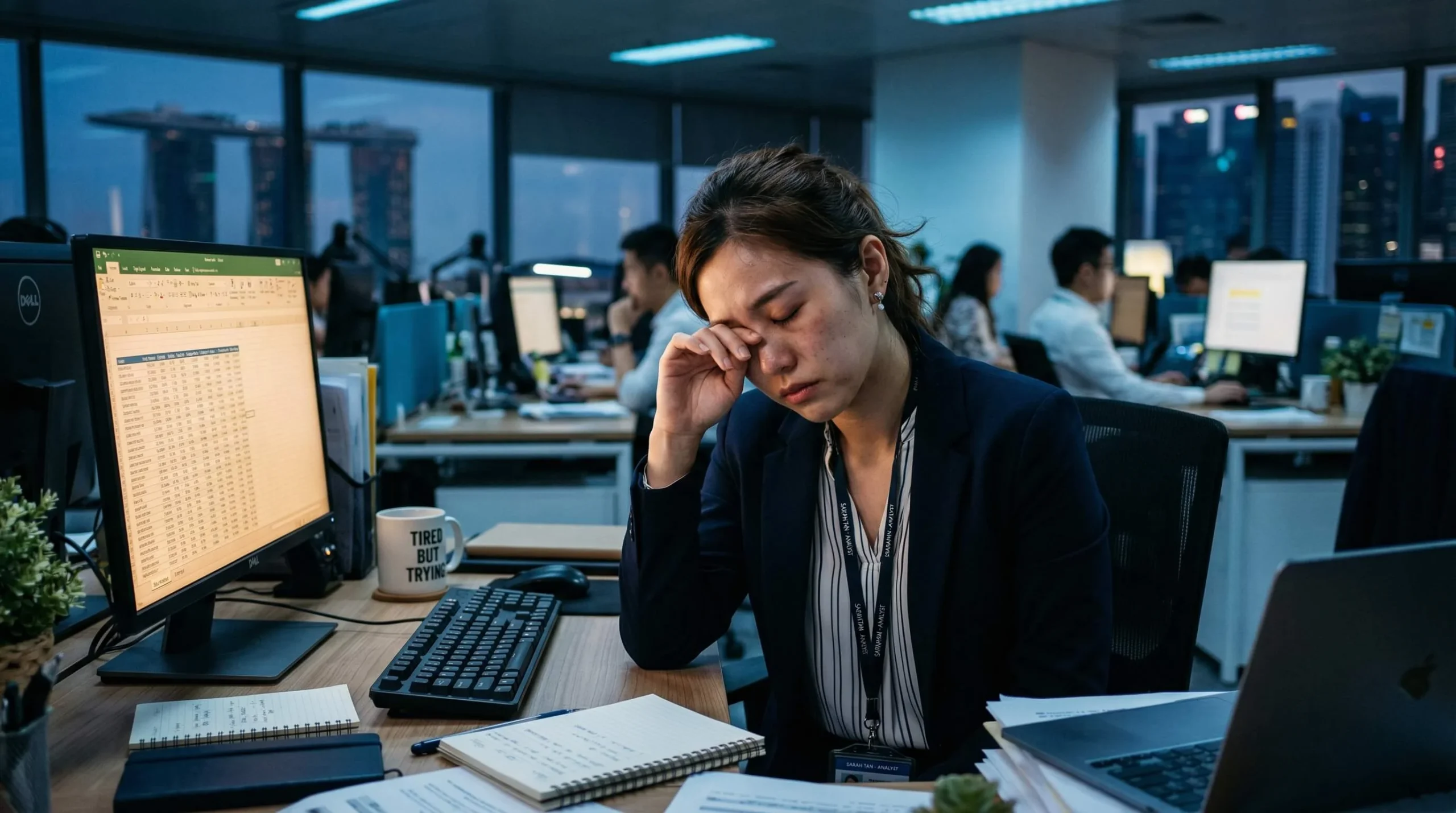

The profound exhaustion following a nine-hour desk shift is entirely biological. While a construction worker depletes muscle glycogen, a white-collar professional burns through massive amounts of glucose via intense, sustained cognitive output. Your brain is a metabolic furnace. Combine this cognitive overload with a severe lack of physical movement that slows your cardiovascular system to a near-sleep state, the thermal stress of freezing air-conditioning, and the constant psychological threat of office politics. Your body is biologically confused, exhausted by the effort of doing absolutely nothing physical.
You arrived at the office at 9 AM. You sat in a highly engineered, breathable mesh chair. You stared at a glowing rectangle. You moved your fingers across a keyboard. You drank two iced lattes. At 6 PM, you pack your bag to leave.
You feel like you have just unloaded a cargo ship at Pasir Panjang.
Your legs are heavy. Your eyes burn. Your brain refuses to process the concept of deciding what to eat for dinner. The pervasive reality of office work fatigue Singapore residents deal with is a massive paradox. We equate tiredness with physical labor. But the white-collar workforce is collapsing onto their sofas every night with zero physical exertion to show for it.
You didn’t lift anything heavier than a laptop, yet you are completely physically drained.
Understanding why office workers feel more tired than physical workers Singapore environments employ requires looking at how the human body distributes fuel. You are essentially a highly stressed brain in a jar, and the jar is kept at 19 degrees Celsius.
The Metabolic Furnace in Your Skull
Let us address the mental vs physical fatigue Singapore explained simply. The brain represents roughly 2% of your body weight, but it consumes a staggering 20% of your daily energy.
When a physical laborer works, their muscles consume glycogen, and their cardiovascular system works efficiently to pump oxygen to those muscles. When you sit at a desk analyzing spreadsheets, negotiating with difficult clients over email, and managing the relentless cognitive overload of the modern workplace, your brain is burning massive amounts of glucose.
You are performing high-intensity interval training, but entirely inside your skull.
This intense focus fatigue drains your central nervous system. Every single micro-decision you make—how to phrase an email, which task to prioritize, how to politely reject a ridiculous request from management—depletes your cognitive reserves. The decision fatigue Singapore offices demand from executives is relentless. By 4 PM, the tank is empty. The brain exhaustion is so severe that it manifests as a deep, physical heaviness in your limbs.
You simply cannot think anymore, so your body decides it cannot move anymore.
The Paralysis of the Ergonomic Chair
Your cardiovascular system hates your desk.
When you sit motionless for hours, your heart rate plummets. Your blood circulation slows down significantly. Because your muscles are not contracting, they are not helping to pump blood back up to your heart and brain. Your body interprets this prolonged physical stillness as a signal that it is time to go to sleep.
This is exactly why sitting all day makes you tired Singapore workers realize around mid-afternoon. The lack of movement fatigue forces your biology into a low-power mode.
The physical environment makes this worse. The aircon office fatigue is real. You are sitting completely still in a freezing room, forcing your body to burn baseline metabolic energy just to maintain your core temperature. You stare at artificial blue light for nine hours, suppressing your melatonin cycles and dealing with severe eye strain Singapore professionals accept as a standard occupational hazard.
You avoid leaving the office for lunch because the thought of facing the midday heat and figuring out why singapore businesses long queues are somehow getting even longer at the salad bar is too much effort. You eat at your desk. You never move.
The Psychological Threat Matrix
Then comes the invisible layer of exhaustion: the office politics.
A physical job usually ends when the shift ends. A brick is laid, a package is delivered. The task is objectively complete. In a corporate environment, tasks are ambiguous, endless, and deeply tied to navigating the intense singapore workplace competition survival race. You are constantly on guard.
You are reading between the lines of a passive-aggressive email. You are wondering if your manager noticed you left at 5:50 PM. This constant, low-level psychological vigilance keeps your amygdala firing, flooding your system with cortisol. This invisible mental strain feeds directly into the massive singapore corporate burnout 30s demographic. Your body is physically preparing for a fight-or-flight scenario that never actually happens, leaving you trembling with unspent adrenaline that slowly decays into total apathy.
You stay in this chair, absorbing this damage, because you are terrified of losing your spot in the singapore salary bonus trap.
The Contagion of Understaffing
The workload is rarely static.
When the person sitting next to you finally breaks and resigns, triggered by the exact same corporate job exhaustion Singapore normalizes, their work does not disappear. It lands directly on your desk. The loyalty penalty employee turnover singapore companies rely on means the remaining staff are forced to do the jobs of three people without a pay raise.
You are absorbing their cognitive load on top of your own.
This daily drain is expensive. You leave the office so completely depleted that you refuse to cook, you refuse to take public transport, and you resort to the singapore exhaustion tax hidden expenses—ordering premium food delivery and taking a Grab Premium home just to feel a shred of comfort. The office work fatigue Singapore corporations generate is literally costing you your disposable income.
Expert Insight / Occupational Health
“The phenomenon of white collar fatigue Singapore presents is a classic example of ‘sedentary sympathetic dominance.’ The brain is hyper-aroused by constant digital stimuli and complex problem-solving, keeping the sympathetic nervous system (fight or flight) engaged. However, the physical body is entirely dormant. This massive disconnect prevents the natural metabolization of stress hormones. The result is a profound, systemic energy crash by late afternoon. The worker feels physically destroyed despite having expended virtually zero kinetic energy. Mitigating this requires breaking the physical stagnation forcefully throughout the day.”
Forcing the Reset
You cannot out-think brain fatigue. You have to move.
If you want to know how to reduce office fatigue Singapore environments cause, you have to break the cardiovascular stagnation. Setting a timer to stand up every forty-five minutes is not a luxury; it is a biological requirement to keep your blood flowing to your prefrontal cortex.
Go outside. The lack of natural sunlight exposure in modern corporate towers wrecks your circadian rhythm, confusing your brain about what time of day it is. Five minutes of intense, unfiltered tropical sunlight on your retinas will do more to wake you up than a third cup of office pantry coffee.
✅ Do This
- Force a ‘kinetic break’ every hour. Stand up, walk to the pantry, stretch your calves. You must manually pump the blood back to your brain.
- Implement the 20-20-20 rule to fight eye strain. Every 20 minutes, look at something 20 feet away for 20 seconds to relax your ocular muscles.
- Leave the building for lunch. The physical separation from the artificial lighting and the short walk in natural daylight resets your circadian alertness.
- Batch your decisions. Check emails only at specific hours rather than continuously reacting to every notification, which rapidly accelerates decision fatigue.
❌ Avoid This
- Do not eat a massive, carbohydrate-heavy lunch at your desk while staring at a spreadsheet; the resulting insulin spike will guarantee a devastating 3 PM energy crash.
- Do not assume more caffeine will fix the brain fog. Caffeine masks the fatigue receptors; it does not generate actual cellular energy.
- Do not sit completely still in a freezing office; your body will burn through its energy reserves simply trying to keep your internal organs warm.
The biological reality of office work fatigue Singapore environments create is that your brain is stealing all the fuel while your body slowly shuts down from neglect. You are exhausted because you are asking a high-performance engine to run at maximum RPM while the vehicle is parked in a freezing garage. You have to put the car in drive.

Ege Sg
Senior Editor & Workplace Culture Expert, SGVital
Ege Sg is an investigative writer specializing in corporate life, employee wellness, and workplace psychology in Singapore. By blending local occupational health data (WSH, MOM) with expert insights, he provides science-backed, actionable strategies to combat the physical and mental challenges created by modern Singaporean office culture.
Frequently Asked Questions
Official Context & Occupational Health Resources
For more official guidelines on workplace ergonomics, managing sedentary risks, and maintaining occupational mental well-being, consult the following local authorities: