Singapore’s Heartland Shops Look Busy — So Why Are Owners Earning Less?


The foot traffic hasn’t vanished. The queues are still there. But day after day, heartland shop owners are closing with less cash — revealing a quiet shift in how Singaporeans spend.
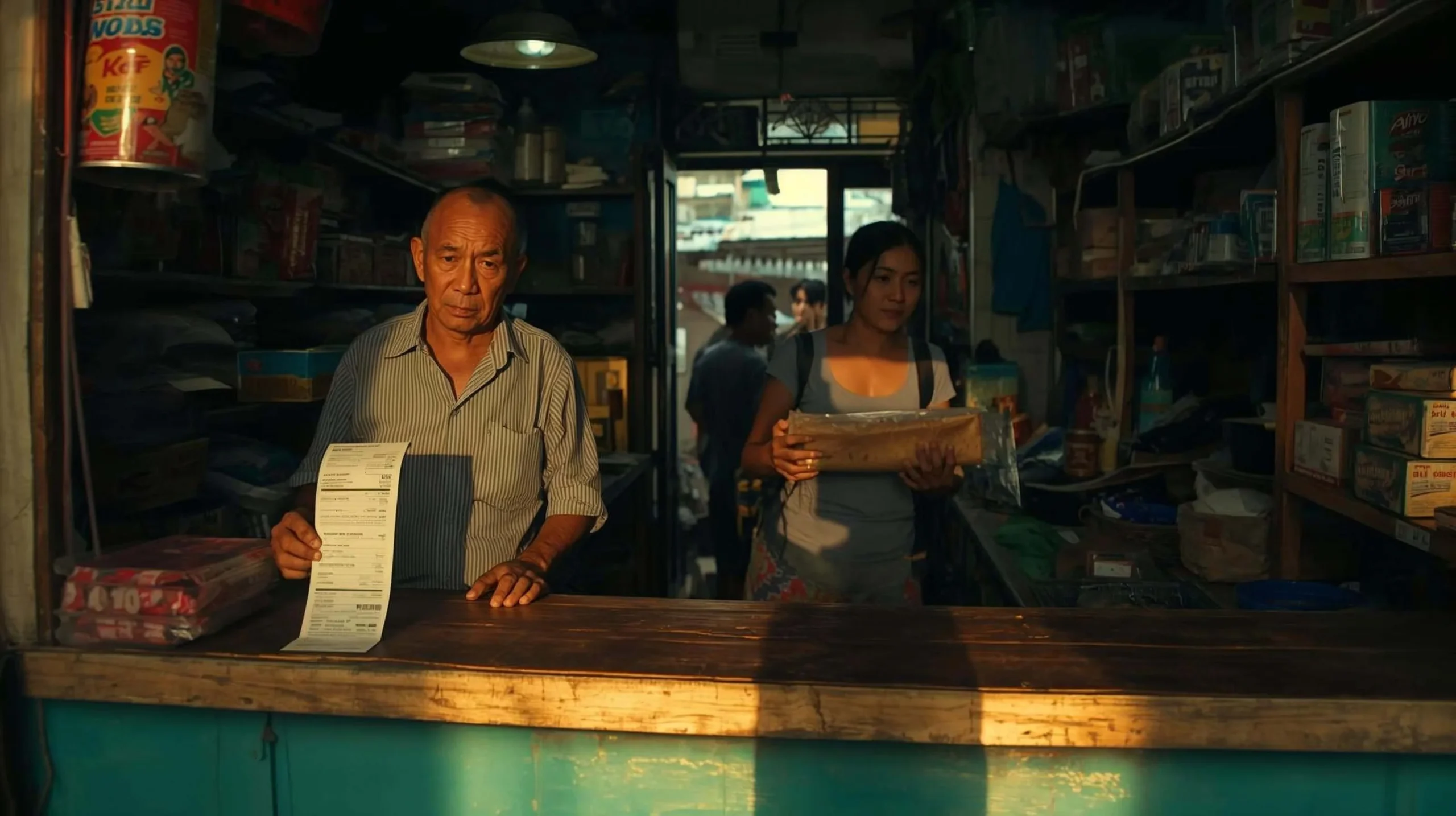
Mr. Chen stands behind the counter of his provision shop in Ang Mo Kio Avenue 10. It is 6:30 PM. The “going home” crowd is thick.
To the casual observer, business looks booming. There are three people in the aisle. Someone is buying bread. Someone is buying eggs. The bell on the door is dinging constantly.
But Mr. Chen isn’t smiling.
“See that one?” he whispers, pointing to a young man leaving with a single loaf of Gardenia bread. “Last time, he buy bread, he buy Kaya, he buy Milo, maybe buy chips. Now? Bread only. Just the bread.”
Mr. Chen pulls out a long receipt from 2023 that he keeps tacked to the wall—a superstition, perhaps, or a memory. “Average customer used to spend $12. Now, average is $4. They walk in, they walk out. Busy, yes. Money? No.”
This is the silent crisis facing small businesses in Singapore heartlands. It isn’t a crisis of abandonment; Singaporeans still love their neighbourhoods. It is a crisis of “optimization.” The residents have become ruthless, tactical spenders, and without realizing it, they are slowly starving the ecosystem that sustains their daily convenience.
This shift is closely tied to how many residents feel about rising daily expenses. As explored in
why Singapore’s cost of living feels higher in 2026, even small purchases are now carefully rationed.
The “Just One Item” Economy
If you spend a week sitting in these shops, you start to see the pattern. It is the death of the “Basket Size.”
In the past, the heartland shop was where you did your weekly fill-up. You bought the heavy detergent, the rice, the oil. Today, those items are gone.
Why? Because of the “RedMart Effect” and the sheer logistics of modern life. We don’t want to carry 5kg of rice up the stairs. We order the heavy, expensive items online where they are cheaper and delivered to the door. We use the heartland retailers only for the emergency gaps.
The neighbourhood shop has been demoted. It is no longer the “Primary Store.” It is the “Panic Room.” It is where you go when you run out of toilet paper at 9 PM, or when you need one egg for instant noodles. The volume of sales (number of transactions) is high, but the value is rock bottom.
This explains why shops feel quieter despite foot traffic being decent. The transaction time is shorter. There is no browsing. It is a tactical strike: Enter, grab milk, exit.
The Disappearing “Impulse Buy”
The biggest casualty of this shift is the “treat.”
I spoke to a stationery shop owner in Clementi. She used to make her margin on the cute, unnecessary things: stickers, fancy pens, novelty erasers that kids would beg their parents for.
“Now, parents say ‘No’ very fast,” she observes. “They buy the exercise book because school need. They buy the blue pen because exam need. The kid ask for sticker, the mother say ‘Shopee cheaper’ or just ‘Don’t waste money.'”
This decline in fewer impulse purchases is fatal. Retailers know that the margin on essential items (like bread or newspapers) is razor-thin. The profit comes from the impulse buys—the chocolate bar at the counter, the extra drink. When customers cut those out, the shop survives, but the profit evokes.
It creates a paradox: The shop is “busy” selling low-margin essentials, doing twice the work for half the profit.
The Drink Stall Paradox
Nowhere is this clearer than in the coffee shop owners Singapore ecosystem.
The “Cai Fan” (Economy Rice) stall is packed. The line snakes out the door. But look at the tables. How many people are drinking a paid beverage?
Ten years ago, a meal wasn’t complete without a Kopi or a Lime Juice. Today, you see a sea of water bottles. Thermos flasks from the office. Tupperware bottles from home.
“People eat rice because must eat,” says Uncle Lim, a drink stall operator in Bedok. “But drink? They say drink water healthy. Or they bring their own. My profit is in the water, not the rental. If they don’t drink, I die.”
This is a massive cultural shift in neighbourhood spending habits. The “Set Meal” mentality is broken. We treat food as fuel (necessary cost) and drinks as luxury (cuttable cost). The result is a kopitiam that looks full but is financially anemic.
The Voucher Dependency
We cannot talk about the heartland economy without talking about the teal-colored lifelines.
The CDC Vouchers scheme has become the heartbeat of these businesses. When the vouchers drop (usually in January), the shops are ecstatic. People splurge. They buy the “extra fish.” They buy the fancy biscuits.
But shop owners tell me there is a dark side. “February, business die,” says a dry goods store owner. “Everyone spend voucher finish, then they stop spending. We wait for next year.”
It has created a “Feast and Famine” cycle. Small shop owners Singapore-wide are noticing that organic, cash-based spending is shrinking, replaced by government-subsidized spending. It keeps them alive, but it doesn’t allow them to grow.
It feels like the whole neighborhood is holding its breath, waiting for the government to exhale cash into their pockets.
| The Metric | The “Boom” Years (2015) | The “Quiet” Years (2026) |
|---|---|---|
| Basket Composition | Rice, Oil, Snacks, Magazines | 1 Loaf of Bread, 1 Onion |
| Drink Ratio | 1 Meal = 1 Drink | 3 Meals = 1 Drink (2 Water Bottles) |
| Shopping Time | 20 Minutes (Browsing) | 3 Minutes (Tactical) |
| Payment | Cash (Keep change) | CDC Voucher / PayNow |
The “Dabao” Disconnect
Another factor why small businesses are earning less in Singapore is the permanent shift to “Dabao” (takeaway).
When you eat at the shop, you might order a second drink. You might see a kueh and buy it. You are a captive audience.
When you dabao, you leave. You take the food into your fortress (your flat). You drink your own water. You eat your own fruit. The shop loses all opportunity for “upselling.”
The HDB Heartland Shops scheme tries to revitalize these spaces with events and promotions, but they cannot legislate presence. If people prefer their Netflix to the noisy void deck, the economic footprint of the customer shrinks to the bare minimum of the food packet.
The “Showrooming” of the Heartland
This is the most frustrating one for mature estates businesses selling non-food items (hardware, electronics, household goods).
I watched a lady in a hardware shop in Toa Payoh. She picked up a mop. She tested the handle. She asked the uncle how to use it. She spent ten minutes getting a tutorial.
Then she put it down, pulled out her phone, scanned the barcode, and walked out. I guarantee you she bought it on Lazada five minutes later for $3 less.
The heartland shop has become a free showroom. They pay the rent to display the goods; the internet reaps the profit. “I am just a museum now,” the hardware uncle told me, resigned. “People come look look see see, then buy from cloud.”
The “Still Busy But Spending Less” Paradox
This brings us to the central mystery: The shops *look* alive.
If you walk through Bedok Central on a Saturday, it is heaving. But look at the hands. How many bags are people carrying?
What shop owners are noticing this year is the high “browsing-to-buying” ratio. People are out. They are walking. They want to be out of the house (because electricity is expensive). But they are treating the mall or the town centre as a park. It is a place to walk, not a place to spend.
It is “Window Shopping” taken to an extreme survivalist level.
What This Means for Residents
We might think we are being smart. We are saving $2 here, $1 there.
But there is a cost. When the profit margins dip below survival levels, the shops change. The friendly uncle who stocked 50 types of biscuits retires. He is replaced by a chain franchise or a vending machine.
We are optimizing the character out of our neighbourhoods.
The “Use It or Lose It” Reality:
The Singapore heartland economy is fragile. It relies on volume. If we only buy the loss-leaders (the bread and eggs) and give the profit-makers to the internet, the shops will vanish.
Official Context
The government supports heartland enterprises through the Heartland Enterprise Upgrading Programme (HEUP) under Enterprise Singapore. This helps shops digitize and renovate. Additionally, the Revitalisation of Shops (ROS) Scheme provides funding for promotional events to boost footfall in HDB town centres.
This article is based on on-the-ground observations and conversations with heartland shop owners across Ang Mo Kio, Bedok, Clementi, and Toa Payoh between late 2024 and early 2026. Names have been changed to protect privacy, but spending patterns described reflect widely reported experiences within Singapore’s mature estates.
🕰️ One Small Moment
“I bought a packet of tissue paper from the provision shop downstairs. It was $1.20. I handed the auntie $2. She fumbled with the coins. Her hands were shaking slightly. While she counted, I looked at the shelves behind her. They were dusty. The stock was low. She handed me the 80 cents. ‘Thank you, boy,’ she said. ‘Come back again ah.’ It wasn’t a sales pitch. It sounded like a plea. I walked out and realized: I hadn’t bought anything from her in three months, even though I walk past her every single day.”