The Real Reason Singapore Businesses Force You to Queue (Even With Empty Tables)
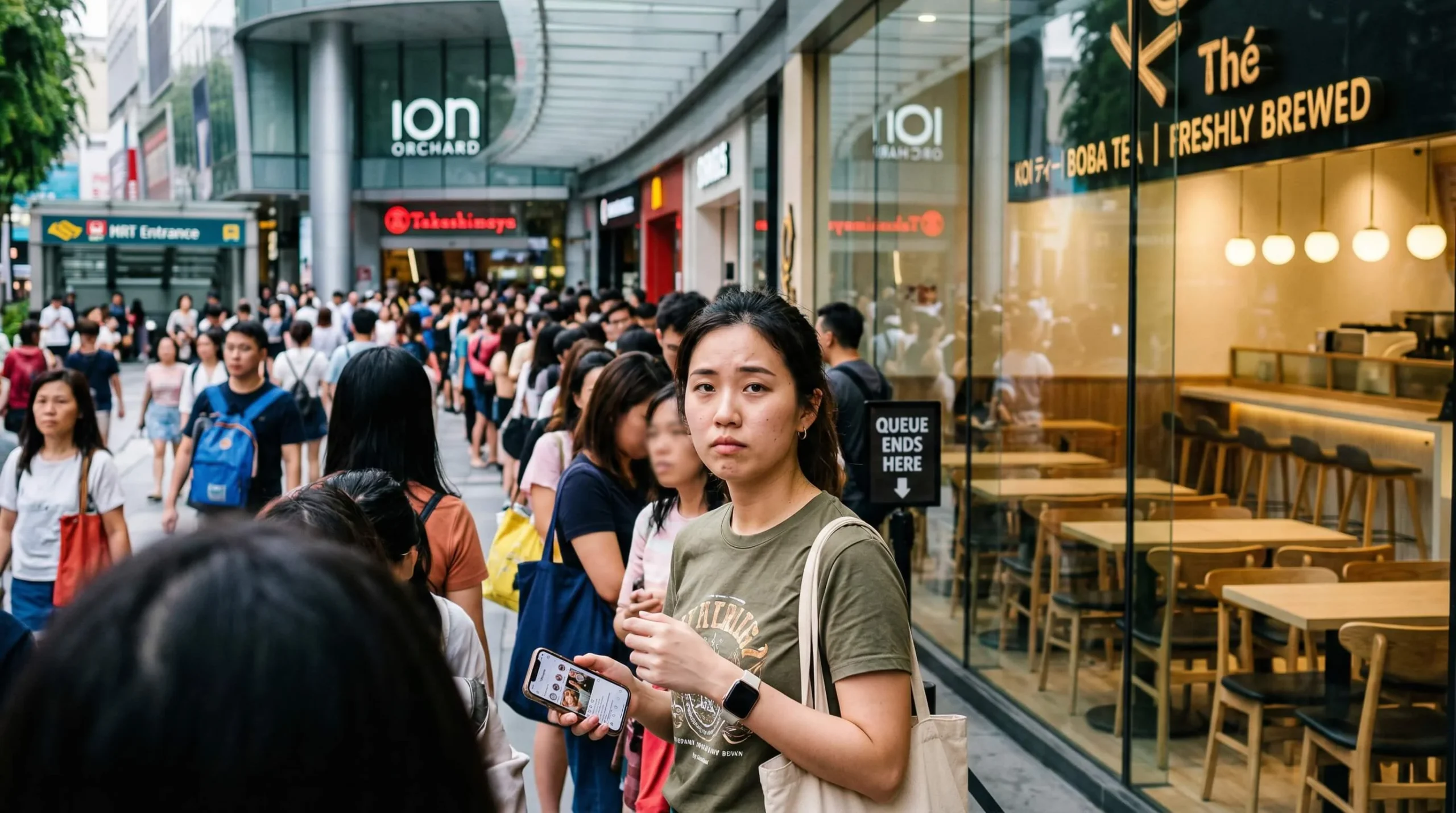

The snaking line outside your favorite eatery is rarely a logistical accident. While extreme commercial rent and a crippling frontline labor shortage physically prevent many SMEs from expanding their floor space, the queue itself serves a massive psychological purpose. A visible line is the ultimate billboard for social proof. By artificially throttling supply and turning the checkout process into an endurance test, brands manufacture premium exclusivity. The delay is not a failure of service; it is a highly calibrated marketing strategy.
You see a line of forty people snaking around a mall corridor. Your first instinct isn’t to walk away. It is to wonder what you are missing.
We accept the queue as a fundamental, unavoidable reality of the urban landscape. We stand in the heat for thirty minutes for a viral pastry, scroll through our phones, and complain about the slow service. But the long waiting time Singapore businesses subject us to is almost never a surprise to the management. They know exactly how many customers are outside. They know exactly how slow the kitchen is moving.
They just have absolutely no financial incentive to speed it up.
Understanding why some Singapore businesses keep customers waiting instead of expanding capacity requires looking past the menu and diving into the brutal, unforgiving math of local commercial operations. You are not waiting because they are disorganized. You are waiting because keeping you outside is vastly more profitable than bringing you inside.
The Real Estate Squeeze and Dead Hours
Knocking down a wall to add twenty more tables sounds like basic business logic. If demand is high, increase supply.
The math of high rental costs Singapore landlords demand completely destroys this logic. Commercial leases in premium malls or high-footfall neighborhoods are astronomical. If a cafe expands its floor space to accommodate the weekend rush, their fixed monthly overheads double instantly.
Here is the catch. The peak hour demand Singapore crowds generate only lasts for a very narrow window. The lunch rush is exactly two hours. The rest of the afternoon, those expensive extra tables would sit completely empty, bleeding capital.
Rather than taking on the massive financial risk of expansion just to clear a temporary queue, operators simply cap their supply. This operational margin squeeze is the exact same defensive financial maneuvering that forces eateries to quietly utilize the shrinkflation singapore food portions strategy. When the numbers get too tight, the business protects itself first. It is significantly cheaper to let you stand on the public sidewalk for free than to pay premium rent for you to sit inside.
The Crippling Frontline Drought
Who is going to man the extra registers even if they did expand?
The retail and F&B sectors are operating in a state of perpetual crisis. Frontline workers are completely drained by the demands of the service industry. The sheer volume of angry customers and the grueling hours drive massive attrition, pushing retail staff to flee to other industries to escape the exact same exhaustion outlined in the singapore corporate burnout 30s demographic.
The turnover is relentless. When companies are already bleeding cash trying to fight the loyalty penalty employee turnover singapore businesses suffer from, hiring ten more people simply to speed up the checkout line is a financial impossibility. They cannot even keep their current shifts fully staffed.
This friction is the direct catalyst behind why singapore companies hire international workers for grueling back-of-house roles. It also explains why singapore companies outsource vs hiring entirely for backend administrative tasks. The local labor pool has simply rejected the low-wage frontend grind. A business cannot expand its business capacity Singapore style if there are zero physical humans willing to put on the uniform.
Scarcity as a Weaponized Marketing Strategy
There is a darker, psychological manipulation at play.
A physical queue is the ultimate form of social proof. If there is no line, the consumer assumes the product must be mediocre. Savvy operators have mastered this scarcity marketing strategy. By intentionally bottlenecking their workflow—baking only fifty croissants an hour or using a single espresso machine—they artificially engineer exclusivity.
The strategic long waiting time Singapore businesses cultivate becomes a core feature of their brand identity, not a bug.
They create demand through waiting. Customers who survive the queue feel a sunk-cost fallacy; they have invested forty-five minutes of their life into this transaction, so the product absolutely must be spectacular. It triggers the intense FOMO buying behavior that dominates local consumer spending. You end up ordering three extra items simply because you never want to stand in that line again. The business just doubled its transaction value precisely because they made you suffer.
Expert Insight / Consumer Behavioral Economics
“The visible queue serves as an offline virality loop. Our data shows that restaurants operating at 80% capacity with a steady line of ten people outside consistently report higher perceived brand value than restaurants operating at 100% capacity with empty waiting areas. The long waiting time Singapore businesses enforce acts as a psychological filter. It conditions the consumer to lower their service speed expectations while simultaneously raising their product quality expectations. By the time the customer reaches the counter, the power dynamic has entirely shifted from the buyer to the seller.”
The Conditioned Patience of the Urban Consumer
Why do we tolerate this manipulation?
Our queue tolerance Singapore style is heavily conditioned from birth. We are deeply used to fighting for limited resources. It is a mindset born from the intense singapore workplace competition survival tactics we navigate daily in the office.
Even our broader economic compensation structures train us for this. Getting caught in the singapore salary bonus trap teaches us to endure an entire year of toxic office politics for a delayed financial reward. We just take that exact same waiting psychology consumers here possess and apply it to a bowl of ramen or a limited-edition sneaker drop.
We wait because we are culturally programmed to believe that the reward at the end is inherently valuable simply because the journey to acquire it was difficult.
The Illusion of Queue Management
Businesses know exactly how to walk the tightrope.
Instead of fixing the limited service capacity, they invest in systems that make the wait feel productive. They hand you a buzzing coaster. They make you scan a QR code to join a digital queue so you can wander around the mall. This is not about reducing the wait; this is about optimizing your patience.
They know that an angry customer standing in the heat will eventually leave. But a customer browsing Zara while waiting for their queue number to ping on WhatsApp will wait for two hours.
The managed long waiting time Singapore businesses enforce is a highly calculated equilibrium. If the digital line moves too fast, they lose the aura of premium exclusivity. If it moves too slow, people cancel their tickets. They are constantly adjusting the dials to ensure the restaurant remains perceived as inaccessible just enough to drive desire.
✅ Do This
- Recognize the psychological trigger of a long line. Ask yourself if you actually want the product, or if you are just responding to the social proof of a crowd.
- Utilize digital queue apps before you even arrive at the mall to bypass the physical waiting period entirely.
- Vote with your wallet. If a business consistently disrespects your time with artificial delays, shift your spending to operators who value service efficiency.
❌ Avoid This
- Do not fall for the sunk-cost fallacy. Just because you waited 40 minutes does not mean you need to over-order to “make the wait worth it.”
- Do not take your frustration out on the frontline cashier. The long waiting time Singapore businesses rely on is engineered by corporate management, not the staff pouring your coffee.
- Do not assume a lack of a queue means poor quality. Many excellent establishments simply have highly optimized, efficient kitchen workflows that clear customers rapidly.
The next time you find yourself stuck at the back of a line stretching out the door, take a look at the layout inside. Look at the deliberate pacing of the staff. The delay is the product. The wait is the marketing. Complaining about the long waiting time Singapore businesses put you through is pointless when the entire system is operating exactly as designed.

Ella Dirlasso
Senior Retail Analyst & Behavioral Economics Writer
Ella is a Singapore-based economic researcher specializing in consumer behavioral economics and F&B operational strategies. With extensive on-the-ground experience analyzing retail trends and corporate policies across Singaporean malls, she provides data-backed insights into why local businesses operate the way they do. She is passionate about decoding the local “queue culture” and translating complex economic realities into everyday human stories.
Frequently Asked Questions
Official Context & Economic Resources
To understand the official economic landscape regarding retail labor constraints, commercial real estate, and consumer protection, consult the following local resources: