
Singapore’s Quiet Office Rebellion: Why Workers Are Leaving Exactly at 6PM

For decades, staying late was a badge of honor. Now, it’s seen as a sign of inefficiency. Inside the invisible shift that is changing Raffles Place.
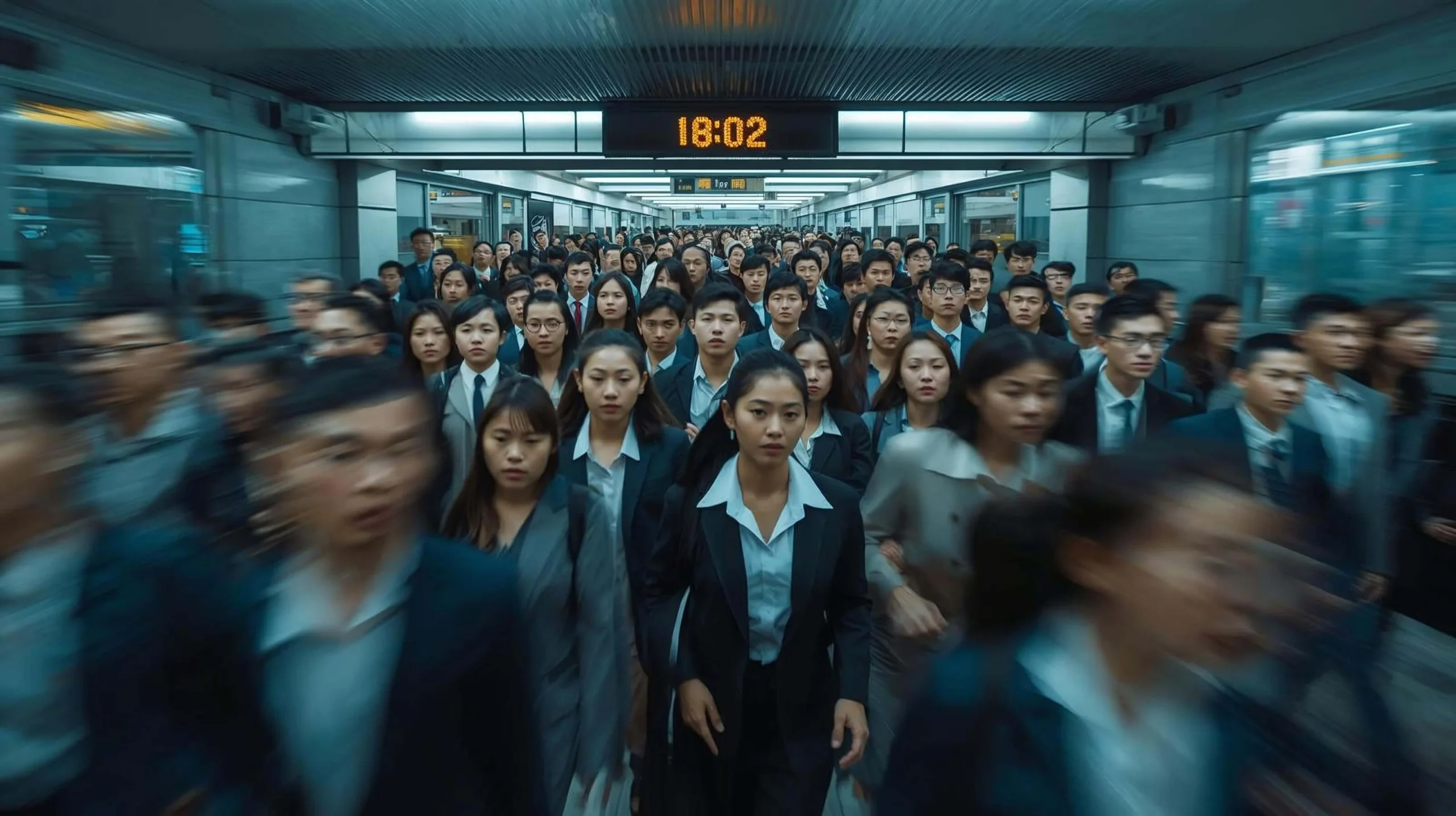
It is 5:58 PM on a Tuesday in a glass tower near Tanjong Pagar.
Sarah, a 28-year-old marketing executive, is packing her bag. Her boss is still in a meeting. Three years ago, Sarah would have stayed. She would have opened a spreadsheet, stared at it, and waited until 6:30 PM just to perform the act of “working.” In local parlance, she would have engaged in “wayang”—a theatrical performance of diligence.
Today? She zips her bag. She walks out. She taps out at the gantry at 6:01 PM.
“I finished my tasks,” she says simply, merging into the crowd heading for the MRT. “Why stay? The lights are nice, but my bed is nicer.”
Sarah isn’t lazy. In fact, she cleared a workload that used to take her predecessor two days. But she didn’t do it by typing faster. She did it by rewriting the unwritten rules of the Singaporean workplace. Across the island, a silent revolution is happening. The famously overworked Singaporean worker is figuring out how to cheat the system—not to do less work, but to get their life back.
The Death of “Face Time”
For a long time, Singaporean corporate culture was defined by visibility. If the boss couldn’t see you, you weren’t working.
The pandemic broke that. But what replaced it is fascinating. We didn’t just go back to the office; we went back with a new ruthless efficiency.
Talk to the mid-level managers in Changi Business Park. They will tell you that the “long lunch” is dead. But not because people are working through it. It’s because the lunch hour has been weaponized.
It is now the “Life Admin” hour. It’s when you do the grocery run via the FairPrice app. It’s when you hit the gym for a 45-minute HIIT class so you don’t have to go at night. It’s when you reply to personal emails.
By compressing personal tasks into the workday breaks, and compressing work tasks into “Deep Work” blocks where notifications are silenced, the modern worker is achieving a strange kind of equilibrium. They aren’t working longer. They are working denser.
This quiet cultural shift isn’t limited to office walls and 6PM exits.
It reflects a broader pattern of how Singaporeans are changing their everyday behaviours
— from how they spend in the heartlands to how they manage their work-life balance.
👉
In Singapore’s heartlands, spending habits are changing quietly.
The “Secret” Intern: AI
Then there is the elephant in the room. The one nobody mentions in the town hall meetings.
Artificial Intelligence.
We interviewed a paralegal who wished to remain anonymous. “Drafting a client update used to take me two hours,” he admits. “Now? I paste the bullet points into ChatGPT. I tell it ‘Professional Tone, British English.’ It gives me a draft in 10 seconds. I check it, polish it, send it. Takes 15 minutes.”
Does he tell his partner? “No. If I tell them, they will just give me more work.”
This is the Productivity Paradox. Workers are using advanced tools to slash their execution time, but they aren’t broadcasting it. They are banking the saved time. They are using those recovered hours to leave on time, to learn a new skill, or simply to stare at a wall and decompress.
It’s funny, really. We spent years begging for work-life balance policies. In the end, we just installed a chatbot and took it for ourselves.
| The Metric | The Old “Wayang” (Pre-2020) | The New Hustle (2026) |
|---|---|---|
| Working Hours | 9 AM to “When Boss Leaves” | 9 AM to 6 PM (Hard Stop) |
| Email Style | Long, flowery, formal | Bullet points / AI-generated drafts |
| Meetings | “Let’s meet to discuss” (1 hour) | “Send me a voice note” (5 mins) |
| Lunch | Socializing with colleagues | Gym / Errands / Solitude |
| Goal | Look busy | Be finished |
The “Ghost Mode” Phenomenon
Another tactic gaining ground is “Ghost Mode.”
In the open-plan offices of the 2010s, accessibility was key. You had to be available. Now, walk through a tech firm in One-North. You will see headphones on. Big, noise-canceling ones. This is the universal sign for “Don’t talk to me.”
Slack statuses are permanently set to “In the Zone” or “Focus Time.”
Workers have realized that the biggest enemy of productivity isn’t the difficulty of the work; it’s the interruption. By carving out 3-hour blocks of absolute silence, they are doing a day’s worth of work in a morning. This allows the afternoon to be a “soft coast”—answering emails, attending low-stakes Zoom calls, and preparing to exit.
The “Calibrated Effort”:
Some call it “Quiet Quitting.” That’s a bad name. It implies giving up. A better term is “Calibrated Effort.” It is the conscious decision to give 100% during paid hours and 0% after. It is treating employment as a transaction, not a lifestyle.
“I act my wage,” says Ken, a graphic designer. “You pay me for 9 to 6. You get my best work 9 to 6. You want 7 PM me? That’s a subscription upgrade.”
Why This Matters to the Economy
The Ministry of Manpower (MOM) has been pushing for Flexible Work Arrangements (FWA). But policy is slow. Culture is fast. While the government releases guidelines, the workforce is actively redefining productivity from the bottom up. This shift might actually be saving the Singaporean economy from a burnout crisis. A rested worker who uses AI is infinitely more valuable to the GDP than an exhausted worker pretending to look at Excel sheets at 8 PM.
The Generational Divide
Of course, this creates friction.
The older generation of managers—the ones who built their careers on stamina and face time—are confused. They see an empty office at 6 PM and think “lack of dedication.” They see a subordinate using ChatGPT and think “cheating.”
But the data doesn’t support their anxiety. Companies that allow this “output-first” culture are seeing retention rates stabilize. The ones forcing a return to the “Wayang” days are bleeding talent to competitors who don’t care where you are, as long as the job is done.
The New Social Contract
Ultimately, Singaporeans are renegotiating the social contract of work. We were told that hard work creates success. We believed that for 50 years. But we also saw our parents work hard and get sick. We saw them miss dinners and school concerts.
The current generation is saying: “We will do the work. We will build the nation. But we will not give you our soul.”
So they toggle the AI on. They put the headphones on. They crush the task list. And when the clock hits 6:00, they vanish into the humid evening air, not feeling guilty, but feeling free.
👟 From the Ground
“I was in the elevator with a senior director last week. He looked at his watch. It was 6:05 PM. The lift was packed with young staff leaving. He looked annoyed. He turned to me and said, ‘Half day is it?’ The girl next to him didn’t even look up from her phone. She just smiled and said, ‘Full day done, sir. See you tomorrow.’ The doors opened, and she walked out. That’s the energy now. Unapologetic competence.”