The Silence Beneath Singapore’s HDB Blocks

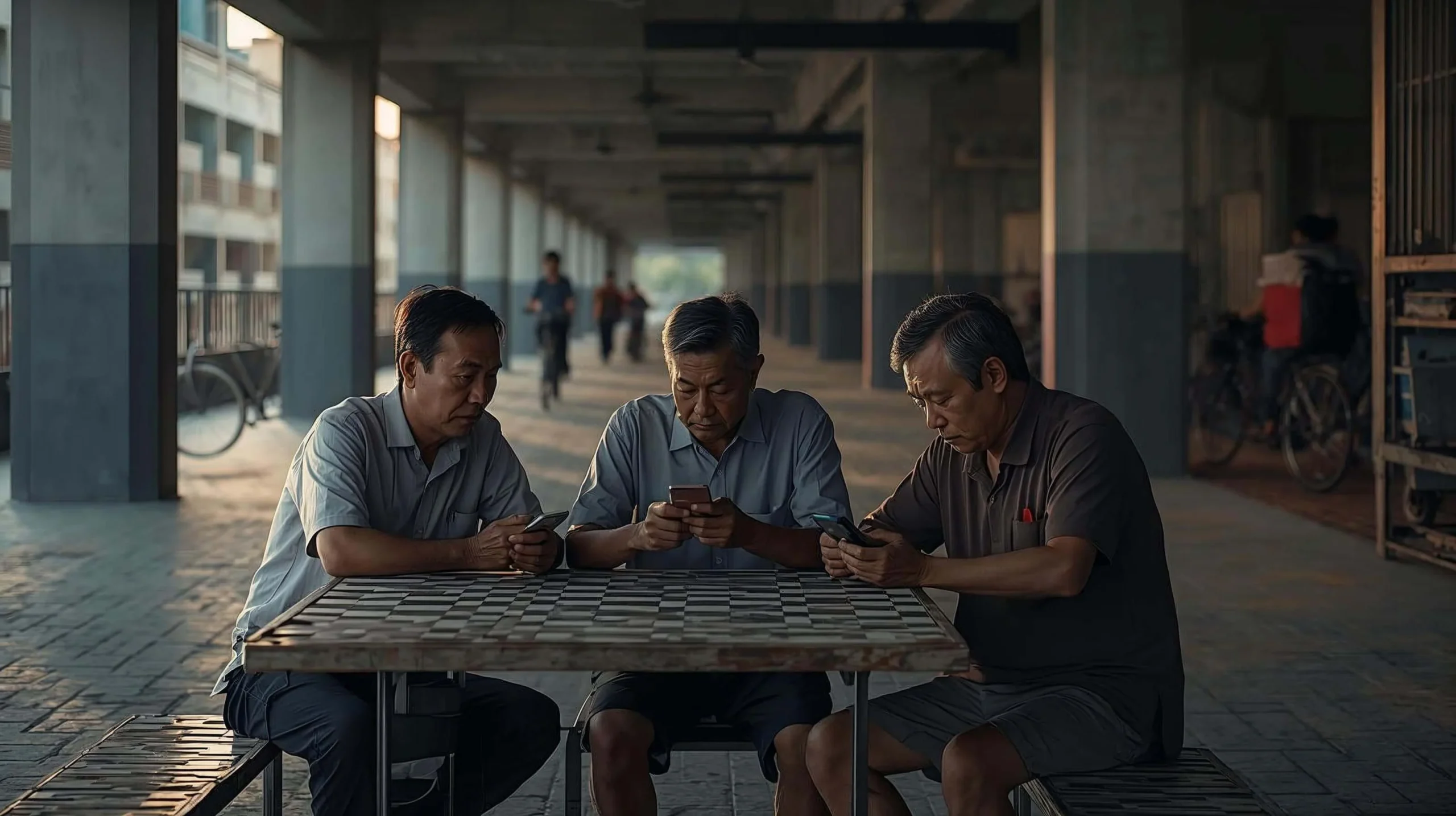

The “Community Living Room” used to be a place of loud banter and clacking chess pieces. Now, it is a space of quiet scrolling and transient pauses.
Mr. Soh sits at the blue tiled table in Yishun Ring Road. It is 4:00 PM.
Ten years ago, this table would have been a battlefield. Mr. Soh and his kakis (buddies) would be slamming down checkers pieces, shouting in Hokkien, filling the air with smoke and laughter. Kids would be running past, screaming.
Today, Mr. Soh is alone. well, not technically alone. There are two other uncles at the table. But they aren’t looking at each other. They are looking at their phones. One is watching a Douyin video at full volume. The other is scrolling through WhatsApp.
“Last time, we talk about politics, talk about 4D,” Mr. Soh says, looking up briefly. “Now, eyes tired. Neck pain. But still must look.”
The void deck—that uniquely Singaporean architectural experiment designed to force integration—is changing. The pillars are the same. The wind is the same. But the acoustic footprint has shifted from a roar to a hum. The “Kampung Spirit” hasn’t vanished, but it has gone digital, and in the process, the physical space has become strangely quiet.
The Rise of the “Pit Stop”
If you sit there long enough, you realize the void deck isn’t just a living room anymore. It’s a transit lounge.
A FoodPanda rider pulls up his e-bike. He takes off his helmet, wipes his sweat, and sits on the bench. He isn’t here to socialize. He is here to charge his phone and drink water. He checks his earnings, sighs, and ten minutes later, he is gone.
Then comes the domestic helper on her break. She sits in the corner, earbuds in, video-calling her family back in Myanmar or Indonesia. She is physically in Ang Mo Kio, but emotionally, she is 2,000 kilometers away.
The space is being used, yes. But it is being used in isolation bubbles. The communal aspect—the cross-pollination of neighbors talking to neighbors—is fading.
The “Digital” Table
It’s not just that we are talking less. It’s *what* we are talking about.
This quiet shift mirrors a broader pattern across Singapore, where digital efficiency has streamlined daily life but subtly eroded human connection — a trade-off increasingly felt in everyday spaces.
I eavesdropped on a group of aunties in Bedok. They weren’t gossiping about the neighbor’s son.
“How to scan this CDC voucher ah?” one asked.
“You open the Singpass first,” the other replied, leaning over to tap the screen.
The conversation has become technical. It is logistical. The void deck has become an informal IT support centre for the elderly.
I miss the bird singing corners. You know, the ones with the cages on hooks? Those were loud, messy, and real. Now, the only birds I hear are from an Angry Birds game on an iPad.
| The Element | The Old Void Deck (2010s) | The New Void Deck (2026) |
|---|---|---|
| Soundtrack | Tiles slamming, kids shouting | TikTok loops, video calls |
| Occupants | Retirees playing chess | Delivery riders & Helpers resting |
| Furniture | Checkered tables (Used for games) | Checkered tables (Used for phone support) |
| Vibe | “Kampung” Chaotic | “Transit” Functional |
For a deeper look at how traditional social spaces like kopitiams — not just void decks — have become quieter and more isolated in Singapore,
read this related piece on the fading soundscape of older HDB kopitiams.
The Fear of “Staring”
There is also a new social anxiety.
In the past, staring at people walking by was the national pastime of the void deck uncle. It was surveillance. It was connection.
Now, eye contact feels aggressive. If you look at someone too long, they wonder if you are going to Stomp them. They wonder if they are breaching some new social protocol.
Residents walk briskly to the lift lobby, eyes downcast, key fobs ready. We treat the void deck as a gap to be crossed, not a place to linger. The architecture was designed to pause time, but our lifestyles are designed to kill it.
What This Means for Residents
We are losing the “Third Place” without realizing it.
The Isolation of the Elderly:
For the seniors who don’t have smartphones, the silence is isolating. They sit there waiting for a conversation that never comes because the person next to them is doomed-scrolling through Facebook.
The “Senior Activity Corner”:
The Town Councils are trying. They are building designated “Senior Activity Corners” with exercise machines and organized activities. But that is programmed fun. It lacks the raw, spontaneous magic of the old void deck banter.
Official Context
HDB void decks are officially “common property” managed by Town Councils. While intended for social bonding (weddings, funerals, community events), strict rules against noise, smoking, and ball games—implemented to reduce complaints—have inadvertently sanitized the vibrancy of these spaces.
🕰️ One Small Moment
“Just as I was leaving, a heavy rain started. A GrabFood rider, a student, and an old uncle all huddled under the same shelter pillar. For a moment, the phones went into pockets. They looked at the rain. The uncle pointed at the sky and said, ‘This kind rain, long time stop.’ The rider nodded. ‘Ya lor, jialat.’ A three-second exchange. Then the rain stopped, and the silence returned.”