The Algorithms Deciding Your Daily Life in Singapore



We are waiting for the robot uprising. Meanwhile, an algorithm just decided how long your green light lasts, what bus you take, and whether your claim gets approved.
If you ask the average uncle at a coffee shop in Tampines if he uses artificial intelligence, he will probably laugh.
“AI? No lah,” he might say, waving his hand. “That one for scientists and tech billionaires. I just drink kopi and take bus.”
Then, he will tap his EZ-Link card on a reader that feeds data into a predictive transport model. He will unlock his phone using facial recognition trained on millions of images. He will open Facebook, which uses a complex neural network to decide that he really, really needs to see a video of a cat fighting a durian. And finally, he will walk across a traffic crossing where the “Green Man” stays on five seconds longer because a sensor recognized he was walking slowly.
He is wrong. He is swimming in AI. He just doesn’t see the water.
This is the reality of AI in daily life Singapore has built. It is not spectacular. It is not loud. It does not look like the movies. It looks like… nothing. It looks like seamlessness. And that is exactly how AI affects daily decisions Singapore residents make: by making the path of least resistance so smooth that we don’t even realize we are being guided.
A Morning Routine Powered by Algorithms
Let’s track a typical Tuesday morning.
Sarah wakes up in Punggol. She checks her phone. Google Maps tells her: “Light traffic on KPE. 25 minutes to work.”
She didn’t ask for this information. The AI in transport Singapore relies on—predictive analytics—has already crunched historical data, real-time speed sensors, and the movement of thousands of other phones to make a decision for her: Take the car today.
If she takes the bus, she is stepping into another machine. The Land Transport Authority (LTA) doesn’t just run buses on a fixed timetable anymore. They use AI systems Singapore people don’t notice to analyze tap-in/tap-out data. If the algorithm detects a surge of commuters at Bedok Reservoir, it can signal to deploy an empty bus to loop that sector. You think you are lucky the bus came empty; the machine knew you were there before you did.
“I just follow the app,” Sarah says. “If Citymapper says take the Downtown Line, I take. I don’t think about why.”
She has outsourced the executive function of navigation to a server farm.
From Transport to Groceries, AI Is Already There
It continues at lunch.
Sarah opens her food delivery app. The first option is “Chicken Rice.” Is it because she craves it? Or is it because the app knows she ordered it last Tuesday at 12:15 PM? The examples of AI in Singapore daily routines are often disguised as “Recommended for You.”
Later, she goes to the supermarket. She scans her FairPrice app. A coupon pops up: “$2 off Salmon.”
This isn’t random generosity. It’s AI quietly used in Singapore retail sectors. The system knows she hasn’t bought fish in two weeks. It knows her price sensitivity. It is nudging her behavior. She buys the salmon. She thinks she made a thrifty choice. In reality, an algorithm successfully converted inventory into revenue by pulling her psychological levers.
It’s slightly terrifying when you realize the machine knows you are out of milk before you even open the fridge.
| The Decision | What We Think Happens | What AI Actually Does |
|---|---|---|
| The Route | “I chose the fastest way.” | AI routed you away from a jam before it formed. |
| The Purchase | “I felt like eating this.” | AI analyzed your past 50 orders and predicted cravings. |
| The Price | “Standard fare.” | Dynamic pricing (Surge) based on real-time demand. |
| The Security | “Guard watched the CCTV.” | Vision AI flagged “loitering” automatically. |
Why Most Singaporeans Don’t Realise AI Is Involved
Why is there no panic? Why is the quiet rise of AI in Singapore society met with a shrug?
Because it works.
In Singapore, we value efficiency above almost everything else.
Just as algorithms quietly optimize our daily routines,
the same invisible shift has reshaped social spaces —
from transport systems to the way
older HDB kopitiams have grown noticeably quieter
over time.
If artificial intelligence Singapore everyday use means we wait three minutes less for a bus, we don’t care how it works. We don’t care if it’s a neural network or a hamster on a wheel.
We brand it differently too. We don’t call it “AI.” We call it “Smart Nation.” We call it “Digitalization.” We call it “The App.”
By wrapping AI decision making systems in friendly, bureaucratic language, the government and corporations have made it palatable. It feels like infrastructure, not invasion. It feels like the air-conditioning—invisible, essential, and only noticeable when it breaks.
Convenience vs Awareness: The Quiet Trade-Off
But there is a trade-off, and it happens in the realm of Singpass AI systems and public administration.
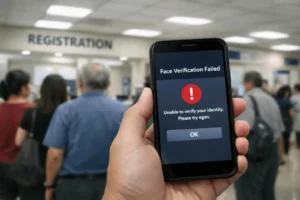
Consider the “Face Verification” feature on Singpass. You look at your phone. It scans. You are in. It is incredibly convenient. No passwords to remember.
But this is one of the most sophisticated AI in public services Singapore possesses. It compares your live biometrics against the national database. It is a level of surveillance that would spark riots in some Western countries. Here? We love it because it saves us 10 seconds.
The question arises: Is AI already deciding things for us in Singapore?
Increasingly, yes. When you apply for a grant, an HDB flat, or a financial aid package, the first layer of assessment is often automated. How Singapore uses AI in public services is shifting toward “anticipatory” help. There are pilot schemes where the government identifies families in need based on data patterns and offers help *before* they apply.
It is benevolent. It is efficient. But it removes the human element of “asking.” The system decides you need help. What if the system decides you don’t?
The Smart Nation Vision
This invisibility is by design. The Smart Nation roadmap explicitly aims for a “digital-first” society where technology is seamless. Agencies like GovTech are building the “Singapore Government Tech Stack” (SGTS) to embed AI into the backend of everything from municipal feedback sorting (OneService) to healthcare appointment optimization (HealthHub).
Is This What ‘Smart Nation’ Was Meant to Feel Like?
We expected the Smart Nation to look like “The Jetsons.” Flying cars. Robots sweeping the streets.
Instead, it feels like this: You walk out of your house, and the lift is already there (AI traffic optimization). You get on a train that isn’t crowded (AI demand management). You buy groceries with a fingerprint (AI biometrics). You get a notification that your tax is filed (AI automation).
It is boring. It is quiet. And it is everywhere.
How AI is used in everyday life in Singapore is not a story of disruption; it is a story of integration. We have allowed the algorithms to become the silent administrators of our lives.
The danger isn’t that the machines will take over. The danger is that we get so used to the convenience that we forget how to make decisions without them. We forget how to read a map. We forget how to choose a restaurant without a 4.5-star rating. We forget how to drive without Waze.
As we move into 2026, the question for every Singaporean isn’t “Do I use AI?” You do. The question is: “Do I know when to turn it off?”
🕰️ One Small Moment
“I was in a taxi yesterday. The driver’s GPS told him to turn left. He hesitated. ‘System say left,’ he muttered. ‘But my heart say right. Right got less jam.’ He turned right. We hit a massive jam immediately. He laughed, tapped the screen, and said, ‘Aiyoh. Machine win again.’ It was a small defeat for human intuition, but a big victory for the data.”
This article is based on publicly documented Smart Nation initiatives and widely deployed consumer technologies in Singapore. AI systems described here are designed for efficiency, safety, and service optimization rather than individual surveillance.